Equineguelph.ca - Full Article
October 2014
Story by: Dr. Brianne Henderson
Every year riders are plagued with limb injuries to their equine partners. Sometimes this is a small blip in the training schedule, other times it spells the end of a competitive season. In this article we are going to highlight some common injuries and different modalities that can help your horse onto the road to recovery (and a few preventative tips!). At the end of the article, there is a table outlining different treatments to help manage the injuries discussed.
The Suspensory Ligament
The Suspensory Ligament (SL) is effectively a broad elastic cable that runs from the back of the knee down the back of the canon bone and then branches to cradle the fetlock joint. Its purpose is to suspend the fetlock joint and prevent over extension during loading. Essentially, it works like a spring mechanism to absorb the energy as it stretches and then recoils to lift the fetlock back to its normal position.
Over time, micro-damage occurs within the fibres of the ligament and due to the poor blood supply, these micro-tears are more likely to accumulate than heal. Often this is why we see repetitive strain injuries/inflammation to the SL. The impact of foot balance is critical to the health of the SL. A foot with long toe/low heel places increased strain on structures within the foot (navicular bone), the Deep Digital Flexor Tendon and the Suspensory ligament by predisposing to a “toe first” landing. Instead of allowing a gradual absorption of impact through the structures of the heels and up the limb, this movement creates a snapping action on the DDFT and Suspensory ligament. The long-term effect of foot imbalance is associated with chronic heel pain (“toe first”) and also chronic proximal suspensory desmitis. Veterinary Treatment options may include? Shockwave therapy, biological injections...
Read more here:
http://www.equineguelph.ca/news/index.php?content=427
Thursday, October 30, 2014


State-of-the-Art Imaging Techniques Reviewed
Thehorse.com - Full Article
By Equine Disease Quarterly
Oct 11, 2014
An appropriate treatment plan for rehabilitation and recovery post-musculoskeletal injury is built upon the foundations of an accurate diagnosis and detailed characterization of the pathology. Radiography and ultrasonography are the cornerstones of the evaluation, but can fall short in the assessment of some conditions. Advanced modalities such as computed tomography (CT), MRI, and nuclear scintigraphy might be beneficial in select cases...
Read more here:
http://www.thehorse.com/articles/34690/state-of-the-art-imaging-techniques-reviewed?utm_source=Newsletter&utm_medium=lameness&utm_campaign=10-15-2014
By Equine Disease Quarterly
Oct 11, 2014
An appropriate treatment plan for rehabilitation and recovery post-musculoskeletal injury is built upon the foundations of an accurate diagnosis and detailed characterization of the pathology. Radiography and ultrasonography are the cornerstones of the evaluation, but can fall short in the assessment of some conditions. Advanced modalities such as computed tomography (CT), MRI, and nuclear scintigraphy might be beneficial in select cases...
Read more here:
http://www.thehorse.com/articles/34690/state-of-the-art-imaging-techniques-reviewed?utm_source=Newsletter&utm_medium=lameness&utm_campaign=10-15-2014
Tuesday, October 28, 2014
Heart of the Matter
Thehorse.com - Full Article
By Jennifer O. Bryant
Oct 22, 2014
A look at the remarkable equine heart and what can go wrong.
With the high rate of heart disease in humans, most of us are aware of our potential for cardiac troubles. But when it comes to our horses, we tend to be less informed.
Horses don’t have human-style “heart attacks.” Actually, the equine heart is a robust organ that’s not overly prone to problems. But when something does go wrong it tends to be front-page news, as in the 2011 death of 2008 Olympic individual gold-medal-winning Canadian jumper, Hickstead, from an aortic rupture.
In this article, two veterinarians well-versed in cardiac events describe the equine heart and what can go wrong...
Read more here:
http://www.thehorse.com/articles/34740/heart-of-the-matter?utm_source=Newsletter&utm_medium=sports-medicine&utm_campaign=10-26-2014
By Jennifer O. Bryant
Oct 22, 2014
A look at the remarkable equine heart and what can go wrong.
With the high rate of heart disease in humans, most of us are aware of our potential for cardiac troubles. But when it comes to our horses, we tend to be less informed.
Horses don’t have human-style “heart attacks.” Actually, the equine heart is a robust organ that’s not overly prone to problems. But when something does go wrong it tends to be front-page news, as in the 2011 death of 2008 Olympic individual gold-medal-winning Canadian jumper, Hickstead, from an aortic rupture.
In this article, two veterinarians well-versed in cardiac events describe the equine heart and what can go wrong...
Read more here:
http://www.thehorse.com/articles/34740/heart-of-the-matter?utm_source=Newsletter&utm_medium=sports-medicine&utm_campaign=10-26-2014
Monday, October 27, 2014
Free Online Equine Nutrition Course Offered
Coursera.org
Coursera.org is again offering their 5-week online equine nutrition course from the University of Edinburgh for free from January 26 to March 2 2015.
This course will cover many aspects of equine nutrition ranging from anatomy and physiology of the gastrointestinal tract to dietary management of horses/ponies affected with nutrition-related disorders. This is course is designed for self-directed study with minimal tutor input, and as such emphasis is placed upon peer discussions of the topics presented in each section of the course. This course is not designed to have a large amount of tutor input as this is an open access course that attracts tens of thousands of participants. However, tutors will endeavour to answer the main queries relating to the understanding of the lecture materials and to provide a summary of the key questions raised in each of the weekly topics and clarification of any misunderstandings.
About the Course
This course is designed to provide knowledge of equine digestion and nutrition for those with an interest in this area. The anatomy and physiology of the equine alimentary canal will be studied to provide students with an understanding of the equine digestive system. Nutrient sources for horses will be discussed, with emphasis placed on the health and welfare issues surrounding the inclusion of various types of feedstuffs in equine diets. Students will also discuss recommendations on rations for horses and ponies performing various activities and should feel better equipped to make judgements on rations for horses and ponies, in health and disease.
To watch the intro video and for more information see:
https://www.coursera.org/course/equinenutrition
Coursera.org is again offering their 5-week online equine nutrition course from the University of Edinburgh for free from January 26 to March 2 2015.
This course will cover many aspects of equine nutrition ranging from anatomy and physiology of the gastrointestinal tract to dietary management of horses/ponies affected with nutrition-related disorders. This is course is designed for self-directed study with minimal tutor input, and as such emphasis is placed upon peer discussions of the topics presented in each section of the course. This course is not designed to have a large amount of tutor input as this is an open access course that attracts tens of thousands of participants. However, tutors will endeavour to answer the main queries relating to the understanding of the lecture materials and to provide a summary of the key questions raised in each of the weekly topics and clarification of any misunderstandings.
About the Course
This course is designed to provide knowledge of equine digestion and nutrition for those with an interest in this area. The anatomy and physiology of the equine alimentary canal will be studied to provide students with an understanding of the equine digestive system. Nutrient sources for horses will be discussed, with emphasis placed on the health and welfare issues surrounding the inclusion of various types of feedstuffs in equine diets. Students will also discuss recommendations on rations for horses and ponies performing various activities and should feel better equipped to make judgements on rations for horses and ponies, in health and disease.
To watch the intro video and for more information see:
https://www.coursera.org/course/equinenutrition
Thursday, October 23, 2014
Understanding the Horse's Sole
 Hoofrehab.com - Full Article
8-16-05
Pete Ramey
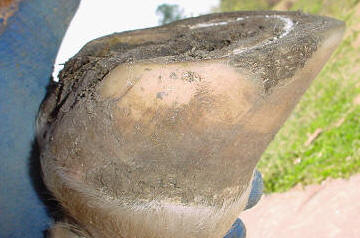
The sole of the foot is the most abused and misunderstood part of the domestic horse (with the possible exception of its digestive system). I’ve been guilty of it, too. As a horseshoer it always seemed necessary for me to routinely cut the sole at the toe, and in my early days as a barefoot trimmer I thought it was desirable to thin it at the back of the foot. When I began both professions, I was taught to view the sole as an idle passenger; trimming the hoof wall to certain parameters and then trimming or relieving the sole to match. Now I see the sole as the ultimate guide for hoof trimming; keeping the bars and walls 1/16 inch above the natural callused sole plane. (See the "Heel Height" article for exceptions.) When I think back on the past and compare it to my results now, I shudder at the comparison. My own learning curve has been a long one. I hope to shorten it for you, here.
It is a confusing subject, though. It can be difficult to distinguish between healthy sole that should be preserved, false sole that should be removed, shedding sole that needs to stay around as long as possible because the new sole underneath is immature, shedding sole that needs to be removed because fungal infection underneath is eating away at the new sole that is trying to grow, unsupported sole under flared walls that needs to have pressure relief………….. The list goes on, and it seems the more you learn, the less you may understand what needs to be done. Since the sole is the first line of defense between the horse and the ground, its proper management is crucial to soundness. Luckily we have a very reliable guide. The seams between the sole and frog; the collateral grooves, are the most reliable and important guide we have for determining the needs of the foot. A full understanding of their significance and the information they offer will give you “x-ray vision” when you look at every hoof...
Read more here:
http://www.hoofrehab.com/HorsesSole.html
A Simple Method of Conditioning the Endurance Horse
 Perseveranceendurancehorses Blog - Full Article
Francois & Laura Seegers, Perseverance Arabian and Endurance Horses
We are frequently asked by people who are interested in taking up endurance, or who have bought a horse from us, how they should prepare their horses for an endurance ride. There are many different ways to condition horses. The good methods have this in common: a slow beginning, a steady build up of distances ridden, and later, gradual increase in training speed. Too fast, too soon, too often, leads inevitably to injury.
We used this simple program ourselves for many years before we began riding our horses without shoes. It’s a straightforward system that we learned more than 20 years back from another experienced endurance rider at a day seminar when we began doing endurance. The principles are much older than modern endurance sport, and don’t change with fashion as they are based on the physiology of the horse. We have taught this method to many riders with good results. It is a method of slowly preparing the novice horse for his first endurance ride, but also for giving the advanced endurance horse a good start after a period off work. There are many more sophisticated training techniques that we won’t discuss in this article. Once a horse has completed this initial program, other techniques can be applied. This simple foundation will only help the other training techniques give better results...
Read more here:
http://perseveranceendurancehorses.wordpress.com/2012/10/17/endurance-training/
Wednesday, October 22, 2014
Water-Soluble Vitamins 101
Thehorse.com - Full Article
By Karen Briggs
Oct 4, 2014
Vitamins are tiny organic compounds with a huge impact on the health and well-being of your horse. But how do they function, and why are they important to your horse? Here's what you need to know about the water-soluble vitamins.
Thiamin (Vitamin B1)
Function: Thiamin plays an important role in carbohydrate metabolism and in nerve transmission and stimulation...
Read more here:
http://www.thehorse.com/articles/34652/water-soluble-vitamins-101?utm_source=Newsletter&utm_medium=nutrition&utm_campaign=10-06-2014
By Karen Briggs
Oct 4, 2014
Vitamins are tiny organic compounds with a huge impact on the health and well-being of your horse. But how do they function, and why are they important to your horse? Here's what you need to know about the water-soluble vitamins.
Thiamin (Vitamin B1)
Function: Thiamin plays an important role in carbohydrate metabolism and in nerve transmission and stimulation...
Read more here:
http://www.thehorse.com/articles/34652/water-soluble-vitamins-101?utm_source=Newsletter&utm_medium=nutrition&utm_campaign=10-06-2014
Sunday, October 19, 2014
Fat-Soluble Vitamins 101
Thehorse.com - Full Article
By Karen Briggs
Oct 5, 2014
Vitamins are tiny organic compounds with a huge impact on the health and well-being of your horse. But how do they function, and why are they important to your horse? Here's what you need to know about the fat-soluble vitamins. In a future article, we'll take a look at the water-soluble ones.
Vitamin A
Function: Vitamin A, also called retinol, is important for maintaining good vision, particularly at night. It is also important in bone and muscle growth of young horses, in reproduction, and in healthy skin. Research has revealed that vitamin A has a key role in the immune response to infection as well...
Read more here:
http://www.thehorse.com/articles/34651/fat-soluble-vitamins-101?utm_source=Newsletter&utm_medium=nutrition&utm_campaign=10-06-2014
By Karen Briggs
Oct 5, 2014
Vitamins are tiny organic compounds with a huge impact on the health and well-being of your horse. But how do they function, and why are they important to your horse? Here's what you need to know about the fat-soluble vitamins. In a future article, we'll take a look at the water-soluble ones.
Vitamin A
Function: Vitamin A, also called retinol, is important for maintaining good vision, particularly at night. It is also important in bone and muscle growth of young horses, in reproduction, and in healthy skin. Research has revealed that vitamin A has a key role in the immune response to infection as well...
Read more here:
http://www.thehorse.com/articles/34651/fat-soluble-vitamins-101?utm_source=Newsletter&utm_medium=nutrition&utm_campaign=10-06-2014
Monday, October 13, 2014
Is It Okay for My Horse to Live by Himself?
Thehorse.com - Full Article
By Nancy Diehl, VMD, MS
Sep 25, 2014
Q. Is it okay for a horse to live without herdmates or companions?
A. I am going to say that yes, it is okay for a horse to live alone, but with a bunch of caveats.
Horses are social animals. Feral horses live in harems, with a stallion, some mares, and offspring who will later disperse to other harems. Domesticated horses have lost really none of their "natural" behaviors. Nearly all of our domesticated species are highly social animals. That, along with their relative docility, probably contributed to them being good species for domestication...
Read more here:
http://www.thehorse.com/articles/34605/is-it-okay-for-my-horse-to-live-by-himself?utm_source=Newsletter&utm_medium=behavior&utm_campaign=10-05-2014
By Nancy Diehl, VMD, MS
Sep 25, 2014
Q. Is it okay for a horse to live without herdmates or companions?
A. I am going to say that yes, it is okay for a horse to live alone, but with a bunch of caveats.
Horses are social animals. Feral horses live in harems, with a stallion, some mares, and offspring who will later disperse to other harems. Domesticated horses have lost really none of their "natural" behaviors. Nearly all of our domesticated species are highly social animals. That, along with their relative docility, probably contributed to them being good species for domestication...
Read more here:
http://www.thehorse.com/articles/34605/is-it-okay-for-my-horse-to-live-by-himself?utm_source=Newsletter&utm_medium=behavior&utm_campaign=10-05-2014
Saturday, October 11, 2014
Installing Automatic Waterers
Thehorse.com Blog
by Alayne Blickle
Smart Horse Keeping
24 Sep 2014
September is a great time to get your winter water supply set up before the icy cold weather slips in and causes havoc for us all. A horse drinks 8 to 12 gallons of water per day. Research shows horses prefer water temperatures of about 45-65 degrees Fahrenheit and tend to drink less when water is cold. Keep in mind that research also tells us that a horse cannot get enough moisture by eating snow alone. Decreased water consumption can lead to colic so make every effort to ensure your horses are drinking an adequate amount...
- See more at: http://cs.thehorse.com/blogs/smart-horse-keeping/archive/2014/09/24/installing-automatic-waterers.aspx#sthash.sJZPDucP.dpuf
by Alayne Blickle
Smart Horse Keeping
24 Sep 2014
September is a great time to get your winter water supply set up before the icy cold weather slips in and causes havoc for us all. A horse drinks 8 to 12 gallons of water per day. Research shows horses prefer water temperatures of about 45-65 degrees Fahrenheit and tend to drink less when water is cold. Keep in mind that research also tells us that a horse cannot get enough moisture by eating snow alone. Decreased water consumption can lead to colic so make every effort to ensure your horses are drinking an adequate amount...
- See more at: http://cs.thehorse.com/blogs/smart-horse-keeping/archive/2014/09/24/installing-automatic-waterers.aspx#sthash.sJZPDucP.dpuf
When in Doubt, Turn Out
Thehorse.com Blog
Across the Fence
29 Sep 2014
Horses are products of their genetics and the environment we provide for their growth and development. One of the most important choices we make when managing horses during the first few years of their life is whether they are stabled or turned out, and for how long. Different types of exercise are necessary to stimulate adaptation of the different locomotor musculoskeletal tissues (bone, articular cartilage, muscle, ligament, and tendon), and these tissues are most responsive at different ages. Therefore, young horses need a sufficient amount of appropriate types of exercise at the right times in their lives to fulfill their athletic potential and reduce their risk of injury.
- See more at: http://cs.thehorse.com/blogs/across-the-fence/archive/2014/09/29/when-in-doubt-turn-out.aspx#sthash.mictJ71x.dpuf
Across the Fence
29 Sep 2014
Horses are products of their genetics and the environment we provide for their growth and development. One of the most important choices we make when managing horses during the first few years of their life is whether they are stabled or turned out, and for how long. Different types of exercise are necessary to stimulate adaptation of the different locomotor musculoskeletal tissues (bone, articular cartilage, muscle, ligament, and tendon), and these tissues are most responsive at different ages. Therefore, young horses need a sufficient amount of appropriate types of exercise at the right times in their lives to fulfill their athletic potential and reduce their risk of injury.
- See more at: http://cs.thehorse.com/blogs/across-the-fence/archive/2014/09/29/when-in-doubt-turn-out.aspx#sthash.mictJ71x.dpuf
Friday, October 10, 2014
It’s Slobber Season for Horses!
KER.Equinews.com - Full Article
By Kentucky Equine Research Staff · September 16, 2014
As you walk out into the pasture to catch your horse, you notice that the clover in the field is really growing well. You know that horses love clover, and it’s clear that there is plenty of the trefoil-leaved plant for Blaze to nibble.
You snap the lead shank on his halter, and Blaze reaches for the treat you always bring him. He opens his mouth and suddenly your carrot-bearing hand is drenched with what seems like an ocean of equine saliva. Blaze crunches happily away on his carrot as you lead him toward the barn, still wiping strings of drool off your hand and wrist. What’s going on?...
Read more here:
http://ker.equinews.com/article/it%E2%80%99s-slobber-season-horses
By Kentucky Equine Research Staff · September 16, 2014
As you walk out into the pasture to catch your horse, you notice that the clover in the field is really growing well. You know that horses love clover, and it’s clear that there is plenty of the trefoil-leaved plant for Blaze to nibble.
You snap the lead shank on his halter, and Blaze reaches for the treat you always bring him. He opens his mouth and suddenly your carrot-bearing hand is drenched with what seems like an ocean of equine saliva. Blaze crunches happily away on his carrot as you lead him toward the barn, still wiping strings of drool off your hand and wrist. What’s going on?...
Read more here:
http://ker.equinews.com/article/it%E2%80%99s-slobber-season-horses
Wednesday, October 08, 2014
Magnetic Blankets' Impacts on Horses Studied
Thehorse.com - Full Article
By Christa Lesté-Lasserre, MA
Sep 6, 2014
If you find yourself attracted to the idea of a magnetic blanket for your horse, you might want to consider some opposing viewpoints: Swedish researchers recently found that magnets in blankets don’t have quite the impact on blood flow that some manufacturers might claim.
“An ordinary blanket probably increases blood flow just as much as a magnetic one does,” said Anna Edner, PhD, of the Department of Clinical Sciences, Faculty of Veterinary Medicine and Animal Science in the University of Agricultural Sciences in Uppsala, Sweden...
Read more here:
http://www.thehorse.com/articles/34497/magnetic-blankets-impacts-on-horses-studied?utm_source=Newsletter&utm_medium=sports-medicine&utm_campaign=09-28-2014
By Christa Lesté-Lasserre, MA
Sep 6, 2014
If you find yourself attracted to the idea of a magnetic blanket for your horse, you might want to consider some opposing viewpoints: Swedish researchers recently found that magnets in blankets don’t have quite the impact on blood flow that some manufacturers might claim.
“An ordinary blanket probably increases blood flow just as much as a magnetic one does,” said Anna Edner, PhD, of the Department of Clinical Sciences, Faculty of Veterinary Medicine and Animal Science in the University of Agricultural Sciences in Uppsala, Sweden...
Read more here:
http://www.thehorse.com/articles/34497/magnetic-blankets-impacts-on-horses-studied?utm_source=Newsletter&utm_medium=sports-medicine&utm_campaign=09-28-2014
Wednesday, October 01, 2014
Study: Low-Dose Omeprazole and Gastric Ulcers
Thehorse.com - Full Article
By Christa Lesté-Lasserre, MA
Sep 22, 2014
If you’ve ever had to deal with equine gastric ulcers, you—and your wallet—will likely be happy that researchers have learned that a much lower dose of one omeprazole formulation could be just as effective in treating the condition as the standard dose...
Read more here:
http://www.thehorse.com/articles/34581/study-low-dose-omeprazole-and-gastric-ulcers?utm_source=Newsletter&utm_medium=nutrition&utm_campaign=09-22-2014
By Christa Lesté-Lasserre, MA
Sep 22, 2014
If you’ve ever had to deal with equine gastric ulcers, you—and your wallet—will likely be happy that researchers have learned that a much lower dose of one omeprazole formulation could be just as effective in treating the condition as the standard dose...
Read more here:
http://www.thehorse.com/articles/34581/study-low-dose-omeprazole-and-gastric-ulcers?utm_source=Newsletter&utm_medium=nutrition&utm_campaign=09-22-2014
Understanding Your Horse's 'Engine' During Exercise
Thehorse.com - Full Article
By Erica Larson, News Editor
Sep 10, 2014
The exhilaration of a gallop through a field might make your heart race, but you're not alone: Your horse's heart is working hard to power every stride he takes. Along with his respiratory system, a horse's cardiovascular system serves as the engine he needs to perform everything from day-to-day activities to high-level athletic pursuits. But both systems have limits, and it's important to understand them.
Anna M. Firshman, BVSc, PhD, Dipl. ACVIM, ACVSMR, an associate clinical professor at the University of Minnesota College of Veterinary Medicine, reviewed how the horse's cardiovascular and respiratory systems function during exercise at the 2014 American College of Veterinary Internal Medicine Forum, held June 4-7 in Nashville, Tennessee...
Read more here:
http://www.thehorse.com/articles/34498/understanding-your-horses-engine-during-exercise?utm_source=Newsletter&utm_medium=health-news&utm_campaign=09-09-2014
By Erica Larson, News Editor
Sep 10, 2014
The exhilaration of a gallop through a field might make your heart race, but you're not alone: Your horse's heart is working hard to power every stride he takes. Along with his respiratory system, a horse's cardiovascular system serves as the engine he needs to perform everything from day-to-day activities to high-level athletic pursuits. But both systems have limits, and it's important to understand them.
Anna M. Firshman, BVSc, PhD, Dipl. ACVIM, ACVSMR, an associate clinical professor at the University of Minnesota College of Veterinary Medicine, reviewed how the horse's cardiovascular and respiratory systems function during exercise at the 2014 American College of Veterinary Internal Medicine Forum, held June 4-7 in Nashville, Tennessee...
Read more here:
http://www.thehorse.com/articles/34498/understanding-your-horses-engine-during-exercise?utm_source=Newsletter&utm_medium=health-news&utm_campaign=09-09-2014
Tuesday, September 23, 2014
Does Your Horse Need a Vitamin Supplement?
Thehorse.com - Full Article
By Karen Briggs
Sep 17, 2014
It's no secret that vitamins are an important part of every horse's diet. But does your horse need some type of vitamin supplement? Some horses might benefit from a vitamin supplement, but many are able to obtain the vitamins they need through their regular diets.
Vitamin supplementation might be beneficial for:
Horses on a high-grain, low-forage diet (such as youngsters in heavy race training), or for those on very poor-quality forage or eating hay that is more than a year old. Vitamins tend to break down over time in stored feed. For example, there is a 9.5% loss of vitamin A activity in hay every month...
Read more here:
http://www.thehorse.com/articles/34558/does-your-horse-need-a-vitamin-supplement?utm_source=Newsletter&utm_medium=nutrition&utm_campaign=09-22-2014
By Karen Briggs
Sep 17, 2014
It's no secret that vitamins are an important part of every horse's diet. But does your horse need some type of vitamin supplement? Some horses might benefit from a vitamin supplement, but many are able to obtain the vitamins they need through their regular diets.
Vitamin supplementation might be beneficial for:
Horses on a high-grain, low-forage diet (such as youngsters in heavy race training), or for those on very poor-quality forage or eating hay that is more than a year old. Vitamins tend to break down over time in stored feed. For example, there is a 9.5% loss of vitamin A activity in hay every month...
Read more here:
http://www.thehorse.com/articles/34558/does-your-horse-need-a-vitamin-supplement?utm_source=Newsletter&utm_medium=nutrition&utm_campaign=09-22-2014
Saturday, September 20, 2014
Algal Blooms Pose Danger to Livestock
Thehorse.com - Full Article
By University of Kentucky College of Agriculture, Food, and Environment
Aug 30, 2014
Recent news reports of unsafe drinking water in the Great Lakes area has drawn national attention to toxic algal blooms. In Kentucky, cyanobacteria, also known as blue-green algae, recently were found in Green River Lake, Taylorsville Lake, Barren River Lake, Nolin Reservoir, and Rough River Lake at levels that prompted a recreational advisory.
Algal blooms are accumulated populations of algae in freshwater and marine water environments. They can reduce water quality, causing animals to drink less water than they need to get them through the hot, dry summer. Of the more than 2,000 species of blue-green algae identified, at least 80 are known to produce cyanotoxins (poisons) that can seriously affect animal and human health...
Read more here:
http://www.thehorse.com/articles/34436/algal-blooms-pose-danger-to-livestock?utm_source=Newsletter&utm_medium=bluegrass-equine-digest&utm_campaign=08-31-2014
By University of Kentucky College of Agriculture, Food, and Environment
Aug 30, 2014
Recent news reports of unsafe drinking water in the Great Lakes area has drawn national attention to toxic algal blooms. In Kentucky, cyanobacteria, also known as blue-green algae, recently were found in Green River Lake, Taylorsville Lake, Barren River Lake, Nolin Reservoir, and Rough River Lake at levels that prompted a recreational advisory.
Algal blooms are accumulated populations of algae in freshwater and marine water environments. They can reduce water quality, causing animals to drink less water than they need to get them through the hot, dry summer. Of the more than 2,000 species of blue-green algae identified, at least 80 are known to produce cyanotoxins (poisons) that can seriously affect animal and human health...
Read more here:
http://www.thehorse.com/articles/34436/algal-blooms-pose-danger-to-livestock?utm_source=Newsletter&utm_medium=bluegrass-equine-digest&utm_campaign=08-31-2014
Recommendations for Overseeding Horse Pastures
Thehorse.com - Full Article
By University of Kentucky College of Agriculture, Food, and Environment
Aug 29, 2014
Overseeding horse pastures that contain cool season grasses can help improve pasture production and forage quality and ensure a good ground cover the following year without major pasture renovations.
Overseeding consists of planting seed in a field with existing grass cover to fill in bare patches and thicken the stand. Property owners can overseed the entire pasture or just the trouble areas. The best time for overseeding is the fall when weed competition is low and ideal growing conditions exist for cool-season grasses...
Read more here:
http://www.thehorse.com/articles/27812/recommendations-for-overseeding-horse-pastures?utm_source=Newsletter&utm_medium=bluegrass-equine-digest&utm_campaign=08-31-2014
By University of Kentucky College of Agriculture, Food, and Environment
Aug 29, 2014
Overseeding horse pastures that contain cool season grasses can help improve pasture production and forage quality and ensure a good ground cover the following year without major pasture renovations.
Overseeding consists of planting seed in a field with existing grass cover to fill in bare patches and thicken the stand. Property owners can overseed the entire pasture or just the trouble areas. The best time for overseeding is the fall when weed competition is low and ideal growing conditions exist for cool-season grasses...
Read more here:
http://www.thehorse.com/articles/27812/recommendations-for-overseeding-horse-pastures?utm_source=Newsletter&utm_medium=bluegrass-equine-digest&utm_campaign=08-31-2014
Thursday, September 18, 2014
Preventing Stomach Ulcers in Horses
KER.Equinews.com - Full Article
By Kentucky Equine Research Staff · August 13, 2014
Gastric ulceration in horses manifests as a failure to finish grain meals, weight loss, altered disposition, and underperformance.
Exercising horses are known to have a reduced pH (acidity) in the “sensitive” part of their stomachs, possibly due to stomach contents being pushed there during exercise. Stress is also thought to be a part of the development of ulcers in athletic horses. Because even pastured horses can develop gastric ulcers, the exact causes of ulceration remain unclear, and studies devoted to determining the causes of ulceration have yielded unclear and inconsistent findings.
How, then, can we better feed horses to minimize this important problem?...
Read more here:
http://ker.equinews.com/article/preventing-stomach-ulcers-horses?utm_source=KER+Newsletter&utm_campaign=93d8a13e39-ker-horse-nutri-kentucky-equine-08_27_2014&utm_medium=email&utm_term=0_0d95781dfc-93d8a13e39-11166
By Kentucky Equine Research Staff · August 13, 2014
Gastric ulceration in horses manifests as a failure to finish grain meals, weight loss, altered disposition, and underperformance.
Exercising horses are known to have a reduced pH (acidity) in the “sensitive” part of their stomachs, possibly due to stomach contents being pushed there during exercise. Stress is also thought to be a part of the development of ulcers in athletic horses. Because even pastured horses can develop gastric ulcers, the exact causes of ulceration remain unclear, and studies devoted to determining the causes of ulceration have yielded unclear and inconsistent findings.
How, then, can we better feed horses to minimize this important problem?...
Read more here:
http://ker.equinews.com/article/preventing-stomach-ulcers-horses?utm_source=KER+Newsletter&utm_campaign=93d8a13e39-ker-horse-nutri-kentucky-equine-08_27_2014&utm_medium=email&utm_term=0_0d95781dfc-93d8a13e39-11166
Friday, September 12, 2014
Feeding Treats to Horses
KER.Equinews.com - Full Article
By Kentucky Equine Research Staff · August 7, 2014
Horses are programmed to eat small amounts of food on a continuous basis, so your horse will ALWAYS want another treat, but for his well-being, learn to say no.
If you love your horse (and what horse owner doesn’t?), you probably like to feed him treats from time to time. Your horse is happy to gobble up whatever you offer him, and always wants more. Everyone at your stable has a different idea, however, on what sort of treats are best, which ones should be avoided, and how and when to feed treats. What’s the best answer?
What to offer as treats. Almost any fruits, and many vegetables, are safe treats for healthy horses. Apples and carrots are traditional favorites. You can safely offer your horse raisins, grapes, bananas, strawberries, cantaloupe or other melons, celery, pumpkin, and snow peas. Most horses will chew these treats before swallowing, but horses that gulp large pieces of a fruit or vegetable have a risk of choking. Remember to cut treats into smaller pieces before feeding. A few sugar cubes or peppermint candies (one or two) are okay, as are many of the commercially available horse treats sold in equine catalogs...
Read more here:
http://ker.equinews.com/article/feeding-treats-horses
By Kentucky Equine Research Staff · August 7, 2014
Horses are programmed to eat small amounts of food on a continuous basis, so your horse will ALWAYS want another treat, but for his well-being, learn to say no.
If you love your horse (and what horse owner doesn’t?), you probably like to feed him treats from time to time. Your horse is happy to gobble up whatever you offer him, and always wants more. Everyone at your stable has a different idea, however, on what sort of treats are best, which ones should be avoided, and how and when to feed treats. What’s the best answer?
What to offer as treats. Almost any fruits, and many vegetables, are safe treats for healthy horses. Apples and carrots are traditional favorites. You can safely offer your horse raisins, grapes, bananas, strawberries, cantaloupe or other melons, celery, pumpkin, and snow peas. Most horses will chew these treats before swallowing, but horses that gulp large pieces of a fruit or vegetable have a risk of choking. Remember to cut treats into smaller pieces before feeding. A few sugar cubes or peppermint candies (one or two) are okay, as are many of the commercially available horse treats sold in equine catalogs...
Read more here:
http://ker.equinews.com/article/feeding-treats-horses
Rehabilitating Horses with Back Problems
Thehorse.com - Full Article
By Alexandra Beckstett, The Horse Managing Editor
Aug 13, 2014
Horses can suffer musculoskeletal pain and injuries anywhere along the axial skeleton that comprises the skull, vertebral column, sternum, and ribs. Bringing these horses back to form post-injury can be difficult and time-consuming, but possible thanks to both time-tested mobilization exercises and cutting-edge physical therapy techniques.
During the American Association of Equine Practitioners' Focus on the Sport Horse program, held July 20-22, in Louisville, Kentucky, Philippe Benoit, DVM, MS, of Clinique Equine des Bréviaires in France and former veterinarian for the French show jumping team, described methods for rehabilitating horses recovering from any number of back problems...
Read more here:
http://www.thehorse.com/articles/34365/rehabilitating-horses-with-back-problems?utm_source=Newsletter&utm_medium=lameness&utm_campaign=08-13-2014
By Alexandra Beckstett, The Horse Managing Editor
Aug 13, 2014
Horses can suffer musculoskeletal pain and injuries anywhere along the axial skeleton that comprises the skull, vertebral column, sternum, and ribs. Bringing these horses back to form post-injury can be difficult and time-consuming, but possible thanks to both time-tested mobilization exercises and cutting-edge physical therapy techniques.
During the American Association of Equine Practitioners' Focus on the Sport Horse program, held July 20-22, in Louisville, Kentucky, Philippe Benoit, DVM, MS, of Clinique Equine des Bréviaires in France and former veterinarian for the French show jumping team, described methods for rehabilitating horses recovering from any number of back problems...
Read more here:
http://www.thehorse.com/articles/34365/rehabilitating-horses-with-back-problems?utm_source=Newsletter&utm_medium=lameness&utm_campaign=08-13-2014
Starch Digestion in the Horse
KER.Equinews.com - Full Article
By Kentucky Equine Research Staff · July 30, 2014
Several factors determine how quickly and thoroughly starch is digested by horses. These include properties of the starch granule; the effect of processing; associated food structures such as plant cell walls; transit time through the small intestine; and the availability and concentration of enzymes. These factors will affect the horse’s glycemic response to feeding and the subsequent production of insulin. Resistant starch, together with undigested starch, can pass into the large intestine, where it may be fermented to produce short-chain fatty acids.
Resistant starch may escape digestion in the small intestine of the horse because of physical entrapment within a food, such as in partly milled grains and seeds (RS1 starch), or because starch granules have a B or C crystalline structure, which is highly resistant to digestion (RS2 starch). RS1 and RS2 are quantitatively the most important forms of resistant starch found in horse feeds...
Read more here:
http://ker.equinews.com/article/starch-digestion-horse?utm_source=KER+Newsletter&utm_campaign=87f5ad128a-ker-horse-nutri-kentucky-equine-08_13_2014&utm_medium=email&utm_term=0_0d95781dfc-87f5ad128a-11166
By Kentucky Equine Research Staff · July 30, 2014
Several factors determine how quickly and thoroughly starch is digested by horses. These include properties of the starch granule; the effect of processing; associated food structures such as plant cell walls; transit time through the small intestine; and the availability and concentration of enzymes. These factors will affect the horse’s glycemic response to feeding and the subsequent production of insulin. Resistant starch, together with undigested starch, can pass into the large intestine, where it may be fermented to produce short-chain fatty acids.
Resistant starch may escape digestion in the small intestine of the horse because of physical entrapment within a food, such as in partly milled grains and seeds (RS1 starch), or because starch granules have a B or C crystalline structure, which is highly resistant to digestion (RS2 starch). RS1 and RS2 are quantitatively the most important forms of resistant starch found in horse feeds...
Read more here:
http://ker.equinews.com/article/starch-digestion-horse?utm_source=KER+Newsletter&utm_campaign=87f5ad128a-ker-horse-nutri-kentucky-equine-08_13_2014&utm_medium=email&utm_term=0_0d95781dfc-87f5ad128a-11166
Thursday, September 11, 2014
How Do Different Saddles Impact Horses' Movement?
Thehorse.com - Full Article
By Christa Lesté-Lasserre, MA
Aug 12, 2014
As scientists seek to improve their knowledge of different saddles’ effects on horses, Swiss researchers have been focusing their attention on how various saddles influence—or don't influence—horses' movement.
Saddle type did not appear to impact movement in a group of Icelandic horses, said Katja Geser-von Peinen, DVM, clinical researcher in the Department of Sports Medicine at the Equine Clinic of Vetsuisse Faculty, in Zurich, Switzerland. The team chose to study Icelandic horses because their shoulder movement—often thought to be impeded by saddles—is considered an important criterion in their special gaits, including the four-beat tölt.
“Icelandic horse riders often think that the right saddle can free up the shoulder and give better movement, but our research shows that the kind of saddle doesn’t affect that at all,” she told The Horse...
Read more here:
http://www.thehorse.com/articles/34359/how-do-different-saddles-impact-horses-movement?utm_source=Newsletter&utm_medium=health-news&utm_campaign=08-12-2014
By Christa Lesté-Lasserre, MA
Aug 12, 2014
As scientists seek to improve their knowledge of different saddles’ effects on horses, Swiss researchers have been focusing their attention on how various saddles influence—or don't influence—horses' movement.
Saddle type did not appear to impact movement in a group of Icelandic horses, said Katja Geser-von Peinen, DVM, clinical researcher in the Department of Sports Medicine at the Equine Clinic of Vetsuisse Faculty, in Zurich, Switzerland. The team chose to study Icelandic horses because their shoulder movement—often thought to be impeded by saddles—is considered an important criterion in their special gaits, including the four-beat tölt.
“Icelandic horse riders often think that the right saddle can free up the shoulder and give better movement, but our research shows that the kind of saddle doesn’t affect that at all,” she told The Horse...
Read more here:
http://www.thehorse.com/articles/34359/how-do-different-saddles-impact-horses-movement?utm_source=Newsletter&utm_medium=health-news&utm_campaign=08-12-2014
Choosing a Slow Feeder to Provide Hay to Horses
KER.Equinews.com - Full Article
By Kentucky Equine Research Staff · July 29, 2014
Slow hay feeders are a wonderful development for equines because they allow only a few bits of hay to be withdrawn at a time. This mimics the natural feeding pattern, keeps the horse busy for a long period, and avoids stretches of several hours when the horse has nothing to put in its stomach. Owners love the nets because they simplify lengthy trailer rides and prevent hours of hungry boredom for stalled horses. Horses should be happy because they can nibble at their hay for hours instead of gobbling it all and then standing around with nothing to eat until the next feeding. The equine digestive tract should be at peace because it receives a slow but continuous supply of fiber...
Read more here:
http://ker.equinews.com/article/choosing-slow-feeder-provide-hay-horses?utm_source=KER+Newsletter&utm_campaign=87f5ad128a-ker-horse-nutri-kentucky-equine-08_13_2014&utm_medium=email&utm_term=0_0d95781dfc-87f5ad128a-11166
By Kentucky Equine Research Staff · July 29, 2014
Slow hay feeders are a wonderful development for equines because they allow only a few bits of hay to be withdrawn at a time. This mimics the natural feeding pattern, keeps the horse busy for a long period, and avoids stretches of several hours when the horse has nothing to put in its stomach. Owners love the nets because they simplify lengthy trailer rides and prevent hours of hungry boredom for stalled horses. Horses should be happy because they can nibble at their hay for hours instead of gobbling it all and then standing around with nothing to eat until the next feeding. The equine digestive tract should be at peace because it receives a slow but continuous supply of fiber...
Read more here:
http://ker.equinews.com/article/choosing-slow-feeder-provide-hay-horses?utm_source=KER+Newsletter&utm_campaign=87f5ad128a-ker-horse-nutri-kentucky-equine-08_13_2014&utm_medium=email&utm_term=0_0d95781dfc-87f5ad128a-11166
Tuesday, September 09, 2014
Endurance Ride Strategy
Aerc.org - Full Article
June 2014
By Rusty Toth
There is great value in building a ride strategy; it can make the difference in successfully completing your first ride, achieving your first top ten or going for a win. To build a successful strategy one must first decide on a goal, say, a first 50, a fast 50, or a 100-mile ride. Then create a plan to attain that goal.
Build a program to strengthen yourself and your horse, keeping in mind the tactics required to achieve your particular goal. This will include conditioning at home, however will also most likely involve competitions, and the key here is to maintain your focus on your end goal and not get caught up in the particular ride at speeds or conditions you didn't plan for.Â
Creating a ride strategy begins months before the ride. Learn everything you can about the trail, examine the strengths and weaknesses your horse may have on the selected course and build a training program to enhance his advantages and strengthen his weaknesses. Knowing about the course is extremely beneficial. Training on flat ground at high speed, for example, would obviously not suit the needs of a mountainous competition.
The sage advice of riding vet check to vet check should always be followed. However, when creating tactics for a ride strategy, look at the big picture and have a plan that begins at the start line and ends at the finish line. (Actually, think beyond the finish line -- you want your horse to pass that final vet check with flying colors...)
Read more here:
http://www.aerc.org/ENJune14Ed.aspx
June 2014
By Rusty Toth
There is great value in building a ride strategy; it can make the difference in successfully completing your first ride, achieving your first top ten or going for a win. To build a successful strategy one must first decide on a goal, say, a first 50, a fast 50, or a 100-mile ride. Then create a plan to attain that goal.
Build a program to strengthen yourself and your horse, keeping in mind the tactics required to achieve your particular goal. This will include conditioning at home, however will also most likely involve competitions, and the key here is to maintain your focus on your end goal and not get caught up in the particular ride at speeds or conditions you didn't plan for.Â
Creating a ride strategy begins months before the ride. Learn everything you can about the trail, examine the strengths and weaknesses your horse may have on the selected course and build a training program to enhance his advantages and strengthen his weaknesses. Knowing about the course is extremely beneficial. Training on flat ground at high speed, for example, would obviously not suit the needs of a mountainous competition.
The sage advice of riding vet check to vet check should always be followed. However, when creating tactics for a ride strategy, look at the big picture and have a plan that begins at the start line and ends at the finish line. (Actually, think beyond the finish line -- you want your horse to pass that final vet check with flying colors...)
Read more here:
http://www.aerc.org/ENJune14Ed.aspx
Subscribe to:
Posts (Atom)