Thehorse.com - Full Article
by: Marie Rosenthal, MS
January 19 2011, Article # 17568
Mistletoe might be a timeless excuse for stealing a kiss at Christmas, but Swiss researchers have found a more practical and innovative use for the plant: treating equine sarcoids, the most common skin tumors in horses.
The research team, led by Vincent Gerber, PhD, DVM, Dipl. ACVIM, ECEIM, FVH, of the University of Bern, in Switzerland, tested the effect of mistletoe extract, Viscum album, on 43 horses with sarcoids using either the extract or a saline placebo.
Sarcoids usually are benign and often cause little disruption in a horse's daily life. Under certain circumstances, however, these tumors can be a nuisance and a health risk, not to mention unsightly. If they appear in an area where tack or equipment might rub against them (for example, near the mouth where a bit would rest), they can crack and bleed frequently in addition to causing significant discomfort. Larger masses are even more troublesome, sometimes splitting and becoming infected by flies and maggots...
Read more here:
http://www.thehorse.com/ViewArticle.aspx?ID=17568
Tuesday, January 25, 2011


Monday, January 24, 2011
Feeding Horses When Temperatures Drop
Thehorse.com - Full Article
by: University of Maryland College of Agriculture and Natural Resources
November 30 2008, Article # 13169
Winter presents a challenge to horse owners when it comes to feeding their horses. Low temperatures, harsh winds and rain, snow, and ice all contribute to the increasing nutrient requirements a horse has to keep themselves warm and maintain their body weight.
Here are a few feeding tips to help horse owners keep their horses happy and healthy this winter:
* Winter tends to be a time when horses lose weight, and a heavy winter coat can hide a thin horse. Make sure to check your horse's body condition every 30 days. If your horse loses weight during the winter, try increasing his body weight prior to the winter months so that he can lose some weight during the winter without becoming thin.
* Horses require additional energy from the diet to maintain body weight when temperatures drop below 45�F. Remember that pasture grasses do not grow during the colder months. Providing good quality hay at 2% of the horse's body weight should meet his nutrient requirements for maintenance...
Read more here:
http://www.thehorse.com/ViewArticle.aspx?ID=13169
by: University of Maryland College of Agriculture and Natural Resources
November 30 2008, Article # 13169
Winter presents a challenge to horse owners when it comes to feeding their horses. Low temperatures, harsh winds and rain, snow, and ice all contribute to the increasing nutrient requirements a horse has to keep themselves warm and maintain their body weight.
Here are a few feeding tips to help horse owners keep their horses happy and healthy this winter:
* Winter tends to be a time when horses lose weight, and a heavy winter coat can hide a thin horse. Make sure to check your horse's body condition every 30 days. If your horse loses weight during the winter, try increasing his body weight prior to the winter months so that he can lose some weight during the winter without becoming thin.
* Horses require additional energy from the diet to maintain body weight when temperatures drop below 45�F. Remember that pasture grasses do not grow during the colder months. Providing good quality hay at 2% of the horse's body weight should meet his nutrient requirements for maintenance...
Read more here:
http://www.thehorse.com/ViewArticle.aspx?ID=13169
Thursday, January 20, 2011
Endurance Horse Longevity - Karen Chaton
Enduranceridestuff.com - Full Article
I wanted to share this post from Mike Maul that was posted to the AERC members list. It has to do with longevity in endurance horses. A topic that is near and dear to my heart. When you ride a lot at some point you have the face the reality of what it is exactly you want to do. What do I want out of this? What does it all mean?
For me, it is more about the journey….taking the time to see the scenery and smell the roses. Versus the more immediate satisfaction of going out and winning a ride, or getting best condition. I’ve done it both ways. Nowadays everybody thinks I ride slow, and that is a fair assessment as I am now a pretty conservative rider. I have learned that if I go at a conservative speed well under 10 mph that my horses will stay sound.
It seems so simple. Only it’s not really. It takes a lot of determination to be able to constantly focus on rating a horse. It is so much easier to let them go a little faster than it is to reel them in and keep them steady. Why the 10 mph speed? That’s the magic number, it seems. When I keep my horses at 10 mph or slower while moving out they have few problems. Having fewer problems is important. It means that I have less vet bills because we aren’t trying to find and then fix a problem (most likely caused by riding faster). I also don’t have to sit out many rides because I’ve always or nearly always got a horse to ride. If I don’t go to a ride it’s usually due to other reasons but almost never horse related...
Read more here:
http://enduranceridestuff.com/blog/2011/01/endurance-horse-longevity/comment-page-1/
I wanted to share this post from Mike Maul that was posted to the AERC members list. It has to do with longevity in endurance horses. A topic that is near and dear to my heart. When you ride a lot at some point you have the face the reality of what it is exactly you want to do. What do I want out of this? What does it all mean?
For me, it is more about the journey….taking the time to see the scenery and smell the roses. Versus the more immediate satisfaction of going out and winning a ride, or getting best condition. I’ve done it both ways. Nowadays everybody thinks I ride slow, and that is a fair assessment as I am now a pretty conservative rider. I have learned that if I go at a conservative speed well under 10 mph that my horses will stay sound.
It seems so simple. Only it’s not really. It takes a lot of determination to be able to constantly focus on rating a horse. It is so much easier to let them go a little faster than it is to reel them in and keep them steady. Why the 10 mph speed? That’s the magic number, it seems. When I keep my horses at 10 mph or slower while moving out they have few problems. Having fewer problems is important. It means that I have less vet bills because we aren’t trying to find and then fix a problem (most likely caused by riding faster). I also don’t have to sit out many rides because I’ve always or nearly always got a horse to ride. If I don’t go to a ride it’s usually due to other reasons but almost never horse related...
Read more here:
http://enduranceridestuff.com/blog/2011/01/endurance-horse-longevity/comment-page-1/
Wednesday, January 19, 2011
Managing Pasture-Associated Laminitis
Thehorse.com - Full Article
by: Erica Larson, News Editor
January 11 2011, Article # 17523
Laminitis is not a modern condition--it has been recognized for well over 2,000 years. The Greek philosopher Aristotle even referred to it around 350 B.C. as 'Barley Disease,' presumably because it was associated even then with excessive grain consumption. However, according to Patricia Harris, MA, PhD, Dipl. ECVCN, VetMB, MRCVS, there has recently been an increased interest in pasture-associated laminitis and researchers have devised management strategies to minimize at-risk horses' chances of being affected by it.
The results of a survey conducted in the United Kingdom relay that 61% of the horses and ponies that suffered from laminitis attacks were out on grass prior to the attack; 30% lived both on grass and in a stall; and only 9% were stabled. The results of a similar study in the United States revealed that about 45% of laminitis cases were linked to pasture turnout...
Read more here:
http://www.thehorse.com/ViewArticle.aspx?ID=17523
by: Erica Larson, News Editor
January 11 2011, Article # 17523
Laminitis is not a modern condition--it has been recognized for well over 2,000 years. The Greek philosopher Aristotle even referred to it around 350 B.C. as 'Barley Disease,' presumably because it was associated even then with excessive grain consumption. However, according to Patricia Harris, MA, PhD, Dipl. ECVCN, VetMB, MRCVS, there has recently been an increased interest in pasture-associated laminitis and researchers have devised management strategies to minimize at-risk horses' chances of being affected by it.
The results of a survey conducted in the United Kingdom relay that 61% of the horses and ponies that suffered from laminitis attacks were out on grass prior to the attack; 30% lived both on grass and in a stall; and only 9% were stabled. The results of a similar study in the United States revealed that about 45% of laminitis cases were linked to pasture turnout...
Read more here:
http://www.thehorse.com/ViewArticle.aspx?ID=17523
Minimizing Winter Colic
Equisearch.com - Full Article
How to keep colic at bay during cold months.
When asked to describe the most common wintertime equine health problem in their areas, veterinarians and horse owners around the country respond with near unanimity: colic. Even in the Southwest, where frigid temperatures are extremely rare, cases of impaction and sand colic spike during the winter months.
Three cold-weather practices converge to increase the likelihood of intestinal blockages (impactions) this time of year:
* Horses tend to consume less water in colder weather, either because they don't get as thirsty as in the summer or because their water sources freeze over. In addition, the roughages common in winter rations contain less than 20 percent moisture compared to the 75 percent or more water content in spring and summer grass. With insufficient liquid in the digestive tract, the food being processed becomes too dry to be moved along by peristaltic action and blocks a portion of an intestine...
Read more here:
http://www.equisearch.com/horses_care/health/illnesses_injuries/eqcolic3473/
How to keep colic at bay during cold months.
When asked to describe the most common wintertime equine health problem in their areas, veterinarians and horse owners around the country respond with near unanimity: colic. Even in the Southwest, where frigid temperatures are extremely rare, cases of impaction and sand colic spike during the winter months.
Three cold-weather practices converge to increase the likelihood of intestinal blockages (impactions) this time of year:
* Horses tend to consume less water in colder weather, either because they don't get as thirsty as in the summer or because their water sources freeze over. In addition, the roughages common in winter rations contain less than 20 percent moisture compared to the 75 percent or more water content in spring and summer grass. With insufficient liquid in the digestive tract, the food being processed becomes too dry to be moved along by peristaltic action and blocks a portion of an intestine...
Read more here:
http://www.equisearch.com/horses_care/health/illnesses_injuries/eqcolic3473/
Tuesday, January 11, 2011
Strap It All On: Protecting Your Head Requires More Than a Helmet (But That's a Start)
The Jurga Report - Full Article
Monday January 10 2011
News of a meeting held over the weekend to discuss the wisdom of wearing helmets while riding was a memory trigger for me. No, not of my many and often creative or spectacular falls from horses (with and without helmets), not even of that time I had amnesia.
It goes back to pre-WEG days last summer, when I meant to write about the Australian endurance team and the glaring absence of that country's leading rider, Meg Wade. Not only was Meg not in the saddle for her country in September at the Kentucky Horse Park--she wasn't in the saddle at all.
At the 2009 Quilty ride (Australia's premier endurance event), Meg Wade was found in a crumpled heap on the trail a short distance from a checkpoint she'd just cleared. That was the defining lifetime moment for one of the most competitive and consistent equestrians in the world.
Meg did fall, and did have serious brain injuries. But, she was wearing a $900 titanium approved safety helmet--the same helmet that was approved for use by the Australian teams...
Read more here:
http://horsehealth.blogs.equisearch.com/2011/01/strap-it-all-on-protecting-your-head.html
Monday January 10 2011
News of a meeting held over the weekend to discuss the wisdom of wearing helmets while riding was a memory trigger for me. No, not of my many and often creative or spectacular falls from horses (with and without helmets), not even of that time I had amnesia.
It goes back to pre-WEG days last summer, when I meant to write about the Australian endurance team and the glaring absence of that country's leading rider, Meg Wade. Not only was Meg not in the saddle for her country in September at the Kentucky Horse Park--she wasn't in the saddle at all.
At the 2009 Quilty ride (Australia's premier endurance event), Meg Wade was found in a crumpled heap on the trail a short distance from a checkpoint she'd just cleared. That was the defining lifetime moment for one of the most competitive and consistent equestrians in the world.
Meg did fall, and did have serious brain injuries. But, she was wearing a $900 titanium approved safety helmet--the same helmet that was approved for use by the Australian teams...
Read more here:
http://horsehealth.blogs.equisearch.com/2011/01/strap-it-all-on-protecting-your-head.html
Sunday, January 09, 2011
Skill-Drills For Efficient Movement
http://blog.easycareinc.com/blog/duncs-diatribe/skill-drills-for-efficient-movement
Friday, January 7, 2011 by Duncan McLaughlin
In human endurance sports, winning performance is a result of both technique and fitness: in that order. Technique accounts for up to 60-70% of endurance performance, more so in swimming and cycling, less so in running, while fitness accounts for 30-40% of endurance performance, less so in swimming and cycling, more so in running. The importance of technique is most clearly demonstrated by studies on the very successful African marathoners who score around average, when compared to other elite marathoners, on all commonly measured fitness parameters (VO2max, lactate threshold, height to weight ratios, muscle fiber types and proportions, etc) - their exceptional speed comes from exceptional technique.
By contrast, successful performance in endurance horses is due primarily to fitness, for two reasons:
1. Endurance horses are nowhere near as fit as endurance humans. Winning horses are generally performing at around 30% VO2 max (compared to winning humans performing at around 70% VO2 max), so even small increases in fitness can create a major performance advantage; and
2. Practically no endurance riders work to improve their horse's technique.
And there is a third reason: aesthetics. As endurance riders, our concept of what constitutes a good moving horse is still largely derived from other equestrian disciplines. Aesthetics drawn from dressage, eventing and showjumping - where good technique involves increased articulation of the joints, a relatively slow tempo, and an emphasis on increased weight carrying by the hindquarters - are particularly pervasive. Movement like is this is entirely appropriate for these sports but incredibly inefficient in getting your horse down the trail over long distances: Our endurance horses should not move like dressage horses! That is not to say your endurance horse should not do regular arena work - he should. Dressage is unparalleled in creating strength, flexibility and balance in your horse. If your horse is conditioned enough to be run a competitive 100 mile endurance ride he should also be comfortably performing arena-work gymnastics (trot shoulder-in, trot and canter half-pass, flying change) with correct longitudinal flexion and some degree of collection, to build strength and suppleness. But he shouldn’t move down the trail like that.
So what is efficient movement like? In human endurance athletes efficiency is characterised by:
1. A relatively short stride;
2. A relatively fast tempo;
3. Minimal vertical displacement (movement is channelled forward, not up and down);
4. Reduced or no braking effect on foot strike; and
5. Utilisation of gravity rather than muscular effort where possible.
The same characteristics apply to efficient movement in horses - it is the type of movement horses evolved to make prior to selective breeding (think hackneys, warmbloods), long hoof capsules and fancy shoeing. In fact, we have a very good model of effecient equine movement in our wild/feral horses.
full article here
Friday, January 7, 2011 by Duncan McLaughlin
In human endurance sports, winning performance is a result of both technique and fitness: in that order. Technique accounts for up to 60-70% of endurance performance, more so in swimming and cycling, less so in running, while fitness accounts for 30-40% of endurance performance, less so in swimming and cycling, more so in running. The importance of technique is most clearly demonstrated by studies on the very successful African marathoners who score around average, when compared to other elite marathoners, on all commonly measured fitness parameters (VO2max, lactate threshold, height to weight ratios, muscle fiber types and proportions, etc) - their exceptional speed comes from exceptional technique.
By contrast, successful performance in endurance horses is due primarily to fitness, for two reasons:
1. Endurance horses are nowhere near as fit as endurance humans. Winning horses are generally performing at around 30% VO2 max (compared to winning humans performing at around 70% VO2 max), so even small increases in fitness can create a major performance advantage; and
2. Practically no endurance riders work to improve their horse's technique.
And there is a third reason: aesthetics. As endurance riders, our concept of what constitutes a good moving horse is still largely derived from other equestrian disciplines. Aesthetics drawn from dressage, eventing and showjumping - where good technique involves increased articulation of the joints, a relatively slow tempo, and an emphasis on increased weight carrying by the hindquarters - are particularly pervasive. Movement like is this is entirely appropriate for these sports but incredibly inefficient in getting your horse down the trail over long distances: Our endurance horses should not move like dressage horses! That is not to say your endurance horse should not do regular arena work - he should. Dressage is unparalleled in creating strength, flexibility and balance in your horse. If your horse is conditioned enough to be run a competitive 100 mile endurance ride he should also be comfortably performing arena-work gymnastics (trot shoulder-in, trot and canter half-pass, flying change) with correct longitudinal flexion and some degree of collection, to build strength and suppleness. But he shouldn’t move down the trail like that.
So what is efficient movement like? In human endurance athletes efficiency is characterised by:
1. A relatively short stride;
2. A relatively fast tempo;
3. Minimal vertical displacement (movement is channelled forward, not up and down);
4. Reduced or no braking effect on foot strike; and
5. Utilisation of gravity rather than muscular effort where possible.
The same characteristics apply to efficient movement in horses - it is the type of movement horses evolved to make prior to selective breeding (think hackneys, warmbloods), long hoof capsules and fancy shoeing. In fact, we have a very good model of effecient equine movement in our wild/feral horses.
full article here
Wednesday, January 05, 2011
Bran Mash: What's it Really Good For?
Thehorse.com - Full Article
by: Kentucky Equine Research Inc.
January 01 2011, Article # 17468
During the colder months, many horse owners go on a quest for wheat bran, probably so that they can make their four-legged friends a bran mash--a warm treat for horses on frosty winter days. Aside from the obvious, what's in a bran mash? And what is it meant to do?.
Here's an easy recipe. The two basic ingredients, simply enough, are wheat bran (rice bran, which is relatively high in unsaturated fats and is often used as a fat supplement in the diet of high-performance horses) and boiling water. The amount of water used depends on the desired wetness or sloppiness of the mash. Blend thoroughly and steep for at least 15 minutes, covering the bucket or feed tub with a towel. Just prior to feeding, add any other ingredients that might tempt a horse to dive in, such as diced apples, sliced carrots, a pull of molasses, or a handful of oats. And voilà ... a bran mash is created.
Bran mashes remain a staple in the feeding regime of some horsemen and continue to be a traditional meal for horses recovering from sickness, for mares immediately following foaling, and for aged horses with dental problems...
Read more here:
http://www.thehorse.com/ViewArticle.aspx?ID=17468
by: Kentucky Equine Research Inc.
January 01 2011, Article # 17468
During the colder months, many horse owners go on a quest for wheat bran, probably so that they can make their four-legged friends a bran mash--a warm treat for horses on frosty winter days. Aside from the obvious, what's in a bran mash? And what is it meant to do?.
Here's an easy recipe. The two basic ingredients, simply enough, are wheat bran (rice bran, which is relatively high in unsaturated fats and is often used as a fat supplement in the diet of high-performance horses) and boiling water. The amount of water used depends on the desired wetness or sloppiness of the mash. Blend thoroughly and steep for at least 15 minutes, covering the bucket or feed tub with a towel. Just prior to feeding, add any other ingredients that might tempt a horse to dive in, such as diced apples, sliced carrots, a pull of molasses, or a handful of oats. And voilà ... a bran mash is created.
Bran mashes remain a staple in the feeding regime of some horsemen and continue to be a traditional meal for horses recovering from sickness, for mares immediately following foaling, and for aged horses with dental problems...
Read more here:
http://www.thehorse.com/ViewArticle.aspx?ID=17468
Wednesday, December 29, 2010
Shagya Arabians
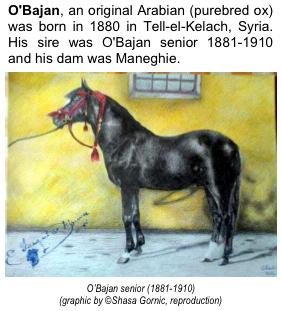 Follow this link for the December ASAV newsletter, featuring an article on O'Bajan - an original foundation stud.
Benefits of Soaking Hay for Horses
Equinews.com - Full Article
By Kentucky Equine Research · October 21, 2008
Even the cleanest, best-quality hay is likely to contain a moderate amount of fine material. When a horse plunges its head into a pile of hay or pulls mouthfuls out of a hay net, it inhales countless small particles of dust, mold spores, and fibrous plant material. Collectively known as the respirable dust concentration, or RDC, these fine particles can cause severe airway irritation in sensitive horses. Heaves, broken wind, and recurrent airway obstruction are terms for the condition that can manifest as mild coughing or severe bronchial spasms that preclude any sort of training or exercise. Management steps—wetting or soaking hay, selecting alternative bedding materials, and removing horses from stalls during periods of peak activity—have been used to minimize RDC impact. The goals of this study were to establish the result of soaking hay on RDC in the horse’s breathing zone; to find out the usefulness of short immersion as opposed to longer soaking periods; and to investigate how management of one stall influences the RDC in a neighboring stall...
Read more here:
http://www.equinews.com/article/benefits-of-soaking-hay-for-horses
By Kentucky Equine Research · October 21, 2008
Even the cleanest, best-quality hay is likely to contain a moderate amount of fine material. When a horse plunges its head into a pile of hay or pulls mouthfuls out of a hay net, it inhales countless small particles of dust, mold spores, and fibrous plant material. Collectively known as the respirable dust concentration, or RDC, these fine particles can cause severe airway irritation in sensitive horses. Heaves, broken wind, and recurrent airway obstruction are terms for the condition that can manifest as mild coughing or severe bronchial spasms that preclude any sort of training or exercise. Management steps—wetting or soaking hay, selecting alternative bedding materials, and removing horses from stalls during periods of peak activity—have been used to minimize RDC impact. The goals of this study were to establish the result of soaking hay on RDC in the horse’s breathing zone; to find out the usefulness of short immersion as opposed to longer soaking periods; and to investigate how management of one stall influences the RDC in a neighboring stall...
Read more here:
http://www.equinews.com/article/benefits-of-soaking-hay-for-horses
Tuesday, December 28, 2010
Tying-Up in Thoroughbreds: Narrowing the Genetic Search
Thehorse.com - Full Article
by: Stacey Oke, DVM, MSc
December 24 2010, Article # 17439
Researchers suspect tying-up in horses is a heritable condition; however, they have yet to determine the gene--or genes--responsible. But a team of Japanese researchers recently moved the investigation forward with a groundbreaking study of affected Thoroughbred racehorses' DNA.
Muscle disorders such as polysaccharide storage myopathy (PSSM, recognized mainly in Quarter Horses) and recurrent exertional rhabdomyolysis (RER, found primarily in Thoroughbred and Standardbred racehorses) can lead to tying-up. A horse that's tying-up typically displays stiffness, sweating, muscle tremors, and a reluctance to move, among other clinical signs.
"Tying-up in racehorses is important because it affects approximately 5% of Thoroughbred racehorses," explained Teruaki Tozaki, PhD, from the Department of Molecular Genetics, Laboratory of Racing Chemistry, Tochigi, Japan, author of the recent study. "Although the condition is influenced by sex (of the affected horse), temperament, and diet, the current body of evidence suggests that tying-up is a heritable trait that is affected by one or several genetic factors..."
Read more here:
http://www.thehorse.com/ViewArticle.aspx?ID=17439
by: Stacey Oke, DVM, MSc
December 24 2010, Article # 17439
Researchers suspect tying-up in horses is a heritable condition; however, they have yet to determine the gene--or genes--responsible. But a team of Japanese researchers recently moved the investigation forward with a groundbreaking study of affected Thoroughbred racehorses' DNA.
Muscle disorders such as polysaccharide storage myopathy (PSSM, recognized mainly in Quarter Horses) and recurrent exertional rhabdomyolysis (RER, found primarily in Thoroughbred and Standardbred racehorses) can lead to tying-up. A horse that's tying-up typically displays stiffness, sweating, muscle tremors, and a reluctance to move, among other clinical signs.
"Tying-up in racehorses is important because it affects approximately 5% of Thoroughbred racehorses," explained Teruaki Tozaki, PhD, from the Department of Molecular Genetics, Laboratory of Racing Chemistry, Tochigi, Japan, author of the recent study. "Although the condition is influenced by sex (of the affected horse), temperament, and diet, the current body of evidence suggests that tying-up is a heritable trait that is affected by one or several genetic factors..."
Read more here:
http://www.thehorse.com/ViewArticle.aspx?ID=17439
Sunday, December 19, 2010
Antioxidants for Top Performance
Thehorse.com - Full Article
by: Kentucky Equine Research Inc.
December 19 2010, Article # 17418
Oxidation is a normal metabolic process that allows horses to transform the carbohydrates, fats, and proteins they devour in meals into energy. An unavoidable side effect of oxidation is the creation of free radicals--compounds that have the potential to irreparably damage cells. Free radicals are particularly harmful to the cell membranes (structures responsible for keeping destructive entities away from delicate inner organelles).
Under normal circumstances, substances called antioxidants thwart much of the wreckage caused by free radicals. However, oxidation speeds up during athletic effort due to increased oxygen consumption and accelerated aerobic metabolism. The end result of unchecked oxidation in the bodies of equine athletes could be muscular fatigue severe enough to compromise performance.
In instances of strenuous exercise, natural stores of antioxidants have difficulty providing sufficient protection against the cascade of free radicals generated from aerobic metabolism. Thus, supplementation of antioxidants is particularly helpful in warding off the ill effects of mass-produced free radicals associated with intense exercise...
Read more here:
http://www.thehorse.com/ViewArticle.aspx?ID=17418
by: Kentucky Equine Research Inc.
December 19 2010, Article # 17418
Oxidation is a normal metabolic process that allows horses to transform the carbohydrates, fats, and proteins they devour in meals into energy. An unavoidable side effect of oxidation is the creation of free radicals--compounds that have the potential to irreparably damage cells. Free radicals are particularly harmful to the cell membranes (structures responsible for keeping destructive entities away from delicate inner organelles).
Under normal circumstances, substances called antioxidants thwart much of the wreckage caused by free radicals. However, oxidation speeds up during athletic effort due to increased oxygen consumption and accelerated aerobic metabolism. The end result of unchecked oxidation in the bodies of equine athletes could be muscular fatigue severe enough to compromise performance.
In instances of strenuous exercise, natural stores of antioxidants have difficulty providing sufficient protection against the cascade of free radicals generated from aerobic metabolism. Thus, supplementation of antioxidants is particularly helpful in warding off the ill effects of mass-produced free radicals associated with intense exercise...
Read more here:
http://www.thehorse.com/ViewArticle.aspx?ID=17418
Friday, December 17, 2010
What's in a Name?
Terre O'Brennan
AERC, like every other National Endurance organization in the world, defines Endurance as ‘an event of 50 miles (80 km) or more’. Riders who participate in shorter rides may feel that this definition is an affront to them, since it differentiates the events they participate in from “Endurance”. They belong to Endurance organizations, and attend Endurance rides, and yet their sport has a different name. They believe that this definition is arbitrary and artificial, and exists only to enable a bunch of elitist snobs to feel superior. When riders in the 50 or 100 mile events refer to this definition, Limited Distance riders feel insulted. This misunderstanding has led to the single biggest source of disharmony in AERC.
Huge bodies of research have been done on the physiology of horses participating in Endurance rides; all of them agree on one essential point: the overwhelming bulk of water and electrolyte loss occurs during the first 25 miles (40 km) of work*. How the horse and rider manage the next 25 to 75 miles in the face of these losses is, in fact, the definition of “Endurance”. When the horse stops working at 25 miles, it never faces this challenge; what it has done is a valid sport, and a useful sport, but not the same sport as those horses that do longer distance.
It is important to recognize and understand this difference, and not just for intra-organization harmony. Riders wishing to ‘move up’ from Limited Distance to Endurance must understand that it is not just “more of the same”—their horses (and themselves) are actually taking on a whole new challenge. To illustrate by analogy…many of us occasionally undertake “Runs” of 5 miles or so, often for charity. If you are one of these people, picture yourself suddenly entering a Marathon—with no change of training, equipment, or strategy! How do you think you would make out?
Perhaps ironically, the more “successful” a Limited Distance rider may be (in terms of speed), the less likely they are to succeed at the Endurance distances, at least initially. Often, the horse has learned to make time at the expense of grazing and drinking on the trail; it may be difficult to change this acquired behaviour. These horses are often difficult to rate. The riders keep finding their horse hitting a ‘wall’ at about 35 miles—usually poor guts sounds and/or recovery. They resist the advice to return to doing shorter rides because they feel they can’t learn anything new at this distance; they are already succeeding there. What they fail to realise is that the problems they are experiencing are not developing between miles 25 and 35, they occurred between miles 1 and 25. It is only the effect of these problems that occur later—an effect that doesn’t occur if the horse stops working before they become apparent.
Horses that have done the shorter distances at a steadier pace will actually find the transition easier; they are more used to being ‘out on the trail’ for prolonged periods. Keeping “the fuel tanks”—water, guts, electrolytes—topped up on these horses is generally easier, since the horses cooperate!
A factor that unnecessarily discourages some Limited Distance riders from attempting longer distances is the issue of “fitness”. It is not uncommon to hear them state that ‘’they don’t have enough time to train sufficiently to do 50s”. I believe many people have an exaggerated idea of how much training Endurance riders do; if you look around at a typical ride you will note that the majority of riders in the 50 and even 100 mile rides are also ‘ordinary people with jobs, family, etc’. Most mature horses with a good base that have successfully completed several Limited Distance rides in a season are—by the very fact of having done that mileage—fit enough to attempt a 50. Fitness is far more important with regard to speed than to distance; ability and willingness to eat and drink are generally enough to allow most horses to walk and trot for many hours.
Many Limited Distance riders have, of course, absolutely no interest in riding Endurance distances. There is certainly nothing wrong with that! Having made that choice, they need to make peace with the concept that the sport they have decided to participate in is not the same sport as their friends who ride the longer distance. Many riders participating in the longer distances choose not to ride fast. Many riders at all distances choose not to ride under certain weather or trail conditions. Some riders may choose to ride only multidays, or only 100s, or only rides within a few hours of home. All riders make choices which define which of the different challenges of our sport they wish to address. “Different” doesn’t have to mean “disrespected”—everybody has somebody, somewhere, who is doing more or better than they are. Maria Alvarez Ponton, two time World Champion, has only a fraction of the lifetime mileage of many Endurance riders. We must learn to embrace our differences if we are to maintain harmony; and that spirit of acceptance perhaps begins with understanding those differences.
* LINDINGER, M. I. and ECKER, G. L. (1995), Ion and water losses from body fluids during a 163 km endurance ride. Equine Veterinary Journal, 27: 314–322.May 1995
* Michael I Lindinger* , Gloria McKeen and Gayle L Ecker Effects of terrain, speed, temperature and distance on water and ion losses Volume 27, Issue S18, pages 298–305, May 1995
* Dane L. Frazier, DVM 81st Western Veterinary Conference V414The Distance Horse: Dragon Makers
AERC, like every other National Endurance organization in the world, defines Endurance as ‘an event of 50 miles (80 km) or more’. Riders who participate in shorter rides may feel that this definition is an affront to them, since it differentiates the events they participate in from “Endurance”. They belong to Endurance organizations, and attend Endurance rides, and yet their sport has a different name. They believe that this definition is arbitrary and artificial, and exists only to enable a bunch of elitist snobs to feel superior. When riders in the 50 or 100 mile events refer to this definition, Limited Distance riders feel insulted. This misunderstanding has led to the single biggest source of disharmony in AERC.
Huge bodies of research have been done on the physiology of horses participating in Endurance rides; all of them agree on one essential point: the overwhelming bulk of water and electrolyte loss occurs during the first 25 miles (40 km) of work*. How the horse and rider manage the next 25 to 75 miles in the face of these losses is, in fact, the definition of “Endurance”. When the horse stops working at 25 miles, it never faces this challenge; what it has done is a valid sport, and a useful sport, but not the same sport as those horses that do longer distance.
It is important to recognize and understand this difference, and not just for intra-organization harmony. Riders wishing to ‘move up’ from Limited Distance to Endurance must understand that it is not just “more of the same”—their horses (and themselves) are actually taking on a whole new challenge. To illustrate by analogy…many of us occasionally undertake “Runs” of 5 miles or so, often for charity. If you are one of these people, picture yourself suddenly entering a Marathon—with no change of training, equipment, or strategy! How do you think you would make out?
Perhaps ironically, the more “successful” a Limited Distance rider may be (in terms of speed), the less likely they are to succeed at the Endurance distances, at least initially. Often, the horse has learned to make time at the expense of grazing and drinking on the trail; it may be difficult to change this acquired behaviour. These horses are often difficult to rate. The riders keep finding their horse hitting a ‘wall’ at about 35 miles—usually poor guts sounds and/or recovery. They resist the advice to return to doing shorter rides because they feel they can’t learn anything new at this distance; they are already succeeding there. What they fail to realise is that the problems they are experiencing are not developing between miles 25 and 35, they occurred between miles 1 and 25. It is only the effect of these problems that occur later—an effect that doesn’t occur if the horse stops working before they become apparent.
Horses that have done the shorter distances at a steadier pace will actually find the transition easier; they are more used to being ‘out on the trail’ for prolonged periods. Keeping “the fuel tanks”—water, guts, electrolytes—topped up on these horses is generally easier, since the horses cooperate!
A factor that unnecessarily discourages some Limited Distance riders from attempting longer distances is the issue of “fitness”. It is not uncommon to hear them state that ‘’they don’t have enough time to train sufficiently to do 50s”. I believe many people have an exaggerated idea of how much training Endurance riders do; if you look around at a typical ride you will note that the majority of riders in the 50 and even 100 mile rides are also ‘ordinary people with jobs, family, etc’. Most mature horses with a good base that have successfully completed several Limited Distance rides in a season are—by the very fact of having done that mileage—fit enough to attempt a 50. Fitness is far more important with regard to speed than to distance; ability and willingness to eat and drink are generally enough to allow most horses to walk and trot for many hours.
Many Limited Distance riders have, of course, absolutely no interest in riding Endurance distances. There is certainly nothing wrong with that! Having made that choice, they need to make peace with the concept that the sport they have decided to participate in is not the same sport as their friends who ride the longer distance. Many riders participating in the longer distances choose not to ride fast. Many riders at all distances choose not to ride under certain weather or trail conditions. Some riders may choose to ride only multidays, or only 100s, or only rides within a few hours of home. All riders make choices which define which of the different challenges of our sport they wish to address. “Different” doesn’t have to mean “disrespected”—everybody has somebody, somewhere, who is doing more or better than they are. Maria Alvarez Ponton, two time World Champion, has only a fraction of the lifetime mileage of many Endurance riders. We must learn to embrace our differences if we are to maintain harmony; and that spirit of acceptance perhaps begins with understanding those differences.
* LINDINGER, M. I. and ECKER, G. L. (1995), Ion and water losses from body fluids during a 163 km endurance ride. Equine Veterinary Journal, 27: 314–322.May 1995
* Michael I Lindinger* , Gloria McKeen and Gayle L Ecker Effects of terrain, speed, temperature and distance on water and ion losses Volume 27, Issue S18, pages 298–305, May 1995
* Dane L. Frazier, DVM 81st Western Veterinary Conference V414The Distance Horse: Dragon Makers
Thursday, December 16, 2010
Managing Hoof Problems in Horses
http://www.thehorse.com/ViewArticle.aspx?ID=5202
by: Christy West, Digital Editor/Producer
June 01 2004, Article # 5202
Just about every horse out there has what we might call a hoof problem on at least one of his four feet. It might be a simple mismatch that might not really be a problem, or it might be much more serious. In any case, hoof problems, regardless of scope, need to be managed properly to maximize the horse's soundness, comfort, and usefulness to you.
The challenge is five-fold, according to Bruce Lyle, DVM, who focuses primarily on foot care in his practice in Aubrey, Texas. "My approach to any case is to begin with problem identification, identify contributing factors, change what I can, and then observe the response, followed by re-evaluation," he says. "Identifying the problem can be challenging because of the lack of valid research on causes of pain in the foot. Sound horses performing at a high level may have abnormal-appearing bones on radiographs, whereas other lame horses may have an apparently beautiful foot with no radiographic abnormalities. In many cases, ultrasound and nuclear scintigraphy may be negative also, frustrating owner, farrier, and veterinarian.
"Because of these negative experiences and the lack of consistent, practical research, farrier John Arkley (more on him shortly) and I have joined with a growing faction of veterinarians and farriers handling foot problems and lameness from a fundamental form-to-function approach," Lyle says...
Read more here:
http://www.thehorse.com/ViewArticle.aspx?ID=5202
by: Christy West, Digital Editor/Producer
June 01 2004, Article # 5202
Just about every horse out there has what we might call a hoof problem on at least one of his four feet. It might be a simple mismatch that might not really be a problem, or it might be much more serious. In any case, hoof problems, regardless of scope, need to be managed properly to maximize the horse's soundness, comfort, and usefulness to you.
The challenge is five-fold, according to Bruce Lyle, DVM, who focuses primarily on foot care in his practice in Aubrey, Texas. "My approach to any case is to begin with problem identification, identify contributing factors, change what I can, and then observe the response, followed by re-evaluation," he says. "Identifying the problem can be challenging because of the lack of valid research on causes of pain in the foot. Sound horses performing at a high level may have abnormal-appearing bones on radiographs, whereas other lame horses may have an apparently beautiful foot with no radiographic abnormalities. In many cases, ultrasound and nuclear scintigraphy may be negative also, frustrating owner, farrier, and veterinarian.
"Because of these negative experiences and the lack of consistent, practical research, farrier John Arkley (more on him shortly) and I have joined with a growing faction of veterinarians and farriers handling foot problems and lameness from a fundamental form-to-function approach," Lyle says...
Read more here:
http://www.thehorse.com/ViewArticle.aspx?ID=5202
Wednesday, December 15, 2010
Sacking Out the Problem Horse
Myhorse.com - Full Article
Story by Tracey Emslie, John Lyons
Sacking out is a vital training tool. Done well, it creates perfect horses. Done poorly, it causes lifelong problems. Learn the difference here.
Your new horse seems a real charmer-until your saddle blanket slips off and he throws a classic tizzy fit. Or maybe a neighbor has put up a flagpole and your otherwise fine trail horse doesn't respond in a patriotic manner on windy days. Or maybe he strongly objects to swinging ropes, flapping towels, your taking off your jacket, or any of a hundred other distractions.
"Ah," will say a friend, trainer, or absolute stranger. "You need to sack him out!"
"Sacking out" is a vital training tool that's widely misunderstood. Done well, it produces a safe, confident, and responsive partner. Done poorly, it can cause problems that haunt the horse and his subsequent owners/riders for the rest of his life.
What Is Sacking Out?
An unusual object that disturbs your horse is like a pop quiz at school. Sacking out is a way to respond to the pop quiz. We talked about this in "Meet the Monsters." (To review this article from the October 2007 issue, go to www.myhorse.com/perfect horse, and search for "meet the monsters.")
Sacking out gives us a way to control the pop quiz with a training exercise in which we actually plan disturbances for the horse. They help teach your horse to respond to "go right," "go left," "stop," "go forward," "back up," "speed up," or "slow down" cues even if there's something that might startle him, such as a waving towel or a crackling tarp...
Read more here:
http://myhorse.com/sacking-out-problem-horse.html?utm_source=myhorse&utm_medium=email_2B-_2Bnewsletter&utm_campaign=myhorsenewsletter
Story by Tracey Emslie, John Lyons
Sacking out is a vital training tool. Done well, it creates perfect horses. Done poorly, it causes lifelong problems. Learn the difference here.
Your new horse seems a real charmer-until your saddle blanket slips off and he throws a classic tizzy fit. Or maybe a neighbor has put up a flagpole and your otherwise fine trail horse doesn't respond in a patriotic manner on windy days. Or maybe he strongly objects to swinging ropes, flapping towels, your taking off your jacket, or any of a hundred other distractions.
"Ah," will say a friend, trainer, or absolute stranger. "You need to sack him out!"
"Sacking out" is a vital training tool that's widely misunderstood. Done well, it produces a safe, confident, and responsive partner. Done poorly, it can cause problems that haunt the horse and his subsequent owners/riders for the rest of his life.
What Is Sacking Out?
An unusual object that disturbs your horse is like a pop quiz at school. Sacking out is a way to respond to the pop quiz. We talked about this in "Meet the Monsters." (To review this article from the October 2007 issue, go to www.myhorse.com/perfect horse, and search for "meet the monsters.")
Sacking out gives us a way to control the pop quiz with a training exercise in which we actually plan disturbances for the horse. They help teach your horse to respond to "go right," "go left," "stop," "go forward," "back up," "speed up," or "slow down" cues even if there's something that might startle him, such as a waving towel or a crackling tarp...
Read more here:
http://myhorse.com/sacking-out-problem-horse.html?utm_source=myhorse&utm_medium=email_2B-_2Bnewsletter&utm_campaign=myhorsenewsletter
Monday, December 13, 2010
Not all Salt is created equal, Salt is not Salt
Globalendurance Blog - Full Article and photos
12/12/10
Salt is vital for for the survival of all mammals, without it muscles do not function and life will cease to exist. Salt regulates the water content inside cells and it detoxifies the body. Salt is essential for nerve impulse transmissions and proper heart function.
Salt is mainly composed of Sodium and Chloride. Both play a major part in proper blood ph level, balanced stomach acids to digest food and also bone density. Half of the sodium in the body is stored within the bones.
Salt is found in the sea, in the ground and in mines. As soon as it is extracted, it is chemically cleaned and often exposed to temperatures of 1200 F and more, a process that destroys just about all trace minerals and nutrients. Industrially treated table salt is reduced to just Sodium and Chloride, while natural Salt found in the ground and the sea contains up to 90 additional crucial nutrients and chemical elements, which make a huge difference in all our lives.
Horses consume about 1 to 2 oz of Salt a day, in hotter climates and/or while exercising, the demand goes up to 6 or 7 oz of Salt. While sweating, horses do not only loose sodium and chloride, but also a large amount of minerals. Without all the important trace minerals, their bodies are lacking substantial chemical elements and mineral nutrients. Our horses are thus being compromised in their health and their performance...
Read more here:
http://globalendurance.typepad.com/global-endurance-blog/2010/12/not-all-salt-is-created-equal-salt-is-not-salt.html
12/12/10
Salt is vital for for the survival of all mammals, without it muscles do not function and life will cease to exist. Salt regulates the water content inside cells and it detoxifies the body. Salt is essential for nerve impulse transmissions and proper heart function.
Salt is mainly composed of Sodium and Chloride. Both play a major part in proper blood ph level, balanced stomach acids to digest food and also bone density. Half of the sodium in the body is stored within the bones.
Salt is found in the sea, in the ground and in mines. As soon as it is extracted, it is chemically cleaned and often exposed to temperatures of 1200 F and more, a process that destroys just about all trace minerals and nutrients. Industrially treated table salt is reduced to just Sodium and Chloride, while natural Salt found in the ground and the sea contains up to 90 additional crucial nutrients and chemical elements, which make a huge difference in all our lives.
Horses consume about 1 to 2 oz of Salt a day, in hotter climates and/or while exercising, the demand goes up to 6 or 7 oz of Salt. While sweating, horses do not only loose sodium and chloride, but also a large amount of minerals. Without all the important trace minerals, their bodies are lacking substantial chemical elements and mineral nutrients. Our horses are thus being compromised in their health and their performance...
Read more here:
http://globalendurance.typepad.com/global-endurance-blog/2010/12/not-all-salt-is-created-equal-salt-is-not-salt.html
Building Better Hooves
Thehorse.com - Full Article
by: Christy West, Digital Editor/Producer
February 01 2007, Article # 8819
At some point, probably all of us have used some type of product to improve our horses' feet. And many of us haven't seen the results we wanted, so perhaps we tried another. And another. Despite our best efforts, some of us despair of ever having horses with those tough feet that don't crack and hold all the shoes until the farrier's next visit. One of our online readers put it best: "I need a miracle!"
We don't have to despair, but we do have to be smart about how we take care of our horses' feet. Not all products are good for all horses, just as all face creams aren't good for all women. To wade through the hoof product jungle, we first asked our online readers at TheHorse.com to tell us what products they used. Then, we asked the nation's leading hoof experts about how to get the most out of various products.
Careful With Those Feet
Home remedies are commonly used for many things, including hoof care. Our readers have used everything from Clorox to formaldehyde to WD-40 lubricant to commercial deck preservatives to improve their horses' hooves. But trying just anything might not be in your horse's best interest...
Read more here:
http://www.thehorse.com/ViewArticle.aspx?ID=8819
by: Christy West, Digital Editor/Producer
February 01 2007, Article # 8819
At some point, probably all of us have used some type of product to improve our horses' feet. And many of us haven't seen the results we wanted, so perhaps we tried another. And another. Despite our best efforts, some of us despair of ever having horses with those tough feet that don't crack and hold all the shoes until the farrier's next visit. One of our online readers put it best: "I need a miracle!"
We don't have to despair, but we do have to be smart about how we take care of our horses' feet. Not all products are good for all horses, just as all face creams aren't good for all women. To wade through the hoof product jungle, we first asked our online readers at TheHorse.com to tell us what products they used. Then, we asked the nation's leading hoof experts about how to get the most out of various products.
Careful With Those Feet
Home remedies are commonly used for many things, including hoof care. Our readers have used everything from Clorox to formaldehyde to WD-40 lubricant to commercial deck preservatives to improve their horses' hooves. But trying just anything might not be in your horse's best interest...
Read more here:
http://www.thehorse.com/ViewArticle.aspx?ID=8819
Wednesday, December 08, 2010
Angie McGhee: Something to Show
Angie McGhee
All my life my mom has had one major lament: “I just wish you had something to show for all that money you’ve spent on horses.” My mom on the other hand has lots of stuff to show for her money …I’m talking mountains of stuff. She has so much stuff to show for her money that she’s looking for a larger house at age 75.
I guess we all want a little “something to show” for our time on this earth. After all, that’s how we keep score isn’t it? When you play Monopoly the one with the most houses and money at the end of the game is declared the winner. Nobody cared that my personal game goal was just to get to be the Scotty dog and buy all the Railroads. They still told me that I had to put away the game because I “lost”. Fortunately for me, I kind of liked putting away the game and I really hated buying those houses, so who’s to say I “lost”? This sort of logic was probably an accurate predictor of what sort of endurance competitor I would later become.
The problem with counting the money (and stuff) at the end of your life to see who wins is that you’re never around to enjoy the victory. You may know you’re ahead, but third quarter leads aren’t that satisfying, because we all know “It ain’t over till the buzzer blows”. It’s also a difficult job for the scorekeepers. Do you only count resale value or original purchase price? If one person keeps an elderly uncle’s oil painting which seemed ugly and worthless at the time, but turns out to be worth millions (though still ugly), do they beat the person with a 3,500 square foot house that was filled with top of the line (at the time they bought them) furniture and appliances…even if most of it is on its way to the landfill soon after the counting?
I’ve helped “count the points” at the end of a few people’s games and decided that no matter how great the stuff seemed to you at the time you bought it, it’s a rare item that is worth having when you’re ready to pass it on. Since my instinctive urge is to enjoy things today, use them up and wear them out; I hadn’t given much thought to what sort of things were permanent. However, my mom’s comments got me thinking about it. This inspired me to set out on a quest to find what would really last; something that would remind others that I had existed, because I’d like to leave something behind that my descendents could remember me by.
My mom is very practical; she thinks I should invest in real estate. “You could have paid for a rental house by now” she says. So, is a house something that will “last”? Not really. I see what’s left of houses all the time when I’m riding through the woods. One leak in the roof and the rot sets in. A beam rots through, the roof collapses and in what seems like no time at all the vines have pulled down the walls and only the stone chimney remains. Houses don’t last as long as I want my memory to last. On the other hand, daffodils do. I’ve ridden by spots in the woods where daffodils that look as new as the year they were planted come up with the first hint of spring and surround what used to be someone’s yard. All that’s left of the house is the outline of the foundation, but the daffodils are in excellent condition. I contemplate these things as I ride and figure it’s got to mean something…probably something about the futility of hard work.
What about wealth? Should we attempt to build a fortune to pass on so our kids will never know what it feels like to do an honest day’s work? I think the Paris Hiltons of the world have answered that question. So how do we avoid accidentally making too much money and ruining our offspring’s lives? We must know how to recognize when we have made “enough” money, then have the self control to stop and go riding.
My brother is wealthy. He is a very hard worker and loves every minute of it. Even his recreational activities make money. Making more money is his profession and his hobby. If you asked him how much money he wants to make the answer would be “more”. One day he commented to me, “Do you ever think about how much money you could have made if you’d been doing something where you got paid instead of riding?” This seemed like a ridiculous question. I hadn’t missed any meals and always paid my bills, so I obviously hadn’t needed any more money. Personally, I never understood why he continued to work after he had covered all his financial commitments. To me that was like continuing to drink when you weren’t thirsty any more. I simply answered his question with a question. “Have you ever considered how many interesting things you could have seen and done if you had been riding with me instead of making more money?”
I wonder how my brother and I will be remembered by later generations. I know from quizzing my grandmother about my ancestors that most people do well to get a one word summary of their life. “He was a”: “teacher”, “fiddler”, “cripple”, or “tough” was about all she bothered to tell me when I asked about a person on the family tree. But there were a few she’d elaborate on simply because there was a good story attached. Her favorite was my great-great-grandfather who was murdered. The story went that he was bragging and flashing a big wad of money and the preacher’s son murdered him for it. The money turned out to be Confederate and worthless. So I suppose: “Be stupid and die”. That’s one way to leave a legacy. There were others my folks told me about; “Aunt Bird” who was born premature and slept in a shoebox for a crib; my grandmother who was so strong she could hold a chair at arm’s length longer than any of the teenaged boys; the second cousin who bought a mountain and mounted huge theater speakers on the roof of his cabin so he could listen to the “Sons of the Pioneers” while he rode his horse through the woods… all these people are referred to often in family conversations. What I gather from this is, “be dumber, tougher, or stronger than people expect, or do what makes you happy whether it’s normal or not and there will be something to show for your life…a good story. At least in my family, the farther you distanced yourself from normal the more likely you were to be remembered.
So, what do I have to show for my life? What have I done with the money I made with the job that I got with the education I’ve been given? I got to thinking about it and realized that most of it bought me nothing but memories… and maybe some character. I guess most of the memories are about getting my character. As a matter of fact, looking back at my riding career I realize I have acquired so much character that if there was a character bank my balance would be staggering. I would love to be able to leave some of it to others who haven’t had the opportunity to go through some of the things I’ve survived.
I think I’ve spent my money well. The lack of tangible possessions is a blessing. My mom and dad raised 6 children on my dad’s one paycheck. Still, the stuff that she’s got left to show for it is crowding them out of their house. Considering we have only two children and we have two paychecks, it’s terribly lucky for me that I have my horses to protect me from a much worse fate. They take money that would clutter up my life with possessions, and through shoeing, hay, grain, vet bills, entry fees and fuel spent going to rides manage to make it disappear into thin air. No need for storage or maintenance, it’s gone for good!
What else should I have done with that money? Buy 277 toaster ovens, 22 microwaves, 17 refrigerators and dozens of washer & dryer combinations? How many bedroom suits and matching color coordinated comforters can one person handle? I’ve already got stereos, and computers everywhere, should I have bought even more? There would be so much stuff we’d have to add more rooms onto the house and those would be full too. I can just see me now, I’d be one of those old women whose house has a tiny little path winding between her mounds of possessions. It gives me chills thinking about it. Thank goodness for the horses!
So, instead of lots of material junk to sort out when I go, I’m leaving my grandchildren an eccentric grandma to reminisce about. They can look up my AERC record if they need to prove the stories are true. I can write down enough interesting anecdotes from those miles to let each descendent pick a favorite for their own. As for my other possessions, if I time things just right, the money should be spent, the hay should all be eaten, the horse should die, the saddle should wear out and I should expire pretty much simultaneously. If handled properly we should all compost very well taking up precious little landfill space. If someone has to sum up my life very briefly I have no doubt they’ll say, “She rode horses…a lot”. I leave that along with a very large mountain of rich manure behind the barn, which I hope my family will scatter around some daffodils.
Winter Care for Older Horses
Thehorse.com - Full Article
Owners need to consider how they will meet their older horses' (or their younger, hard-keeping horses') nutrient requirements during the winter. Providing adequate energy is the prime concern, and how you will provide those extra calories depends on available feed and each horse's individual needs.
A good place to start is assessing your horse's body condition score (BCS). Horses with a BCS of greater than 5 will have some extra fat stores that can provide insulation and serve as a readily available source of energy when the daily ration falls short as the temperature drops.
In developing your feeding strategy, consider increasing your horse's hay intake to meet his energy needs. Hay is digested in the gastrointestinal tract by fermentation, which produces heat that the horse can use to maintain core body temperature. There is a limit as to how much hay he can consume daily. In most cases, he will consume 2.0-2.5% of his body weight per day. If he can't consume enough hay, then adding grain to the diet will also provide calories.
Temperatures well below freezing, or wet snow or freezing rain conditions, greatly increase a horse's energy requirements, especially if he's maintained outside. Rain and wind can cause the horse to lose the insulating capacity of his hair coat, and he'll use body reserves to maintain core body temperature, often resulting in weight loss...
Read more here:
http://www.thehorse.com/ViewArticle.aspx?ID=15740
Owners need to consider how they will meet their older horses' (or their younger, hard-keeping horses') nutrient requirements during the winter. Providing adequate energy is the prime concern, and how you will provide those extra calories depends on available feed and each horse's individual needs.
A good place to start is assessing your horse's body condition score (BCS). Horses with a BCS of greater than 5 will have some extra fat stores that can provide insulation and serve as a readily available source of energy when the daily ration falls short as the temperature drops.
In developing your feeding strategy, consider increasing your horse's hay intake to meet his energy needs. Hay is digested in the gastrointestinal tract by fermentation, which produces heat that the horse can use to maintain core body temperature. There is a limit as to how much hay he can consume daily. In most cases, he will consume 2.0-2.5% of his body weight per day. If he can't consume enough hay, then adding grain to the diet will also provide calories.
Temperatures well below freezing, or wet snow or freezing rain conditions, greatly increase a horse's energy requirements, especially if he's maintained outside. Rain and wind can cause the horse to lose the insulating capacity of his hair coat, and he'll use body reserves to maintain core body temperature, often resulting in weight loss...
Read more here:
http://www.thehorse.com/ViewArticle.aspx?ID=15740
Saturday, December 04, 2010
Competitive Trail Riding
http://www.midsouthhorsereview.com/articles/2010/12/04/news/news14.txt
A timed event over a marked trail
By Wayne Tolbert
The sport of Competitive Trail Riding (CTR) has been around for at least 50 years. It occupies a niche between pleasure riding, typically casual in nature, and endurance riding, which is a long-distance equine sport. There are several CTR organizations with various histories, rules, and philosophies. I have been an active competitor for the past 13 years in events sanctioned by the North American Trail Ride Conference (NATRC), so this article is based on that experience.
Competitive trail riding as practiced by NATRC is a timed event over a marked trail with competitors in each class having the same time to complete the course. Typically events are one or two days duration with distances ranging from 20 miles for one-day novice classes to 60 miles for two-day advanced classes. A very important characteristic of CTR is the use of two judges per event: a veterinarian judge, who evaluates the horse’s soundness, condition, and trail worthiness (manners) and a horsemanship judge. The horsemanship judge evaluates the rider on trail equitation, trail safety and courtesy, and how well the rider cares for the horse including grooming, proper use of tack and equipment, stabling, and trail care (water stops, pacing, timing, cooling out, etc.). The overall goal is to ride the horse is such a manner so that he finishes the ride as strong as when he started. Thus, CTR has been compared to the cavalry remount program in which horses were selected, trained, and ridden daily over long distances.
The emphasis that NATRC places on judging the riders as well as the horses encourages riders to become better horsemen and horsewomen. It fosters teamwork and a lasting partnership between the horse and rider. Some evidence in support of this is the fact that currently there are approximately 700 horses that have completed over 1,000 miles each in NATRC-sanctioned competitive trail rides. Two of these horses have over 20,000 miles each, one has almost 12,000 miles, one over 10,000, one over 9,000 and five horses have over 8,000 miles. Another 50+ horses have between 4,000 and 7,000 miles. These are official miles ridden exclusively in NATRC-sanctioned rides. These do not count miles ridden in other competitions, such as endurance rides, Nor the many miles ridden to condition/train the horses, nor miles ridden with friends as pleasure riding.
How is it possible that so many horses have such long and productive lives as competitive mounts? How is it possible that CTR successfully promotes horses well into their 20’s, which is a time that many horses have long retired or owners have gotten rid of their “old” horses?
The primary reasons for the success of our horses stems from the founding philosophies and practices of NATRC. Ride participants tend to select horses with stamina and hardiness, who are qualified to make good trail mounts. These horses are, or become with proper conditioning, superior athletes; bloodlines and color, while nice, are secondary to athleticism.
Riders receive guidance from veterinary judges, horsemanship judges, NATRC clinic leaders and more experienced riders. There is a long tradition of fellow competitors assisting newer participants. In my experience, this “unwritten rule” compels more experienced competitors to help and, at times, they may be assigned by ride managers as mentors to new riders. This willingness to share knowledge and experience makes NATRC an excellent starting point for many horse lovers and contributes to the family-oriented nature of competitive trail riding.
Riders also learn from their own experience at NATRC rides the proper methods of training and conditioning of horses. Riders learn good horsemanship skills that contribute to successful partnering with their horses. Riders also learn the best methods for caring for their horses during and after long rides without the aid of artificial methods or stimulants.
NATRC will celebrate its Golden Anniversary, 50 years of competitive trail riding since its founding in 1961, at the 2011 NATRC National Convention in Nashville, Tennessee, February 10-13. The public is cordially invited to attend this special event, a two-day program of educational speakers, 17 vendors (to satisfy all your horse shopping needs), and a Walk of Fame to honor many of the riders and horses that have contributed CTR and to NATRC. Honorees include Past NATRC Presidents, winners of the President’s Cup, Bev Tibbitts, Jim Menefee, and Polly Bridges awards. Horses with 5 or more National Championships, horses with 5,000+ miles, and riders with 7,000+ miles will be recognized, and especially this year’s national winners. A silent auction will be held and a Specialized Saddle raffled. Attendees can also visit the country music capital, hear live entertainment, and get a chance to learn how to line dance.
A timed event over a marked trail
By Wayne Tolbert
The sport of Competitive Trail Riding (CTR) has been around for at least 50 years. It occupies a niche between pleasure riding, typically casual in nature, and endurance riding, which is a long-distance equine sport. There are several CTR organizations with various histories, rules, and philosophies. I have been an active competitor for the past 13 years in events sanctioned by the North American Trail Ride Conference (NATRC), so this article is based on that experience.
Competitive trail riding as practiced by NATRC is a timed event over a marked trail with competitors in each class having the same time to complete the course. Typically events are one or two days duration with distances ranging from 20 miles for one-day novice classes to 60 miles for two-day advanced classes. A very important characteristic of CTR is the use of two judges per event: a veterinarian judge, who evaluates the horse’s soundness, condition, and trail worthiness (manners) and a horsemanship judge. The horsemanship judge evaluates the rider on trail equitation, trail safety and courtesy, and how well the rider cares for the horse including grooming, proper use of tack and equipment, stabling, and trail care (water stops, pacing, timing, cooling out, etc.). The overall goal is to ride the horse is such a manner so that he finishes the ride as strong as when he started. Thus, CTR has been compared to the cavalry remount program in which horses were selected, trained, and ridden daily over long distances.
The emphasis that NATRC places on judging the riders as well as the horses encourages riders to become better horsemen and horsewomen. It fosters teamwork and a lasting partnership between the horse and rider. Some evidence in support of this is the fact that currently there are approximately 700 horses that have completed over 1,000 miles each in NATRC-sanctioned competitive trail rides. Two of these horses have over 20,000 miles each, one has almost 12,000 miles, one over 10,000, one over 9,000 and five horses have over 8,000 miles. Another 50+ horses have between 4,000 and 7,000 miles. These are official miles ridden exclusively in NATRC-sanctioned rides. These do not count miles ridden in other competitions, such as endurance rides, Nor the many miles ridden to condition/train the horses, nor miles ridden with friends as pleasure riding.
How is it possible that so many horses have such long and productive lives as competitive mounts? How is it possible that CTR successfully promotes horses well into their 20’s, which is a time that many horses have long retired or owners have gotten rid of their “old” horses?
The primary reasons for the success of our horses stems from the founding philosophies and practices of NATRC. Ride participants tend to select horses with stamina and hardiness, who are qualified to make good trail mounts. These horses are, or become with proper conditioning, superior athletes; bloodlines and color, while nice, are secondary to athleticism.
Riders receive guidance from veterinary judges, horsemanship judges, NATRC clinic leaders and more experienced riders. There is a long tradition of fellow competitors assisting newer participants. In my experience, this “unwritten rule” compels more experienced competitors to help and, at times, they may be assigned by ride managers as mentors to new riders. This willingness to share knowledge and experience makes NATRC an excellent starting point for many horse lovers and contributes to the family-oriented nature of competitive trail riding.
Riders also learn from their own experience at NATRC rides the proper methods of training and conditioning of horses. Riders learn good horsemanship skills that contribute to successful partnering with their horses. Riders also learn the best methods for caring for their horses during and after long rides without the aid of artificial methods or stimulants.
NATRC will celebrate its Golden Anniversary, 50 years of competitive trail riding since its founding in 1961, at the 2011 NATRC National Convention in Nashville, Tennessee, February 10-13. The public is cordially invited to attend this special event, a two-day program of educational speakers, 17 vendors (to satisfy all your horse shopping needs), and a Walk of Fame to honor many of the riders and horses that have contributed CTR and to NATRC. Honorees include Past NATRC Presidents, winners of the President’s Cup, Bev Tibbitts, Jim Menefee, and Polly Bridges awards. Horses with 5 or more National Championships, horses with 5,000+ miles, and riders with 7,000+ miles will be recognized, and especially this year’s national winners. A silent auction will be held and a Specialized Saddle raffled. Attendees can also visit the country music capital, hear live entertainment, and get a chance to learn how to line dance.
Friday, December 03, 2010
Good Muscular Health: Body Condition Scoring Or Bodywork?
Duncan McLaughlin - latest ramblings
Body condition scoring is a visual assessment of your horse’s level of body fat. You get a body condition score by rating the amount of fat covering various anatomical landmarks against a linear scale. Usually six areas are rated: crest, wither, loin, tailhead, behind elbow, and ribs. Two scales are commonly in use; the US scale runs with values from one (emaciated) to nine (obese), whereas the Australian scale runs with values from zero (emaciated) to five (obese) – they are close but dont directly correspond. Each anatomical area is rated a value from the scale and these are averaged to give your horse’s overall body condition score.
As your horse’s fitness level increases two important things happen to his body fat stores. First, he is able to store more of those very important Intramuscular Triclycerides (IMTGs) between his muscles – refer to Fat: The Good, The Bad And The Ugly for a recap on IMTGs. Remember, the most important role that body fat plays for your athletic horse is as the fat source to replenish IMTGs after work. Second, he can more easily liberate and use energy directly from body fat stores for increasingly strenuous levels of exercise. So as your horse increases fitness you should expect to see an increase in lean muscle bulk and a decrease in body fat stores. Interestingly, fat from body stores is not lost equally: It seems likely that fat along the top of the back and the hindquarter is recruited more quickly than from other fat storage areas, leading to less fat storage along the posterior topline.
...more
Body condition scoring is a visual assessment of your horse’s level of body fat. You get a body condition score by rating the amount of fat covering various anatomical landmarks against a linear scale. Usually six areas are rated: crest, wither, loin, tailhead, behind elbow, and ribs. Two scales are commonly in use; the US scale runs with values from one (emaciated) to nine (obese), whereas the Australian scale runs with values from zero (emaciated) to five (obese) – they are close but dont directly correspond. Each anatomical area is rated a value from the scale and these are averaged to give your horse’s overall body condition score.
As your horse’s fitness level increases two important things happen to his body fat stores. First, he is able to store more of those very important Intramuscular Triclycerides (IMTGs) between his muscles – refer to Fat: The Good, The Bad And The Ugly for a recap on IMTGs. Remember, the most important role that body fat plays for your athletic horse is as the fat source to replenish IMTGs after work. Second, he can more easily liberate and use energy directly from body fat stores for increasingly strenuous levels of exercise. So as your horse increases fitness you should expect to see an increase in lean muscle bulk and a decrease in body fat stores. Interestingly, fat from body stores is not lost equally: It seems likely that fat along the top of the back and the hindquarter is recruited more quickly than from other fat storage areas, leading to less fat storage along the posterior topline.
...more
Tuesday, November 30, 2010
Six Hay Alternatives for Horses
Equisearch.com - Full Article
These options, including hay cubes and chopped forage, will help you stretch your hay supply.
By Elaine Pascoe
If you want to stretch your hay supply with a substitute, know how much hay you’re feeding by weight. “Substitutes don’t come in ‘flake’ measurements, so weigh the hay to have an idea of the appropriate weight to substitute,” says Rhonda Hoffman, PhD, an associate professor of horse science at Middle Tennessee State University in Murfreesboro. She adds that any dramatic changes to a horse’s diet should be done gradually, over a period of one to two weeks, to avoid risk of digestive upset. Here are six substitutes, in her order of preference:
1. Bagged chopped forage. It can replace all of your horse’s hay, if necessary...
Read more here:
http://www.equisearch.com/horses_care/feeding/hay/six_hay_alternatives_101210/?utm_source=edt&utm_medium=EquisearchNewsletter&utm_campaign=eqs
These options, including hay cubes and chopped forage, will help you stretch your hay supply.
By Elaine Pascoe
If you want to stretch your hay supply with a substitute, know how much hay you’re feeding by weight. “Substitutes don’t come in ‘flake’ measurements, so weigh the hay to have an idea of the appropriate weight to substitute,” says Rhonda Hoffman, PhD, an associate professor of horse science at Middle Tennessee State University in Murfreesboro. She adds that any dramatic changes to a horse’s diet should be done gradually, over a period of one to two weeks, to avoid risk of digestive upset. Here are six substitutes, in her order of preference:
1. Bagged chopped forage. It can replace all of your horse’s hay, if necessary...
Read more here:
http://www.equisearch.com/horses_care/feeding/hay/six_hay_alternatives_101210/?utm_source=edt&utm_medium=EquisearchNewsletter&utm_campaign=eqs
Rider Fitness Tip of the Month: Staying Fit as Your Body Changes
Equisearch.com - Full Article
Use these guidelines if you need to adapt your riding fitness program because of changes in your body due to injury or aging.
By Heather Sansom, Owner, Equifitt.com Equestrian Fitness
Heather Sansom is the author of rider fitness ebooks Complete Core Workout for Riders, and a regular columnist in several equestrian publications including Dressage Today. Equifitt.com offers personalized coaching through clinics and convenient online coaching available anywhere. Clinics available include fitness, yoga and fitness, and sport-psychology and fitness. You can get a free subscription to monthly rider fit tips, or download the ebooks at Equifitt.com.
In the December issue of Dressage Today, 2010 Alltech World Equestrian Games competitor Bonny Bonnello (Canada) shared her comeback story as an older athlete bouncing back from major joint replacement surgery in "Back in the Game." Sometimes as riders, it seems that we find ourselves reaching the understanding we've been seeking for years, only to find our body isn't keeping up. The rules have changed. You may have prepared to ride using your body a certain way, but an injury, aging or other circumstance change the rules on you.
Sometimes I see riders at this stage getting frustrated. Often other people don’t see the changes- but you know they’re there. There is usually an adaptation curve. It looks a little like the grief cycle: denial, anger, blame, acceptance and moving on. The quicker you can move through to constructive solutions, the better.
Some people find it useful to think of changes as managing your performance effectively. You can be active as a rider well into decades most people have long ceased to practice other sports. If you are competitive or a professional rider, trainer or coach, you have very solid vested interest in doing whatever you need to do to ride, teach and train for as many years as you can. If your riding is more about developing yourself or your horse for your own sense of achievement, or because it’s your passion but you aren’t competitive, you still want to enjoy it for as long as you can...
Read more here:
http://equisearch.com/horses_riding_training/training/general/rider_fitness_staying_fit_111010/?utm_source=edt&utm_medium=EquisearchNewsletter&utm_campaign=eqs
Use these guidelines if you need to adapt your riding fitness program because of changes in your body due to injury or aging.
By Heather Sansom, Owner, Equifitt.com Equestrian Fitness
Heather Sansom is the author of rider fitness ebooks Complete Core Workout for Riders, and a regular columnist in several equestrian publications including Dressage Today. Equifitt.com offers personalized coaching through clinics and convenient online coaching available anywhere. Clinics available include fitness, yoga and fitness, and sport-psychology and fitness. You can get a free subscription to monthly rider fit tips, or download the ebooks at Equifitt.com.
In the December issue of Dressage Today, 2010 Alltech World Equestrian Games competitor Bonny Bonnello (Canada) shared her comeback story as an older athlete bouncing back from major joint replacement surgery in "Back in the Game." Sometimes as riders, it seems that we find ourselves reaching the understanding we've been seeking for years, only to find our body isn't keeping up. The rules have changed. You may have prepared to ride using your body a certain way, but an injury, aging or other circumstance change the rules on you.
Sometimes I see riders at this stage getting frustrated. Often other people don’t see the changes- but you know they’re there. There is usually an adaptation curve. It looks a little like the grief cycle: denial, anger, blame, acceptance and moving on. The quicker you can move through to constructive solutions, the better.
Some people find it useful to think of changes as managing your performance effectively. You can be active as a rider well into decades most people have long ceased to practice other sports. If you are competitive or a professional rider, trainer or coach, you have very solid vested interest in doing whatever you need to do to ride, teach and train for as many years as you can. If your riding is more about developing yourself or your horse for your own sense of achievement, or because it’s your passion but you aren’t competitive, you still want to enjoy it for as long as you can...
Read more here:
http://equisearch.com/horses_riding_training/training/general/rider_fitness_staying_fit_111010/?utm_source=edt&utm_medium=EquisearchNewsletter&utm_campaign=eqs
Sunday, November 28, 2010
Feral horse foot shape
Equinescienceupdate.co.uk - Full Article
© Copyright Equine Science Update 2010
Sign up for our FREE e-mail newsletter.
Email:
A natural lifestyle - freedom to roam, and the ability to choose what to eat - does not necessarily result in ideal foot conformation.
The feet of feral horses, such as the North American mustang and the Australian brumby, have been held up as examples of ideal conformation. However, not all feral horses are the same, as work carried out in New Zealand demonstrates.
A report published in the Australian Veterinary Journal documents the shape and abnormalities of the feet of Kaimanawa feral horse population.
Lead researcher was Brian Hampson of the Australian Brumby Research Unit, at the University of Queensland’s School of Veterinary Science.
"The aim of the study was, for the first time, to investigate empirically both the morphometric characteristics and the incidence of foot abnormalities in a group of adult feral horses and to determine the effect of a free-roaming feral lifestyle and lack of human intervention on foot morphology and health of the population."
Kaimanawa horses are small (133 -151cm at the withers), being descended from Welsh and Exmoor-type ponies that have been feral since the 1880's. Other bloodlines were added as the result of escapes from farms and cavalry units so that present day horses are more closely related to the Thoroughbred.
About 1500 animals live in a land of upland plateaux, with steep hills, river basins and valleys, covering an area of about 700sqkm...
Read more here:
http://www.equinescienceupdate.co.uk/fhfs.htm
© Copyright Equine Science Update 2010
Sign up for our FREE e-mail newsletter.
Email:
A natural lifestyle - freedom to roam, and the ability to choose what to eat - does not necessarily result in ideal foot conformation.
The feet of feral horses, such as the North American mustang and the Australian brumby, have been held up as examples of ideal conformation. However, not all feral horses are the same, as work carried out in New Zealand demonstrates.
A report published in the Australian Veterinary Journal documents the shape and abnormalities of the feet of Kaimanawa feral horse population.
Lead researcher was Brian Hampson of the Australian Brumby Research Unit, at the University of Queensland’s School of Veterinary Science.
"The aim of the study was, for the first time, to investigate empirically both the morphometric characteristics and the incidence of foot abnormalities in a group of adult feral horses and to determine the effect of a free-roaming feral lifestyle and lack of human intervention on foot morphology and health of the population."
Kaimanawa horses are small (133 -151cm at the withers), being descended from Welsh and Exmoor-type ponies that have been feral since the 1880's. Other bloodlines were added as the result of escapes from farms and cavalry units so that present day horses are more closely related to the Thoroughbred.
About 1500 animals live in a land of upland plateaux, with steep hills, river basins and valleys, covering an area of about 700sqkm...
Read more here:
http://www.equinescienceupdate.co.uk/fhfs.htm
Tuesday, November 23, 2010
Straight to the Horse's Mouth
Thehorse.com - Full Article
by: University of Illinois
October 12 2008, Article # 12883
To prevent your horse from developing painful dental conditions have your veterinarian do a thorough oral exam every year.
Although equine dentists cannot have their patients lie down in a reclining chair for easy access to those hard-to-reach molars, the field has progressed greatly in the past 20 years. It is now possible to perform a root canal or a tooth extraction on a horse, just as in humans.
In 1988, the American Veterinary Dental College was formed, allowing veterinarians who have already completed their degree to train further to become a board certified veterinary dentist. Carol Akers,DVM, is a dentistry resident at the University of Illinois College of Veterinary Medicine in Urbana. She explains that in contrast to human teeth :the majority of a horse's 40 or so teeth are hypsodont, meaning they erupt throughout most of the horse's life, or up until age 30 or 35."
Because of this and the fact that horses do more grinding with their teeth than cats and dogs, it is imperative they receive routine dental care. In addition, horse teeth do not neatly line up as do human teeth. Their maxilla, or upper part of their skull, is wider than their mandible. This anatomical arrangement causes horses to form razor sharp points on some of their teeth that can lead to significant problems such as ulcers on their tongue and inside cheek.
Akers mentions that signs owners might see indicating a horse may have a dental problem are:
* Large fibers and whole pieces of grain in the horse's manure
* Weight loss
* Reaction to the bit
* Tilting of the head while eating
* Quidding (dropping large clumps of food on the ground while eating)
Thehorse.com - Full Article
by: University of Illinois
October 12 2008, Article # 12883
To prevent your horse from developing painful dental conditions have your veterinarian do a thorough oral exam every year.
Although equine dentists cannot have their patients lie down in a reclining chair for easy access to those hard-to-reach molars, the field has progressed greatly in the past 20 years. It is now possible to perform a root canal or a tooth extraction on a horse, just as in humans.
In 1988, the American Veterinary Dental College was formed, allowing veterinarians who have already completed their degree to train further to become a board certified veterinary dentist. Carol Akers,DVM, is a dentistry resident at the University of Illinois College of Veterinary Medicine in Urbana. She explains that in contrast to human teeth :the majority of a horse's 40 or so teeth are hypsodont, meaning they erupt throughout most of the horse's life, or up until age 30 or 35."
Because of this and the fact that horses do more grinding with their teeth than cats and dogs, it is imperative they receive routine dental care. In addition, horse teeth do not neatly line up as do human teeth. Their maxilla, or upper part of their skull, is wider than their mandible. This anatomical arrangement causes horses to form razor sharp points on some of their teeth that can lead to significant problems such as ulcers on their tongue and inside cheek.
Akers mentions that signs owners might see indicating a horse may have a dental problem are:
* Large fibers and whole pieces of grain in the horse's manure
* Weight loss
* Reaction to the bit
* Tilting of the head while eating
* Quidding (dropping large clumps of food on the ground while eating)
Thehorse.com - Full Article
Subscribe to:
Posts (Atom)