Wednesday, December 30, 2020

5 Tips to Get Your Horse to Drink More Water During Winter

StandleeForage.com - Full Article

December 21, 2020

Water is the most essential aspect of any horse’s diet. Without adequate water intake, horses will not survive. An adult horse (1000 lbs.) in a cool, comfortable environment that is not working, or lactating, needs a minimum of seven to ten gallons of fresh, clean water every day. The amount of water required is closely related to the amount of feed the horse has eaten. Most horses will drink 1.5 quarts of water per pound of dry feed intake. If a horse is consuming 20 pounds of dry hay per day, the horse would be expected to drink approximately 7.5 gallons of water each day. The water requirement is higher if the horse is in training, nursing a foal, growing, pregnant or in a hot/humid environment. The best way to ensure adequate water intake is to always provide free access to fresh, clean water.

Issues associated with water intake during the winter months usually revolve around horses not drinking enough water. Water that has frozen or is near freezing will result in decreased intake. Water consumption reaches its maximum when the temperature is maintained between 45 and 65 degrees Fahrenheit...

Read more here:

How an epic horse ride captured a photographer’s adventurous spirit

Horsetalk.co.nz - Full Article

December 30, 2020
Louise Parkes

Jim Hollander’s work as a photographer has taken him to hotspots of conflict all around the globe including Ethiopia, Somalia, Afghanistan, Lebanon, Liberia, Iraq, Kosovo and the Persian Gulf — but his most treasured memory is that of a 1000km horse ride across Spain, he tells Louise Parkes.

Award-winning photographer Jim Hollander has seen a lot in his 71 years. He has worked for UPI and Reuters, and was appointed Staff Photographer for EPA covering Israel and the Palestinian Territories in 2003. But from the early days his connection with horses has been strong, and in recent years he covered the equestrian events at the Sydney Olympics in 2000, London in 2012 and Rio in 2016. He was commissioned by the FEI for the final of the Longines FEI Jumping Nations Cup series in Barcelona on three occasions and the Longines FEI Jumping World Cup Final in Paris in 2018 and was looking forward to returning to Barcelona in 2020 until the pandemic got in the way.

He believes he owes a lot of his success to the experience gained on what the family still describe to this day as “the Hollander horse trip”. Using his diary and photos, in 1993 Jim published From Pizarra to Pamplona – Across Spain on Horseback to recall it in all its glory. The book is as much a homage to his late father as the story of a shared experience, and it captures a moment in time when horses and people could still roam the Spanish countryside in a way that would be impossible today.

The trip was made back in 1973. It took four weeks to cross from Pizarra to Pamplona, and it epitomised the adventurous spirit of an extraordinarily creative family...

Read more here:
https://www.horsetalk.co.nz/2020/12/30/how-an-epic-horse-ride-captured-a-photographers-adventurous-spirit/

Monday, December 28, 2020

10 Winter Health Care Mistakes to Avoid

HorseIllustrated.com - Full Article

Keep your horse healthy and happy through the winter months by adapting your management routine for the season.

By Toni McAllister - December 10, 20182811057

Winter is setting in, and while you may be tempted to wrap your horse in an overly toasty warm blanket and tuck him in to a heated barn for the cold season, avoid the urge. He’s better off if you refrain from too much over-coddling. Of course throwing him out for the winter and forgetting about him until the spring thaw isn’t the way to go either. Read on to learn about horsekeeping winter mistakes.

Ensure your horse stays healthy all season long by using common sense and avoiding these Top 10 winter horsekeeping mistakes:...

Read more here:
https://www.horseillustrated.com/horse-exclusives-10-winter-mistakes?utm_source=newsletter&utm_medium=email&utm_campaign=hi_rnl_12Dec2020

Tuesday, December 22, 2020

Happy Trails Podcast: Riding in Oregon

Happy Trails Podcast - listen

December 18 2020
by Jess

From rainforest to high desert, Oregon has it all! In this episode, guide book author Kim McCarrel joins us to delve into what makes the Pacific Northwest special. Also, Jess tells her story of traveling through Oregon this summer.

Kim is an avid trail rider who has been mapping and writing about trails in the Pacific Northwest since 2002. She has written five guide books plus a booklet on obtaining limited-entry permits. They are available on her website, NW Horse Trails.

In this episode we talk about a few of Kim’s favorite trails. Here they are organized by region...

Listen:
https://rideclimb.com/podcast/riding-in-oregon/

Monday, December 14, 2020

A Day in the Life of a Modern Horse Nomad

RideClimb.com - Full Article

December 13, 2020
by Jess

I wake gently to the sound of birds chirping. The morning air is crisp and clear. My horses raise their heads and nicker softly as I open my door. The sun is rising over distant mountains. The fog begins to clear from the meadow as they graze. I take in the glorious view of snow-capped peaks and breathe in the smells of the pine forest at my back. A crystal clear stream gurgles hypnotically as I go about my chores.

Okay, I know what you’re thinking. Is she for real? The answer is: sort of. Not every day can be this idyllic but many are. That’s why we love living as full-time nomads with our horses. In case this is your first time reading our blog, I’ll give a short synopsis of who we are and what we’re doing...

Read more here:
https://rideclimb.com/a-day-in-the-life-of-a-modern-horse-nomad/

Saturday, December 12, 2020

A Short History of Certain Western Men Attempting To Explain Why Women Love Horses

SusannaForrest.wordpress.com - Full Article

Susanna Forrest
November 30, 2020

“Women are already a bad cocktail unto themselves. Unchecked and untempered they’ll run feral and ruin the best of men, but you combine them with horses and John Freaking Wayne would have difficulty in taming them. I cannot pin it down, nor do I wish to expend the calories of energy to figure out why women have such a psychological attachment to horses, but they do.”
Aaron Clarey on MRA blog, Return of Kings.

Poor Aaron. A certain kind of man will forever be mystified by women, largely because he won’t listen to what they actually have to say. Nowhere is that clearer than in the centuries-old subgenre of Men Attempting To Explain Why Women Love Horses, which is busting with theories about phallic symbolism, misplaced maternal instinct and women basically being oversexed animals anyway. I wrote my first book, If Wishes Were Horses, about the history of the girl–pony bond, an experience that led to my dentist telling me that women had orgasms when riding and a guy standing up after a talk I’d given and mansplaining that it was all about sex anyway. Now it seems more appropriate to flip the script and ask, why are men like Aaron Clarey so worried – even scared – by equestriennes? After some extensive research in the archives I boiled it down to four reasons:...

Read more here:
https://susannaforrest.wordpress.com/2020/11/30/a-short-history-of-certain-western-men-attempting-to-explain-why-women-love-horses/

Thursday, December 10, 2020

Road to the Tevis Cup Post #20: Finding the right saddle

JessicaEBlack.org - Full Article

by Jessica Black
December 7, 2020

Finding the right saddle is far more important when you are riding endurance than when you are galloping racehorses or training show horses. When people used to complain to me about saddles, I had a stock answer: Ride the horse, not the saddle. For most of my life, that is what I have done.

Oh, I cared about saddles–for me, less saddle was always more comfort. When I was a teen working Morgans, I used a cutback flat saddle for everything except showing. At the track, my galloping saddle was as minimal as could be. For me, it has always been about maximizing contact with the horse and minimizing saddle.

Then I started training for endurance. Many miles and long hours in the saddle (of the same horse) make saddle fit to horse and rider essential...

Read more here:
https://jessicaeblack.org/road-to-the-tevis-cup-post-20-finding-the-right-saddle/

Saturday, December 05, 2020

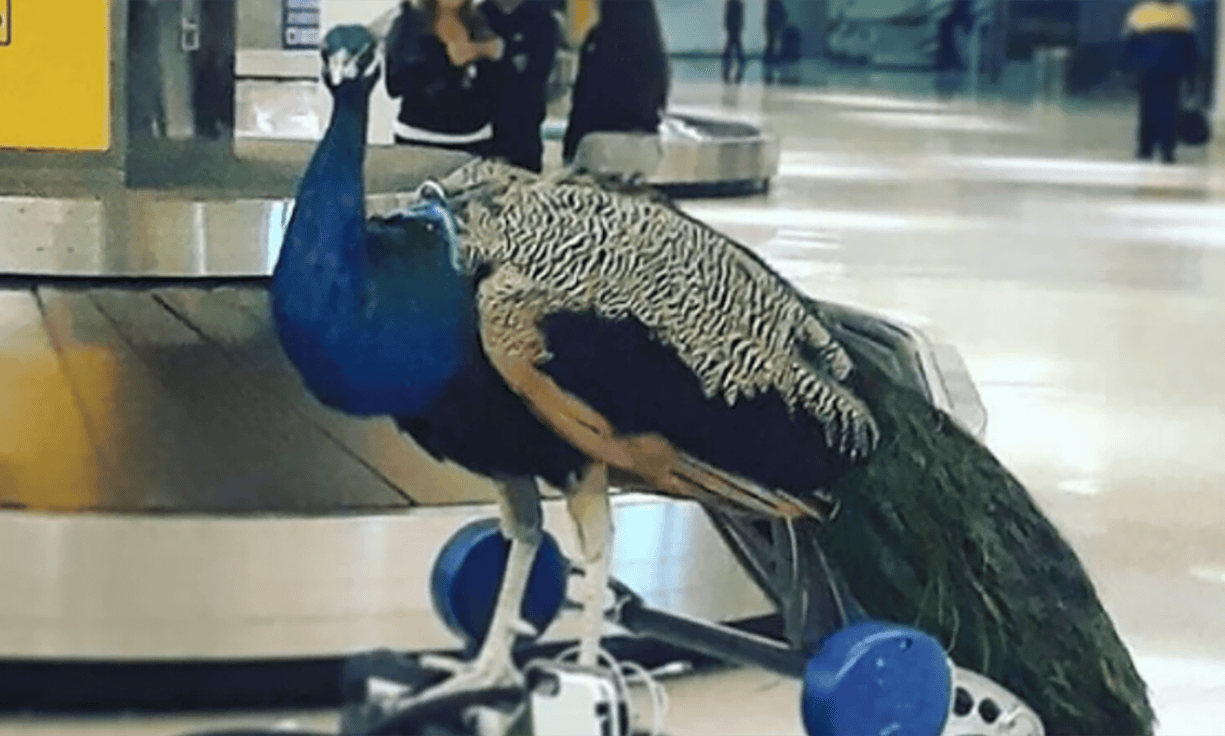
No horses or peacocks: US limits service animals on planes to dogs

TheGuardian.com - Full Article

Transportation department said passengers bringing unusual animals had ‘eroded public trust in legitimate service animals’

The government has decided that when it comes to air travel, only dogs can be service animals, and non-human companions used for emotional support don’t count.

The transportation department issued a final rule Wednesday that aims to settle years of tension between airlines and passengers who bring their pets on board for free by saying they need them for emotional support.

For years, the department required airlines to allow animals with passengers who had a doctor’s note saying they needed the animal for emotional support.

Airlines believed passengers abused the rule to bring a menagerie of animals on board including cats, turtles and pigs...

Read more here:
https://www.theguardian.com/business/2020/dec/02/dogs-service-animals-emotional-support-us-airlines?utm_source=ActiveCampaign&utm_medium=email&utm_content=Ten+Sixty+Stables+%7C+Toronto+Equestrian+Downtown+%7C+Racing+World+Series+%7C+Horses+and+Depression+%7C+National+Equine+Traceability&utm_campaign=HS-Enewsletter2020-Friday+Dec+4

Friday, December 04, 2020

Researchers shine spotlight on two proteins crucial to exercise in horses

HorseTalk.co.nz - Full Article

December 2, 2020
Horsetalk.co.nz

Researchers have taken preliminary steps toward unravelling the roles of two important regulatory proteins produced by muscle cells during exercise in horses.

The Polish research focused on 20 purebred Arabian horses, half of whom were in racehorse training and the remainder being conditioned for Endurance contests.

Sylwester Kowalik and his colleagues from the University of Life Sciences said skeletal muscle is considered the largest endocrine organ determining the maintenance of energy balance.

Adaptive changes in skeletal muscles in response to exercise affect the production, as well as the secretion, of proteins known as myokines, which play a crucial role in energy expenditure.

Kowalik and his colleagues carried out a preliminary study to investigate the impact of two different types of exercise on the circulating level of two myokines, myostatin and irisin, in horses...

Read more here:
https://www.horsetalk.co.nz/2020/12/02/spotlight-proteins-exercise-horses/

Monday, November 30, 2020

Understanding Choke in Horses

Thehorse.com - Full Article

Chokes are common equine emergencies with potentially serious consequences. Here’s what you need to know.

Posted by Lillian M.B. Haywood, VMD, CVMA | Nov 27, 2020

Esophageal obstruction, or “choke,” is a common equine emergency. Unlike in human medicine, where choking refers to a tracheal (or windpipe) obstruction, choke in horses refers to an obstruction of the esophagus, the muscular tube that carries food from the mouth to the stomach. The most common sign horse owners recognize is feed material coming from the nostrils, although they might also notice choking horses hypersalivating, retching, not eating, acting colicky, or coughing. Chokes can have serious consequences, so it is important to have your veterinarian evaluate your horse as soon as possible.

Most commonly, chokes occur when horses eat concentrated feed too quickly without chewing it appropriately. The feed doesn’t get softened with saliva and forms a firm bolus that gets lodged in the esophagus. However, esophageal obstruction can also occur with hay or straw, hard treats, carrots, or nonfood objects. Anatomical problems, such as poor dentition and abnormal esophagus anatomy, can also predispose a horse to choking...

Read more here:
https://thehorse.com/194641/understanding-choke-in-horses/?utm_medium=Old%20horse%20enews&utm_source=Newsletter

Wednesday, November 25, 2020

Early Education: Instilling a Foundation of Trust and Confidence

HorseSport.com - Full Article

The Fox Hollow program teaches future show horses how to handle pretty much anything through gradual exposure to scary stimuli.

By: Shawn Hamilton | November 24, 2020

After a hiatus from their Hanoverian breeding business, Sally and Garry Moore found themselves missing the young horses around their 100-acre farm in Castleton, Ontario. Taking in a foal for a friend laid the stepping-stone to Fox Hollow Stable’s unique service of not only weaning foals, but also laying a foundation of trust and confidence through gradual exposure to stressful or scary stimuli.

Sally worked at a Hanoverian breeding facility as a young girl, where she fell in love with the breed. In 1994 she and Garry purchased the farm and had their first foal in 2002. The work they did with their own foals earned them a reputation of having well-behaved youngsters. In 2013, they retired from the breeding industry completely. The next spring, as a favour to a friend, they took on a foal she wasn’t quite sure how to raise ‒ and they were hooked once again...

Read more here:
https://horsesport.com/magazine/behaviour/early-education-instilling-foundation-trust-confidence/

Friday, November 20, 2020

Road to the Tevis Cup Post #19: Prerequisites for riding the Sierra Nevada

JessicaEBlack.org - Full Article

by Jessica Black
November 19, 2020

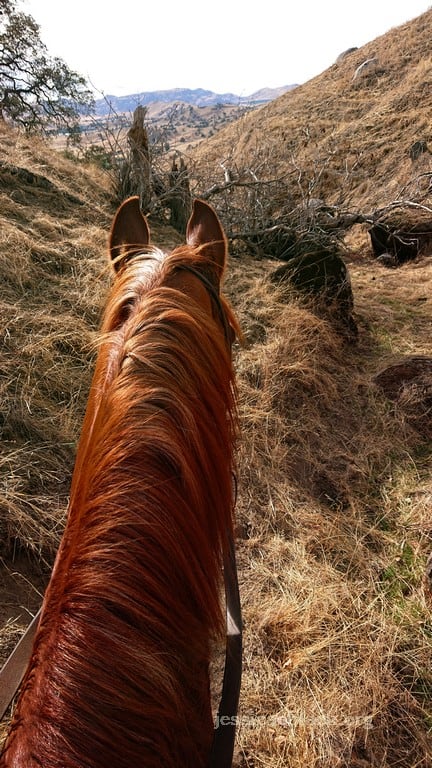
Well.. I suppose technically I mean prerequisites for riding the Sierra Nevada foothills. I’m about 10 miles from Sequoia National Forest. The training barn is at an elevation of ~770 feet. The gate to the cattle ranch adjacent to us is at ~890 feet. My closest riding loop rises to 1860 in a mile (a bit more than half a mile as the crow flies). My current riding (climbing) goal is Hatchett Peak, at 3,261 feet, 2.50 miles as the crow flies.

Yesterday I got about halfway to Hatchett Peak, in the distance it will really take us. I rode about 2.5 miles along our eventual trail, and then headed home. Fantazia is not yet fit enough to go the whole way. Yesterday’s ride was 5.50 miles in 2 hours. Total elevation gain = 1,650 feet. We weren’t in a hurry, we explored trails and rocky ravines. I managed to scare myself many times… Fantazia had to back up, turn leaving a specific foot on the trail, and let me get off and lead. She scrambled up a very steep rocky slope behind me, and did not step on me when I fell.

I was very grateful to have a smart, seasoned horse. And I thought I should make a list of the abilities a horse should possess before it is taken out on these hills. Horses vary in temperament, but you can teach them to be smart, to think, and to listen to the rider when things get scary...

Read more here:
https://jessicaeblack.org/prerequisites-for-riding-the-sierra-nevada-foothills/

Tuesday, November 17, 2020

Is There any Benefit to Feeding Oats?

Horse-canada.com - Full Article

If your horse has nutrient requirements that are higher than what is being met with hay alone – particularly energy, oats can be an excellent option.

By: Shannon Pratt-Phillips, PhD | April 28, 2016

Yes – if your horse needs them! Of all the cereal grains (e.g. corn, barley, wheat, etc.) oats have the most appropriate nutritional profile for horses. They are an excellent source of calories, and have a better protein and amino acid profile than many other grains. They are higher in fat and fibre (thanks to the hull) and are, therefore, lower in non-structural carbohydrates (NSC) than most other grains. They are well digested within the horse’s small intestine, even with little processing (as long a horse has good teeth!) and, therefore, pose a lower risk of sugars reaching the large intestine and contributing to colic or laminitis. Also, because of their lower NSC content, they are not considered a “hot” feed...

Read more here:
https://horse-canada.com/magazine/nutrition/is-there-any-benefit-to-feeding-oats/

Monday, November 16, 2020

Binge Watch the Equus Film & Arts Fest from Home

HorseNetwork.com - Full Article

Gretchen Lida
November 13, 2020

Like many events, the 2020 EQUUS Film & Arts Fest is going virtual this year. Unlike many events in 2020, this one is perfectly suited for the at-home experience. Featuring 50 plus films, 60 books, 13 artists, six podcasts and more, it’s 10 days of jam-packed equestrian escapism—all from the comfort of your couch. And it starts now!

The EQUUS Film & Arts Fest launches today, Friday, November 13 and runs through Sunday, November 22.

Bringing together horse lovers around the world, the theme for 2020 is appropriately “Pony On,” reminding us to keep working and causing mischief even when times are hard. One common thread in this year’s submissions is the idea that horses connect us, serving as bridges across language, culture, and political divides in ways that very little else can...

Read more here:
https://horsenetwork.com/2020/11/binge-watch-the-equus-film-arts-fest-from-home/?utm_source=Horse+Network+Email+List&utm_campaign=bda166154e-nov_13_2020_COPY_01&utm_medium=email&utm_term=0_5694ca6b0c-bda166154e-84641243&goal=0_5694ca6b0c-bda166154e-84641243&mc_cid=bda166154e&mc_eid=b3c9897994

Saturday, November 14, 2020

Researchers probe the metabolic consequences of Endurance racing

Horsetalk.co.nz - Full Article

November 14, 2020 Horsetalk.co.nz

Researchers are hoping to establish a metabolic performance profile for Endurance horses, which could ultimately be used to assess their readiness to compete.

The pilot study, involving 62 horses, used molecular-based techniques to determine the effects of endurance on metabolite levels. In doing so, they painted a picture of the demands of Endurance riding in greater detail than ever before.

Endurance rising involves competitive contests over distances of up to 160km. Races are broken into a series a loops, with veterinary monitoring of horses at the completion of each loop. The elimination rate is typically 30-70 percent, with lameness, dehydration and metabolic issues being the main causes.

It is therefore crucial that horses are metabolically fit to compete.

The study, a collaborative effort between entities under the umbrella of the Qatar Foundation, used metabolomics to assess the metabolic status of competition horses...

Read more here:
https://www.horsetalk.co.nz/2020/11/14/researchers-metabolic-endurance-racing/

Thursday, November 12, 2020

Girth Aversion in Horses: Gastric Ulcers Pinpointed

KER.com - Full Article

February 19, 2020
By Kentucky Equine Research Staff

Saddle enough horses and you will run into one that detests girthing. A horse that is sensitive to cinch-fitting, sometimes called a “girthy horse,” usually displays signs of protest, including tossing the head, pinning ears, wringing the tail, stomping a foreleg, kicking out with a hind leg, and worse. Is girthiness an expression of resistance, a sign of shaky work ethic, or could there be an underlying cause?

Veterinary researchers set out to determine the causes of girthiness in a retrospective study of 37 horses admitted to the University of California, Davis. Although identifying the exact cause for girth aversion remains a challenge, 12 of the horses studied were diagnosed with gastric ulceration...

Read more here:
https://ker.com/equinews/girth-aversion-in-horses-gastric-ulcers-pinpointed/?partner=ker&utm_source=KER+Newsletter&utm_campaign=d5e802c878-Focus_on_Ulcers&utm_medium=email&utm_term=0_0d95781dfc-d5e802c878-11166

Learning Arabian

GoPony.me - Full Article

November 5, 2020 / Ashley Wingert

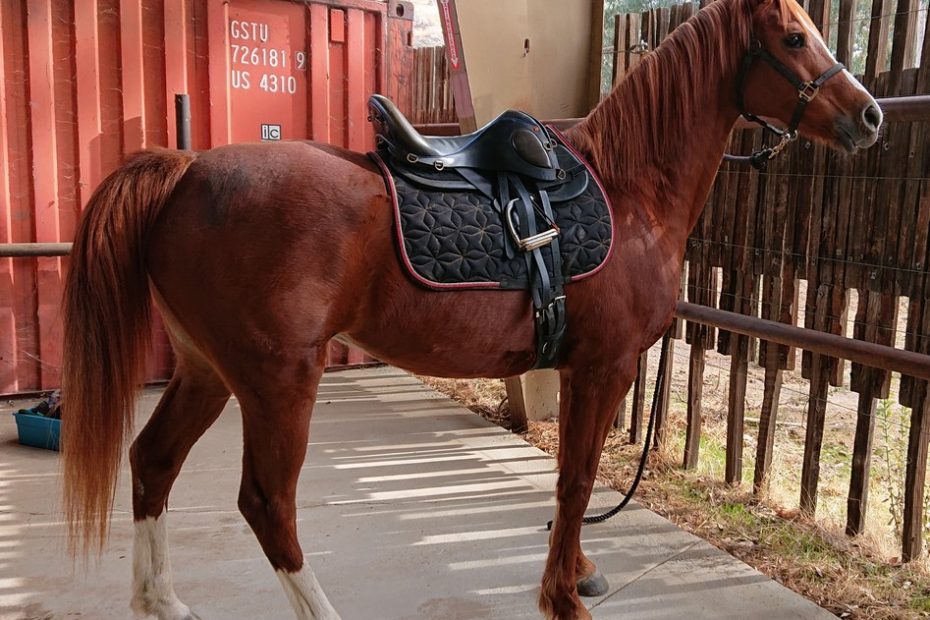
In all fairness to mares, I’ve actually had to have “that” pre-ride chat with more geldings over the years. Granted, the proportion of mares to geldings is significantly smaller, but I don’t feel like I’ve been handed as many shenanigans by the mares. But then I am ardently biased towards Team Mare, so take it for what you will.

That said, last weekend involved full-blown Arabian Raptor Snorts after Liberty decided that large rocks were her mortal enemy. It was probably the spookiest she’s ever been, but even then, I can’t complain when the worst she does is stop and stare and snort, or maybe veer sideways a couple feet if the trail is wide enough. And what I really love is that she doesn’t overreact. Once she’s past something, it’s over and forgotten about, and she doesn’t hold onto worry or angst or keeping ramping up. I’ve said it before that she’s a very “thinky” horse and appreciates some time and no pressure to work something through in her brain. She is bold and brave but she’s also sensitive, and too much pressure will get her back up and make her start to resist...

Read more here:
https://gopony.me/2020/11/05/learning-arabian/

Tuesday, November 10, 2020

Remembering Sgt Reckless: USMC War Horse

BigGeekDad.com - See Video

Sgt Reckless was a Marine Corps Horse who served heroically in the Korean War. Sgt Reckless was featured in The Saturday Evening Post and Life Magazine for her heroic actions during the war. Sgt Reckless was promoted to Staff Sergeant by the Commandant of the US Marine Corps after the war ended and served out her final days with the 1st Marine Division at Camp Pendleton, CA.

Active rest: Three ways to keep your horse in shape while preventing burnout

EquusMagazine.com - Full Article

Changing up your horse’s activities can be better for his body and mind than giving him time off. Biomechanics expert Hilary Clayton, BVMS, PhD, explains why.

JEANNE O'MALLEY
NOVEMBER 9 2020

In Australia we have a saying that goes, “A change is as good as a spell.” It means that if you are feeling tired, don’t stop and rest---do something different. Now, if you’re exhausted from cleaning stalls, switching to cleaning water buckets probably doesn’t sound particularly restful, but the “change is good” principle is worth keeping in mind when training horses.

Developing new skills, whether they are needed to succeed in competition or to simply perform well as a trail or pleasure horse, does require a bit of work. And the best route often involves drills designed to produce incremental improvements in movement, gait or fitness with each session. It then becomes easy to adopt a mindset that makes meeting goals the priority while minimizing other considerations.

“Riders want to practice and refine their skills, and they are probably worried about disrupting the training program if they do anything but formally train,” says Hilary M. Clayton, BVMS, PhD, DACVSMR, FRCVS, who held the Mary Anne McPhail Dressage Chair in Equine Sports Medicine at Michigan State University for 17 years. “So every day they go into the arena, perform the same routine, then take the horse back to the stall.”

This kind of routine can take a toll on a horse, both mentally and physically. Not only is he likely to get bored, but his muscles, tendons and ligaments don’t have time to fully recover from the demands placed on them. If a horse is asked to exert himself in the same way day after day, then his body doesn’t have a chance to repair itself, which means that tiny injuries accumulate...

Read more here:
https://equusmagazine.com/behavior/active-rest-for-horses

Saturday, November 07, 2020

Qatar: QF researchers explore technique to assess readiness of horses before race

menafn.com - Full Article

11/6/2020

(MENAFN - Gulf Times) In a collaborative effort between Qatar Foundation entities, researchers from its Equine Veterinary Medical Centre (EVMC), Al Shaqab's endurance department and Weill Cornell Medicine-Qatar (WCM-Q), have been exploring the use of a technique called 'metabolomics' to assess the readiness of a horse before a race. 'Metabolomics is a relatively new technology used to measure hundreds of small molecules called metabolites, found in a biological sample. Metabolites are the products of constantly occurring and life-sustaining chemical reactions in all living organisms.

'Their production and removal from the blood stream is dependent on multiple factors including genetics, diet and lifestyle. Any change in these factors is reflected by a change in specific metabolite levels, which allows them to be used as biomarkers, said Dr Tatiana Vinardell, head of Research and Education, EVMC.

A pilot-study on equine metabolomics was inspired by Prof Karsten Suhre, director of Bioinformatics Core at WCM-Q and his desire to create a 'health and fitness passport for athletes. It turns out that horse endurance races are just the ideal test environment to explore such an idea.

'Every living organism has a metabolic fingerprint and by frequently monitoring this fingerprint, we can establish the reference or baseline metabolic readings indicative of that organism's wellness. 'Any changes in the health of the organism can be detected by comparing their metabolic state to their established baseline. If a considerable change is seen between the two, it can be indicative of a health problem that should be further investigated, said Prof Suhre.

Metabolomics research in human athletes has provided important insights into energy demands and training physiology, allowing scientists to identify novel biomarkers associated with better performance...

Read more here:
https://menafn.com/1101084940/Qatar-QF-researchers-explore-technique-to-assess-readiness-of-horses-before-race

Helmet Head: Why You Need to Buckle Up Every Time You Ride

Horse-canada.com - full article

Riding is one of the most dangerous sports and you need to protect your noggin. Here are some important (and surprising) facts about helmets.

By: Kim Izzo | October 21, 2020

We love our horses and we love riding. But as much as we are passionate about our sport and may hold onto the glamorous image of our hair blowing in the wind as we gallop with our equine partner across a meadow, along a beach, or towards a jump, safety is also something we should be equally passionate about.

Horseback riding at all ages and levels is one of the most dangerous sports we can participate in. According to Parachute Canada (Canada’s national charity dedicated to injury prevention), our horses are fast, really fast, and some can reach speeds up to 60 km/h. Impressive, right?

This fact has another side to the thrill ‒ we’re talking the spill. There are more injuries per hour in the saddle than during motorcycle or auto racing. Parachute offers up these sobering stats: Per 1,000 injuries in equestrian activities, two are catastrophic – meaning the person has severe injuries to head or spinal cord that result in life-altering impairment or death.

Approximately 70 per cent of equestrian deaths are the result of head injury...

Read more here:
https://horse-canada.com/magazine/rider-health/helmet-head-buckle-up-every-time-you-ride/

Thursday, November 05, 2020

Have donkey, will travel: Woman’s intrepid 1923 journey revealed

Horsetalk.co.nz - Full article

November 3, 2020
Horsetalk.co.nz

The intrepid journey of a young woman who took on a walking tour of England and Scotland in 1923 with a pack donkey as her travelling companion has been documented in a new book.

Eve’s Journey tells the story of Eve (Doris) Brackenbury, 30, who recorded her trip in a surprisingly intimate diary. Described as a “post-WWI Bohemian”, Eve’s quirky interests, courage and curiosity, and a spark of wickedness and inclination to shock people are revealed.

Her granddaughter, Gill Brackenbury, says Eve’s story captured her imagination. “Doris, or Eve as she was also known, did not seem to comfortably fit, nor did she seem to accept, the social norms of her generation. She was very human, a determined and rather independent thinker, and controversial at times...”

Read more here:
https://www.horsetalk.co.nz/2020/11/03/have-donkey-will-travel-intrepid-1923-journey/?utm_source=ActiveCampaign&utm_medium=email&utm_content=Winter+Blanket+Guide+%7C+Royals+Helping+Working+Horses+%7C+China+s+Horse+Boom+%7C+Equine+Industry+Symposium&utm_campaign=HC_Enewsletter2019-Wednesday+Nov+4%2C+2020

Tuesday, November 03, 2020

Things to consider before removing your horse’s shoes this winter

Horseandhound.co.uk - Full Article

Alex Robinson
26 October, 2020 16:24

Is it right for shod horses to have their shoes taken off over the winter months during a break from work? Richard Stephenson MRCVS weighs up the options…

Horses, whether shod or not, have a tough, horny hoof capsule, while human feet, unless accustomed to walking barefoot, are covered with soft, sensitive skin. However, we need to remember that many horses will struggle to make the transition from being shod to going without shoes and, in some cases, they will suffer pain and discomfort to a level which is simply unacceptable. It is fashionable in some circles to view unshod horses as “natural” and shod horses as being the victims of an outdated and harmful practice. But is it natural for a modern horse to be unshod, and what are the potential benefits and pitfalls?

While shoeing is frequently described as a necessary evil, it is important to appreciate that the modern horse is the result of many centuries of selective breeding which has rarely concentrated on hoof quality. With the possible exception of some native pony breeds, there is little “natural” about our horses. We must also recognise that even the so-called native pony has an enormous variety of different environments to cope with in different parts of the UK. One foot management approach cannot be made to fit all circumstances or all horses.

Before thinking about taking shoes off during winter, we need to ask why we put them on in the first place. Farriers will say that shoes offer protection from wear and provide grip — for the majority of horses in active work this is true, but do they really need shoes while at rest?...

Read more here:
https://www.horseandhound.co.uk/features/barefoot-horse-winter-728580?utm_source=ActiveCampaign&utm_medium=email&utm_content=Dayton+Gorsline+on+Youth+Development++%7C++Winter+Survival+Guide++%7C++Canadians+Shine+in+the+South++%7C++Equine+Industry+Symposium&utm_campaign=HS-Enewsletter2020-Monday+Nov+2

Friday, October 23, 2020

This invasive weed spells trouble for horses

EquusMagazine.com - Full Article

Wild parsnip, which is found throughout the United States, can cause phototoxic reactions in horses even if they don't eat it.

CHRISTINE BARAKAT
UPDATED:OCT 16, 2020 • ORIGINAL:OCT 15, 2020

Researchers in Utah have discovered that wild parsnip—an invasive weed found throughout the United States—can cause phototoxic reactions in horses even if they don’t eat it.

Many photosensitive skin reactions occur after a horse ingests a plant that contains photodynamic compounds. When ultraviolet rays from sunlight pass through the horse’s pink skin, they interact with the compounds in the skin and blood, resulting in painful burns with extensive blistering.

However, Utah State University and U.S. Department of Agriculture researchers recently determined that horses and goats may develop photosensitive skin reactions after simply coming in contact with the sap of wild parsnips...

Read more here:
https://equusmagazine.com/horse-care/danger-of-wild-parsnip?utm_campaign=EQU%20%20-%20NL&utm_medium=email&_hsmi=97987781&_hsenc=p2ANqtz--70i7uIBJNbgIUYim50XBJmHZT7HIuMNBJ_X8Pd1ooAWga_HOdzQ2uylor-ngimU8ltWzwupQKCMmxluMDViCooNQfhw&utm_content=97987781&utm_source=hs_email

Wednesday, October 21, 2020

Want a Better-Behaved Horse? Consider Feeding a Low-Starch Diet

Thehorse.com - Full Article

A Virginia Tech researcher investigated the impact of diet on lesson horses. Here’s what she found.

Posted by Alexandra Beckstett, The Horse Managing Editor | Jul 30, 2019

The amount of starch in a horse’s diet can affect him both behaviorally and physiologically. To better understand its effects, Tanner Price, a graduate student at Virginia Tech, in Blacksburg, assessed university riding program horses’ behavioral and metabolic responses to diets with varying fat and starch levels. She shared her findings at the 2019 Equine Science Society Symposium, held June 3-6 in Asheville, North Carolina. In her study, Price split 20 riding horses into five groups of four. Each group received a different starch-to-fat ratio in their diet, ranging from 7.1% to 14.3% starch. Throughout the 21-day period, all horses were fed twice daily, housed individually in stalls, and ridden in regular collegiate lessons (beginner to advanced equitation and hunter/jumper classes).

Price asked riders and instructors that were blind to the horses’ treatment groups to complete a behavior survey after each lesson. They evaluated each horses’ behavior when being caught, led, and groomed, as well as his energy levels while ridden, reaction to leg aids, relaxation, submission, and more...

Read more here:
https://thehorse.com/176821/want-a-better-behaved-horse-consider-feeding-a-low-starch-diet/?utm_medium=vet+and+professional+enews&utm_source=Newsletter