Worm Control Series at Horsetalk.co.nz
Denmark's approach to parasites in horses should have owners around the world thinking about how well they manage the worm burden in their animals.
Horse owners in Western countries largely take for granted the fact they can walk into any saddlery or veterinary clinic and buy a drench. There are unlikely to be questions about what parasites you intend targeting or whether the active ingredients in that particular brand will do the job you intend.
Denmark changed all that in 1999.
Over-the-counter sales went out the window and sales of drenches, more properly called anthelmintics, became prescription only. It placed worm control firmly back under the control of veterinarians, who have to be satisfied a horse's worm burden is such that it requires dosing.
Many horse owners would see this as a bad idea and only adding to the cost of worm control in their animals.
However, Denmark may not be the last Western country to tighten controls over drenches, as concern grows worldwide over parasite resistance.
The unfortunate reality is that many horse owners use drenches inappropriately and, in doing so, are fuelling the growth of parasite resistance to drenches.
[...more]
Monday, February 02, 2009


Sunday, February 01, 2009
Buddy Heaters Can be Dangerous
Isurfhopkinsco.com
Sunday, 01 February 2009
Using a Buddy Heater with propane tank can be dangerous and needs to be where you can properly watch it at all times. DO NOT have one one while sleeping or away from the room.
Returning back from an endurance trail ride greated by chaos as shown by this photo while owner is walking her horse.
Source: Passed along thanks to trail rider Janis Durham and Kentucky Horse Council http://www.kentuckyhorse.org/

Just back from an endurance ride in Hahira, GA. Sunday morning as we were packing up someone yelled to call 911. I looked out and this rig had smoke coming out of the vents. Ran down there with a fire extinguisher and another fellow and I emptied our extinguishers into the door of the living quarters, but the fire was already established and the propane tanks started catching. From first smoke to melted trailer took maybe 15 min. It was pretty shocking. The owner was out walking her horse at the time of the fire. It started with a "Mr. Buddy" propane space heater left running in the center of the living area. The first person there said they saw smoke, opened the door and the heater was melted in the middle of the floor and the bedding had already caught. It *appears* to have been heater malfunction.
Since the truck was attached and there was no way to unhook it we were able to learn that the heavier (steel?) metal in the gooseneck area apparently shielded the truck. It only had melted tail lights and I would guess some paint damage but it wasn't obvious from the distance. The 2 propane tanks under the gooseneck did not appear to explode thought they may have released their contents and added to the inferno. The fire spead so fast nobody was even able to yank the saddles out of the back even though there were people all around trying to help.

I did learn that my small fire extinguisher is inadequate for anything but a pan fire and I will be replacing it with a considerably larger one for my trailer. I also will *never* leave propane running when I'm outside and a family member is inside asleep again! A combination smoke/CO2 alarm would have been helpful too.
Sunday, 01 February 2009
Using a Buddy Heater with propane tank can be dangerous and needs to be where you can properly watch it at all times. DO NOT have one one while sleeping or away from the room.
Returning back from an endurance trail ride greated by chaos as shown by this photo while owner is walking her horse.
Source: Passed along thanks to trail rider Janis Durham and Kentucky Horse Council http://www.kentuckyhorse.org/
Just back from an endurance ride in Hahira, GA. Sunday morning as we were packing up someone yelled to call 911. I looked out and this rig had smoke coming out of the vents. Ran down there with a fire extinguisher and another fellow and I emptied our extinguishers into the door of the living quarters, but the fire was already established and the propane tanks started catching. From first smoke to melted trailer took maybe 15 min. It was pretty shocking. The owner was out walking her horse at the time of the fire. It started with a "Mr. Buddy" propane space heater left running in the center of the living area. The first person there said they saw smoke, opened the door and the heater was melted in the middle of the floor and the bedding had already caught. It *appears* to have been heater malfunction.
Since the truck was attached and there was no way to unhook it we were able to learn that the heavier (steel?) metal in the gooseneck area apparently shielded the truck. It only had melted tail lights and I would guess some paint damage but it wasn't obvious from the distance. The 2 propane tanks under the gooseneck did not appear to explode thought they may have released their contents and added to the inferno. The fire spead so fast nobody was even able to yank the saddles out of the back even though there were people all around trying to help.
I did learn that my small fire extinguisher is inadequate for anything but a pan fire and I will be replacing it with a considerably larger one for my trailer. I also will *never* leave propane running when I'm outside and a family member is inside asleep again! A combination smoke/CO2 alarm would have been helpful too.
Wednesday, January 28, 2009
Saddle fitting - the inside story
Saddle fitters blog
Saddle Recommendation for Arabee and Nicole
Next in the series of saddle recommendations are Nicole and her horse Arabee (you can follow their adventures on Nicole's blog: http://www.adventuresonarabee.blogspot.com/). Nicole is doing endurance and wants to find a saddle that will fit better than the one she has now:
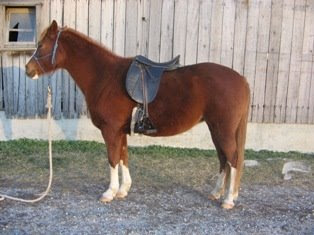
As you can see, the saddle's sitting pommel-high; some of that is due to the fact that the saddle's too far forward (I'd like to see it about 3 fingers' width further back, but given Arabee's conformation, I'd bet most saddles tend to slide forward). Another reason it's pommel-high is that the tree is too narrow. In the next photo, I've outlined the angle of the tree in green, and the angle of Arabee's back in red. You can see they don't match up.
[...more]
Saddle Recommendation for Arabee and Nicole
Next in the series of saddle recommendations are Nicole and her horse Arabee (you can follow their adventures on Nicole's blog: http://www.adventuresonarabee.blogspot.com/). Nicole is doing endurance and wants to find a saddle that will fit better than the one she has now:
As you can see, the saddle's sitting pommel-high; some of that is due to the fact that the saddle's too far forward (I'd like to see it about 3 fingers' width further back, but given Arabee's conformation, I'd bet most saddles tend to slide forward). Another reason it's pommel-high is that the tree is too narrow. In the next photo, I've outlined the angle of the tree in green, and the angle of Arabee's back in red. You can see they don't match up.
[...more]
Tuesday, January 27, 2009
Biotin: Does it Work?
Thehorse.com - Full Article
by: Stacey Oke, DVM, MSc
March 01 2008, Article # 7559
Here's what we know about the efficacy of this popular hoof supplement
Conditions such as chronic laminitis, cracked hooves, or dry, brittle feet incapable of holding shoes are a common and time-consuming problem for owners, trainers, and veterinarians. Biotin is a popular nutritional supplement administered to horses to promote and maintain the growth of healthy hooves and coats. But does it work?
"In the equine world, biotin is revisited every few years," explains Ray Geor, BVSc, PhD, an equine nutritionist, the Paul Mellon Distinguished Professor of Agriculture, and director of research at the Middleburg Agricultural Research and Extension Center, Virginia Polytechnic Institute and State University. "It is rather frustrating because no new information is available to help owners decide whether or not they should be supplementing with biotin."
In this article The Horse presents an in-depth look at the current status of biotin supplementation in horses.
Biotin Basics
Biotin is a water-soluble B vitamin that plays an important role as an enzymatic cofactor in metabolism, meaning it is an inorganic complement to the enzyme reaction involved in metabolism. Horses, humans, and other mammals are incapable of synthesizing biotin. This vitamin must be obtained either through the diet or via the absorption of biotin that is synthesized by intestinal bacteria.
More...
by: Stacey Oke, DVM, MSc
March 01 2008, Article # 7559
Here's what we know about the efficacy of this popular hoof supplement
Conditions such as chronic laminitis, cracked hooves, or dry, brittle feet incapable of holding shoes are a common and time-consuming problem for owners, trainers, and veterinarians. Biotin is a popular nutritional supplement administered to horses to promote and maintain the growth of healthy hooves and coats. But does it work?
"In the equine world, biotin is revisited every few years," explains Ray Geor, BVSc, PhD, an equine nutritionist, the Paul Mellon Distinguished Professor of Agriculture, and director of research at the Middleburg Agricultural Research and Extension Center, Virginia Polytechnic Institute and State University. "It is rather frustrating because no new information is available to help owners decide whether or not they should be supplementing with biotin."
In this article The Horse presents an in-depth look at the current status of biotin supplementation in horses.
Biotin Basics
Biotin is a water-soluble B vitamin that plays an important role as an enzymatic cofactor in metabolism, meaning it is an inorganic complement to the enzyme reaction involved in metabolism. Horses, humans, and other mammals are incapable of synthesizing biotin. This vitamin must be obtained either through the diet or via the absorption of biotin that is synthesized by intestinal bacteria.
More...
Equestrian culture may be fading into the sunset
LA Times
Urban sprawl has been encroaching on the equestrian lifestyle for decades, but with a string of stables closing across Southern California, horse lovers say the threat seems more dire than ever.
By Jessica Garrison
January 26, 2009
As the horse named Sombrero strained up a hill above Hansen Dam, Mary Benson leaned forward over his neck and surveyed the stunning landscape of sun-dappled oaks and trickling mountain streams.
But the view broke her heart: A subdivision where horse trails used to be. Condos and houses that used to have stables behind them. One sign after another of the disappearing horse culture in her neighborhood.
"We are losing an irreplaceable piece of the American culture . . . and the Western heritage," Benson said.
The problem isn't confined to the northeast San Fernando Valley. A flurry of recent stable closures has generated talk where equestrians gather about whether the Southern California horse culture can survive the sprawl of suburbia and its relentless appetite for onetime ranch land.
In December, a collection of ramshackle stalls near the city of Industry abruptly shut down, forcing out a small group of Mexican immigrants who had boarded their horses there at low cost.
The stables had been a gathering place for vaqueros from Zacatecas and Guerrero, and the closure prompted some of the families to give up their horses altogether. The loss follows the disappearance of many other stables along the San Gabriel River watershed.
Weeks later, officials in Orange County announced they might turn the county's Fairgrounds Equestrian Center into a parking lot -- the latest of many Orange County casualties. "There used to be stables all up and down the Santa Ana River, more than 20," said Jim Meyer of the advocacy group Trails4All. "Now there are two left . . . and one of them is up for sale."
The picture in other urban-adjacent areas around the state is similar.
Earlier this month, the Cevalo Riding Academy in San Jose closed its doors -- the land prized for homes over equines even in this post-bubble environment.
Other stables giving way to homes or parking lots include the Wild Horse Valley Ranch in Napa, the equestrian showgrounds at the state fair in Sacramento and San Diego's famed Miramar Stables, said Deb Balliet of the Equestrian Land Conservation Resource, an advocacy group based in Lexington, Ky.
It's happening all over the country, but California "is being really hard hit," Balliet said.
To be sure, equestrians have been complaining about threats to their lifestyle almost as long as Southern Californians have been moaning about traffic.
A 1961 article in The Times quoted rider D.C. McCarthy declaring that the "land is simply too valuable for uses such as this." He predicted that horses in Los Angeles would soon go the way of the Valley's once-predominant citrus groves.
That hasn't quite happened. But there are certainly fewer stables in the region than there were in the 1960s.
McCarthy, for example, talked to a reporter as he rode out of a stable at 3205 Los Feliz Blvd., near Griffith Park, an address that now holds luxury apartment buildings.
Some horse owners say they fear more than just the disappearance of stables.
"This is a dying phenomenon," said Barbara Blanco, a Loyola law professor and amateur horsewoman. "I am convinced we are the last generation that will keep horses in our yards."
Horses are "increasingly a very expensive luxury," she said.
Other horse owners say that prediction may be a bit dire -- there are still dozens of stables and thousands of horses in Southern California, although precise numbers are difficult to come by. (The city of Los Angeles is among the only jurisdictions to register horses; it has a record of 1,793 -- an increase over last year, but one that officials attribute not necessarily to more equines but to better outreach to get owners to fill out paperwork.)
Still, many say it is time for government to do more to preserve horse keeping.
Kristene McGovern, a board member with the Equestrian Coalition of Orange County, said her group wants county officials to help protect stables on public land.
In the San Fernando Valley, Benson and others have formed an advocacy group, the Los Angeles Horse Council, to argue for zoning and other changes that could benefit horse owners.
The third-generation horse owner estimates that more than 50 stables in Lake View Terrace, Sylmar and Sun Valley have closed in the last decade.
That should be of concern even to those who wouldn't dream of climbing onto a horse's back, she said.
According to Benson, the vanishing of horses is a sign that "we are separated from the land. . . . People are afraid of the dirt. They are afraid of the dark. They have no sense of their place in the natural world."
Benson thinks there are a few things government could do to help horses and their owners. One item on her wish list is changing property-tax rules so that horse keeping could be considered an agricultural use (it is currently a commercial use in most instances), allowing horse operators to qualify for significant tax benefits.
The group also wants to find ways to prevent horse property from being rezoned for commercial uses, making it more difficult for stable owners to sell their land for shopping centers or parking lots. But that move is likely to be controversial because it could hurt property values.
The group has met with a handful of local elected officials to press its case, including Los Angeles City Councilwoman Wendy Greuel and state Sen. Alex Padilla.
Past efforts at preventing zoning changes have met with little success.
Even as she throws herself into equine activism, Benson sounds fatalistic. As her horse picked his way through Little Tujunga Wash on a recent morning, she flicked her heels against his flanks, pulled on the reins with her left hand and directed the animal toward where the wash passed under whizzing cars on the Foothill Freeway.
With her long gray hair and steely gaze, Benson sat on her horse with a firm authority over the animal -- even if she can't control what happens to his environment.
"I grew up riding these trails," Benson said. But when she was young, she said, the trails stretched farther and the whole community had horses and would ride them together.
Although her daughter loves to ride, her husband and son don't. So now when Benson rides, she often rides alone.
jessica.garrison@latimes.com
Urban sprawl has been encroaching on the equestrian lifestyle for decades, but with a string of stables closing across Southern California, horse lovers say the threat seems more dire than ever.
By Jessica Garrison
January 26, 2009
As the horse named Sombrero strained up a hill above Hansen Dam, Mary Benson leaned forward over his neck and surveyed the stunning landscape of sun-dappled oaks and trickling mountain streams.
But the view broke her heart: A subdivision where horse trails used to be. Condos and houses that used to have stables behind them. One sign after another of the disappearing horse culture in her neighborhood.
"We are losing an irreplaceable piece of the American culture . . . and the Western heritage," Benson said.
The problem isn't confined to the northeast San Fernando Valley. A flurry of recent stable closures has generated talk where equestrians gather about whether the Southern California horse culture can survive the sprawl of suburbia and its relentless appetite for onetime ranch land.
In December, a collection of ramshackle stalls near the city of Industry abruptly shut down, forcing out a small group of Mexican immigrants who had boarded their horses there at low cost.
The stables had been a gathering place for vaqueros from Zacatecas and Guerrero, and the closure prompted some of the families to give up their horses altogether. The loss follows the disappearance of many other stables along the San Gabriel River watershed.
Weeks later, officials in Orange County announced they might turn the county's Fairgrounds Equestrian Center into a parking lot -- the latest of many Orange County casualties. "There used to be stables all up and down the Santa Ana River, more than 20," said Jim Meyer of the advocacy group Trails4All. "Now there are two left . . . and one of them is up for sale."
The picture in other urban-adjacent areas around the state is similar.
Earlier this month, the Cevalo Riding Academy in San Jose closed its doors -- the land prized for homes over equines even in this post-bubble environment.
Other stables giving way to homes or parking lots include the Wild Horse Valley Ranch in Napa, the equestrian showgrounds at the state fair in Sacramento and San Diego's famed Miramar Stables, said Deb Balliet of the Equestrian Land Conservation Resource, an advocacy group based in Lexington, Ky.
It's happening all over the country, but California "is being really hard hit," Balliet said.
To be sure, equestrians have been complaining about threats to their lifestyle almost as long as Southern Californians have been moaning about traffic.
A 1961 article in The Times quoted rider D.C. McCarthy declaring that the "land is simply too valuable for uses such as this." He predicted that horses in Los Angeles would soon go the way of the Valley's once-predominant citrus groves.
That hasn't quite happened. But there are certainly fewer stables in the region than there were in the 1960s.
McCarthy, for example, talked to a reporter as he rode out of a stable at 3205 Los Feliz Blvd., near Griffith Park, an address that now holds luxury apartment buildings.
Some horse owners say they fear more than just the disappearance of stables.
"This is a dying phenomenon," said Barbara Blanco, a Loyola law professor and amateur horsewoman. "I am convinced we are the last generation that will keep horses in our yards."
Horses are "increasingly a very expensive luxury," she said.
Other horse owners say that prediction may be a bit dire -- there are still dozens of stables and thousands of horses in Southern California, although precise numbers are difficult to come by. (The city of Los Angeles is among the only jurisdictions to register horses; it has a record of 1,793 -- an increase over last year, but one that officials attribute not necessarily to more equines but to better outreach to get owners to fill out paperwork.)
Still, many say it is time for government to do more to preserve horse keeping.
Kristene McGovern, a board member with the Equestrian Coalition of Orange County, said her group wants county officials to help protect stables on public land.
In the San Fernando Valley, Benson and others have formed an advocacy group, the Los Angeles Horse Council, to argue for zoning and other changes that could benefit horse owners.
The third-generation horse owner estimates that more than 50 stables in Lake View Terrace, Sylmar and Sun Valley have closed in the last decade.
That should be of concern even to those who wouldn't dream of climbing onto a horse's back, she said.
According to Benson, the vanishing of horses is a sign that "we are separated from the land. . . . People are afraid of the dirt. They are afraid of the dark. They have no sense of their place in the natural world."
Benson thinks there are a few things government could do to help horses and their owners. One item on her wish list is changing property-tax rules so that horse keeping could be considered an agricultural use (it is currently a commercial use in most instances), allowing horse operators to qualify for significant tax benefits.
The group also wants to find ways to prevent horse property from being rezoned for commercial uses, making it more difficult for stable owners to sell their land for shopping centers or parking lots. But that move is likely to be controversial because it could hurt property values.
The group has met with a handful of local elected officials to press its case, including Los Angeles City Councilwoman Wendy Greuel and state Sen. Alex Padilla.
Past efforts at preventing zoning changes have met with little success.
Even as she throws herself into equine activism, Benson sounds fatalistic. As her horse picked his way through Little Tujunga Wash on a recent morning, she flicked her heels against his flanks, pulled on the reins with her left hand and directed the animal toward where the wash passed under whizzing cars on the Foothill Freeway.
With her long gray hair and steely gaze, Benson sat on her horse with a firm authority over the animal -- even if she can't control what happens to his environment.
"I grew up riding these trails," Benson said. But when she was young, she said, the trails stretched farther and the whole community had horses and would ride them together.
Although her daughter loves to ride, her husband and son don't. So now when Benson rides, she often rides alone.
jessica.garrison@latimes.com
Monday, January 26, 2009
Shoeing for the job
TheHorse.Com
Book Excerpt: Shoeing for the Job
by: Heather Smith Thomas
January 26 2009, Article # 13508
There are many kinds of horseshoes; try to select shoes well suited to your horse's work. While a horse with a problem may need a farrier to create a special shoe, many horses get along fine with factory-made shoes.
Shoes should always be as light as is practical, taking into consideration the wear demanded of them, so that they interfere as little as possible with the normal flight of the horse's foot. Weight, no matter how it's added to the foot, tends to reduce speed and agility. Added weight can also make a minor deviation in foot flight more noticeable.
The normal flight of the foot is a relatively straightforward line. No horse's foot moves perfectly straight, but good leg conformation creates the most straightforward motion with the least wasted effort and movement. Any significant deviation from normal foot flight takes the form of an arc--either to the outside or inside of this relatively straight line. Adding weight to the foot in the form of a shoe will increase the arc because of the additional swing it makes. Ordinary shoeing thus accentuates a horse's foot flight and any gait defect.
Most horses never hit themselves when running barefoot (with short, properly worn hooves) but some will forge or interfere when shod due to the added weight of the shoe. A horse that tends to interfere (strike one front limb against the other, or one hind limb against the other hind) or forge (strike a front heel or sole with the hind toe) does so even worse when shod. The weight makes the horse's strides slightly longer and the arcs of foot flight even more pronounced. Thus, he must be carefully (correctively) shod to prevent these problems.
[...more]
Book Excerpt: Shoeing for the Job
by: Heather Smith Thomas
January 26 2009, Article # 13508
There are many kinds of horseshoes; try to select shoes well suited to your horse's work. While a horse with a problem may need a farrier to create a special shoe, many horses get along fine with factory-made shoes.
Shoes should always be as light as is practical, taking into consideration the wear demanded of them, so that they interfere as little as possible with the normal flight of the horse's foot. Weight, no matter how it's added to the foot, tends to reduce speed and agility. Added weight can also make a minor deviation in foot flight more noticeable.
The normal flight of the foot is a relatively straightforward line. No horse's foot moves perfectly straight, but good leg conformation creates the most straightforward motion with the least wasted effort and movement. Any significant deviation from normal foot flight takes the form of an arc--either to the outside or inside of this relatively straight line. Adding weight to the foot in the form of a shoe will increase the arc because of the additional swing it makes. Ordinary shoeing thus accentuates a horse's foot flight and any gait defect.
Most horses never hit themselves when running barefoot (with short, properly worn hooves) but some will forge or interfere when shod due to the added weight of the shoe. A horse that tends to interfere (strike one front limb against the other, or one hind limb against the other hind) or forge (strike a front heel or sole with the hind toe) does so even worse when shod. The weight makes the horse's strides slightly longer and the arcs of foot flight even more pronounced. Thus, he must be carefully (correctively) shod to prevent these problems.
[...more]
Friday, January 16, 2009
Insulin resistance in Endurance Horses
Karen's Blog
I’m going to start riding Rocky again more regularly now that his feet have grown out and he’s sound again. How wonderful is that? He had a slight episode of laminitis last year. His feet fully recovered. He’s considered to be insulin resistant so I had to make a few changes with how I manage his feeding program.
[...more]
I’m going to start riding Rocky again more regularly now that his feet have grown out and he’s sound again. How wonderful is that? He had a slight episode of laminitis last year. His feet fully recovered. He’s considered to be insulin resistant so I had to make a few changes with how I manage his feeding program.
[...more]
Monday, January 12, 2009
Pulse Criteria the Australian Way - Jay Randle
Hi All
I've had an enquiry about something that was written in the Quilty article in the Endurance News, so I thought I'd let everyone out there know, as someone else may be wondering the same thing.
I was asked why we wanted our horses' pulserates to be brought down so low before presenting to the P&R bays?
There are a couple of reasons for this.......
The pulse criteria for rides in Australia is 55 bpm for the first phase of a ride, and 60bpm for all subsequent phases. Presentation to the P&R bays must be made within 30 minutes of arrival at the ride base, however your riding time stops the moment you arrive at the ride base. There is only ONE opportunity to present to the P&R! If you are over the criteria, you are eliminated from the ride at that point. FEI rides allow up to 64bpm, within 20 minutes, and the opportunity to present twice within that time frame, however the Quilty is not an FEI ride.
So, unless the rider is running at the front of the field, great care is taken to make sure that the horse is well within the pulse criteria. There is no time advantage to presenting early, but there is a huge penalty if your pulse rate is over criteria.
The second reason has to do with our logbooks. It is a source of pride for most riders to present a logbook with the lowest possible pulse rates listed in it. If it takes a few more minutes to get that pulse down another 4-6 beats, then that's what we'll do. If the horse is for sale, the lowest possible pulse rates in the logbook are an advantage, however even if the horse is not for sale most riders here are still concerned about getting a low pulse written into the logbook!
For horses that are just completing the ride, with no intention of being in the *fast* group, then we do tend to take our time and make sure the pulse criteria is well and truly met. However if I had a horse that was running at the front of the field, I would approach the pulse criteria requirement slightly differently.
There is generally a small window of time as a fast-running horse arrives, when the pulse will drop dramatically (within 1-2 minutes), before starting to rise again. If my horse is in a position to win or place in a ride, this window becomes very important, and we will get the horse to the P&R bays immediately. Again, however, it can be a bit of a crap shoot with regard to the fact that we only have one chance to present!
Hope that this explanation clears the matter up somewhat.
.....
Best regards
Jay Randle
SPLENDACREST ENDURANCE TRAINING
www.freewebs.com/splendacrest
May the horse be with you.....
I've had an enquiry about something that was written in the Quilty article in the Endurance News, so I thought I'd let everyone out there know, as someone else may be wondering the same thing.
I was asked why we wanted our horses' pulserates to be brought down so low before presenting to the P&R bays?
There are a couple of reasons for this.......
The pulse criteria for rides in Australia is 55 bpm for the first phase of a ride, and 60bpm for all subsequent phases. Presentation to the P&R bays must be made within 30 minutes of arrival at the ride base, however your riding time stops the moment you arrive at the ride base. There is only ONE opportunity to present to the P&R! If you are over the criteria, you are eliminated from the ride at that point. FEI rides allow up to 64bpm, within 20 minutes, and the opportunity to present twice within that time frame, however the Quilty is not an FEI ride.
So, unless the rider is running at the front of the field, great care is taken to make sure that the horse is well within the pulse criteria. There is no time advantage to presenting early, but there is a huge penalty if your pulse rate is over criteria.
The second reason has to do with our logbooks. It is a source of pride for most riders to present a logbook with the lowest possible pulse rates listed in it. If it takes a few more minutes to get that pulse down another 4-6 beats, then that's what we'll do. If the horse is for sale, the lowest possible pulse rates in the logbook are an advantage, however even if the horse is not for sale most riders here are still concerned about getting a low pulse written into the logbook!
For horses that are just completing the ride, with no intention of being in the *fast* group, then we do tend to take our time and make sure the pulse criteria is well and truly met. However if I had a horse that was running at the front of the field, I would approach the pulse criteria requirement slightly differently.
There is generally a small window of time as a fast-running horse arrives, when the pulse will drop dramatically (within 1-2 minutes), before starting to rise again. If my horse is in a position to win or place in a ride, this window becomes very important, and we will get the horse to the P&R bays immediately. Again, however, it can be a bit of a crap shoot with regard to the fact that we only have one chance to present!
Hope that this explanation clears the matter up somewhat.
.....
Best regards
Jay Randle
SPLENDACREST ENDURANCE TRAINING
www.freewebs.com/splendacrest
May the horse be with you.....
Wednesday, January 07, 2009
Joint Injections: A Good Idea?
Original Article - theHorse.com
by: Sushil Dulai Wenholz
May 01 2004
If you've been around horses, particularly performance horses, for even a short while, you've probably met someone who's had a horse's joints injected. The procedure--which involves injecting medication directly into the joint to combat such problems as synovitis, osteoarthritis, and arthrosis--is now commonplace. Despite prominent use and continuing research, though, disagreement and debate remain, particularly regarding the effectiveness and safety of the products used and the method of treatment. In this article, we'll outline the primary pro and con points currently being made in regard to joint injections. Certain joint injections, such as nerve blocks, can also be used for diagnostic purposes, but in this article we'll focus on therapeutic uses.
An Overview
There are three main categories of medication currently used in joint (intra-articular) injections--hyaluronic acid (HA, also known as sodium hyaluronate), polysulfated glycosaminoglycans (PSGAG), and corticosteroids (also called cortisone or steroid). At the most basic level, these medications aim to decrease inflammation in a damaged or diseased joint, explains Elizabeth Davidson, DVM, Dipl. ACVS, an assistant professor of equine sports medicine at the University of Pennsylvania's New Bolton Center.
By reducing inflammation, the medications also relieve heat and pain, allowing the horse to feel and perform better. In addition, since inflammation releases substances that damage cartilage, eliminating the inflammation helps to slow or even stop the cartilage degeneration that's at the heart of many joint diseases.
CORTICOSTEROIDS: THE BIG THREE
There are three primary corticosteroids used for intra-articular injections in horses, each with potent anti-inflammatory properties, but with differing durations of effectiveness. Here's an overview:
Methylprednisolone acetate (Depo-Medrol)--Longest-lasting of the three; typically used in low-motion joints for degenerative joint disease. Colorado State University (CSU) research has shown that this drug does have negative effects on articular cartilage.
Triamcinolone acetate (Vetalog)--Moderate duration of effectiveness; used in high-motion joints at low dosages. Work at the CSU Orthopaedic Research Laboratory showed no negative effects and an increase in the synthesis of essential articular cartilage elements. Triamcinolone acetate might be chondroprotective (protective of the cartilage).
Betamethasone phosphate (Betavet Soluspan, Celestone)--Shortest-acting of the three; used to reduce synovitis and joint inflammation; a CSU study uncovered no deleterious side effects of the drug.--Sushil Dulai Wenholz
[More ...]
by: Sushil Dulai Wenholz
May 01 2004
If you've been around horses, particularly performance horses, for even a short while, you've probably met someone who's had a horse's joints injected. The procedure--which involves injecting medication directly into the joint to combat such problems as synovitis, osteoarthritis, and arthrosis--is now commonplace. Despite prominent use and continuing research, though, disagreement and debate remain, particularly regarding the effectiveness and safety of the products used and the method of treatment. In this article, we'll outline the primary pro and con points currently being made in regard to joint injections. Certain joint injections, such as nerve blocks, can also be used for diagnostic purposes, but in this article we'll focus on therapeutic uses.
An Overview
There are three main categories of medication currently used in joint (intra-articular) injections--hyaluronic acid (HA, also known as sodium hyaluronate), polysulfated glycosaminoglycans (PSGAG), and corticosteroids (also called cortisone or steroid). At the most basic level, these medications aim to decrease inflammation in a damaged or diseased joint, explains Elizabeth Davidson, DVM, Dipl. ACVS, an assistant professor of equine sports medicine at the University of Pennsylvania's New Bolton Center.
By reducing inflammation, the medications also relieve heat and pain, allowing the horse to feel and perform better. In addition, since inflammation releases substances that damage cartilage, eliminating the inflammation helps to slow or even stop the cartilage degeneration that's at the heart of many joint diseases.
CORTICOSTEROIDS: THE BIG THREE
There are three primary corticosteroids used for intra-articular injections in horses, each with potent anti-inflammatory properties, but with differing durations of effectiveness. Here's an overview:
Methylprednisolone acetate (Depo-Medrol)--Longest-lasting of the three; typically used in low-motion joints for degenerative joint disease. Colorado State University (CSU) research has shown that this drug does have negative effects on articular cartilage.
Triamcinolone acetate (Vetalog)--Moderate duration of effectiveness; used in high-motion joints at low dosages. Work at the CSU Orthopaedic Research Laboratory showed no negative effects and an increase in the synthesis of essential articular cartilage elements. Triamcinolone acetate might be chondroprotective (protective of the cartilage).
Betamethasone phosphate (Betavet Soluspan, Celestone)--Shortest-acting of the three; used to reduce synovitis and joint inflammation; a CSU study uncovered no deleterious side effects of the drug.--Sushil Dulai Wenholz
[More ...]
Wednesday, December 31, 2008
FEI Clean Sport Commission Moves Ahead
Thehorse.com - Full Article
by: Edited Press Release
December 24 2008, Article # 13330
FEI Anti-Doping and Medication Commission Chair Arne Ljungqvist, MD, PhD, FEI First Vice President Sven Holmberg, and FEI Secretary General Alexander McLin met Dec. 16 to plot the way forward for the FEI Clean Sport Commission, which was recently established by the FEI General Assembly.
The subject matter to be addressed by the commission's members is vast and falls into the broad categories of policy, legislation, education, communication, prevention, evidence, prosecution, adjudication, and financing.
The commission's objective is to recommend a practical course of action aimed at establishing the best possible system to prevent the use of methods or substances that influence the performance of a competition horse, while ensuring horse welfare at all times. The recommendations should be able to be universally recognized and supported by all the stakeholders of equestrian sport, namely the athletes and their entourage, the FEI's member National Federations, the International Olympic Committee (IOC), the World Anti-Doping Agency (WADA), and the media as the best effort that can be made by equestrian sport's governing body to tackle the issue. The commission, which includes athletes, will examine the question of the role and responsibility of riders in all relevant subject areas. Ljungqvist is Chair of the IOC Medical Commission and Vice President of WADA.
A number of focus groups formed by commission members, selected experts, and staff, will be tasked with addressing key questions in the following areas: laboratory science, prohibited substances, rules and legal procedure, and communication and education.
The commission aims to produce its initial findings in a report to the FEI Bureau on March 31, 2009. Focus groups will meet in January with a full commission meeting scheduled for March 6.
The members of the focus groups will be announced in due course. They will start working immediately in January and February with the aim of reporting to the commission on March 6, 2009. Comments on the work in progress will only be made through FEI Headquarters.
by: Edited Press Release
December 24 2008, Article # 13330
FEI Anti-Doping and Medication Commission Chair Arne Ljungqvist, MD, PhD, FEI First Vice President Sven Holmberg, and FEI Secretary General Alexander McLin met Dec. 16 to plot the way forward for the FEI Clean Sport Commission, which was recently established by the FEI General Assembly.
The subject matter to be addressed by the commission's members is vast and falls into the broad categories of policy, legislation, education, communication, prevention, evidence, prosecution, adjudication, and financing.
The commission's objective is to recommend a practical course of action aimed at establishing the best possible system to prevent the use of methods or substances that influence the performance of a competition horse, while ensuring horse welfare at all times. The recommendations should be able to be universally recognized and supported by all the stakeholders of equestrian sport, namely the athletes and their entourage, the FEI's member National Federations, the International Olympic Committee (IOC), the World Anti-Doping Agency (WADA), and the media as the best effort that can be made by equestrian sport's governing body to tackle the issue. The commission, which includes athletes, will examine the question of the role and responsibility of riders in all relevant subject areas. Ljungqvist is Chair of the IOC Medical Commission and Vice President of WADA.
A number of focus groups formed by commission members, selected experts, and staff, will be tasked with addressing key questions in the following areas: laboratory science, prohibited substances, rules and legal procedure, and communication and education.
The commission aims to produce its initial findings in a report to the FEI Bureau on March 31, 2009. Focus groups will meet in January with a full commission meeting scheduled for March 6.
The members of the focus groups will be announced in due course. They will start working immediately in January and February with the aim of reporting to the commission on March 6, 2009. Comments on the work in progress will only be made through FEI Headquarters.
Thursday, December 18, 2008
Contagious Equine Metritis Case Could Impact Horse Transport
Thehorse.com - Full Article
by: Erin Ryder, TheHorse.com News Editor
December 16 2008, Article # 13281
State and federal agriculture officials announced Dec. 16 that a Quarter Horse stallion standing at stud in Kentucky has tested positive for contagious equine metritis (CEM). As the United States is considered free of the highly contagious venereal infection (which can cause infertility and abortions, or can exist and spread subclinically), this raises two major issues: where did it come from, and will it affect equine transport, either interstate or internationally?
According to Rusty Ford, equine programs manager in the office of Kentucky State Veterinarian Robert Stout, DVM, the affected stallion is a 16-year-old Quarter Horse who came to a farm in Kentucky (the identity of which he cannot legally reveal) in February 2008, after being collected for breeding via artificial insemination in Texas. Twenty one other stallions, all Quarter Horses, stood at the Kentucky facility. The CEM causative organism, Taylorella equigenitalis, was discovered when the affected horse was examined prior to his semen being shipped to the European Union. All but eight of the stallions had shipped to other farms this summer, following the conclusion of the 2008 breeding season. One stallion had moved to another farm within Kentucky and the rest moved out of state.
More...
by: Erin Ryder, TheHorse.com News Editor
December 16 2008, Article # 13281
State and federal agriculture officials announced Dec. 16 that a Quarter Horse stallion standing at stud in Kentucky has tested positive for contagious equine metritis (CEM). As the United States is considered free of the highly contagious venereal infection (which can cause infertility and abortions, or can exist and spread subclinically), this raises two major issues: where did it come from, and will it affect equine transport, either interstate or internationally?
According to Rusty Ford, equine programs manager in the office of Kentucky State Veterinarian Robert Stout, DVM, the affected stallion is a 16-year-old Quarter Horse who came to a farm in Kentucky (the identity of which he cannot legally reveal) in February 2008, after being collected for breeding via artificial insemination in Texas. Twenty one other stallions, all Quarter Horses, stood at the Kentucky facility. The CEM causative organism, Taylorella equigenitalis, was discovered when the affected horse was examined prior to his semen being shipped to the European Union. All but eight of the stallions had shipped to other farms this summer, following the conclusion of the 2008 breeding season. One stallion had moved to another farm within Kentucky and the rest moved out of state.
More...
Maintain Trailer Breakaway Systems for Safe Hauling
Thehorse.com - Full Article
by: Edited Press Release
December 17 2008, Article # 13286
Emergency breakaway systems lock trailer brakes automatically if the trailer becomes disconnected from the tow vehicle. Maintaining this equipment is an aspect of trailer maintenance you don't want to overlook, although hopefully you'll never need to use it.
"Be a good steward--don't take chances with the safety and welfare of your precious cargo," said Mark Cole, managing member for USRider, a nationwide roadside assistance program for equestrians, which provides emergency road service to its members in the continental United States, Canada, and Alaska.
To ensure your breakaway system is in good working order, USRider offers the following safety tips:
More...
by: Edited Press Release
December 17 2008, Article # 13286
Emergency breakaway systems lock trailer brakes automatically if the trailer becomes disconnected from the tow vehicle. Maintaining this equipment is an aspect of trailer maintenance you don't want to overlook, although hopefully you'll never need to use it.
"Be a good steward--don't take chances with the safety and welfare of your precious cargo," said Mark Cole, managing member for USRider, a nationwide roadside assistance program for equestrians, which provides emergency road service to its members in the continental United States, Canada, and Alaska.
To ensure your breakaway system is in good working order, USRider offers the following safety tips:
More...
Tuesday, December 16, 2008
Australian Equine Endurance - Summising Horse Welfare
Kholonial Endurance Training
By Jo Hamilton-Branigan BVSc (Endurance Vet/Rider)
In Australia the sport of endurance riding has always been under the microscope (and very accountable) as far as horse welfare issues have been concerned. In the beginning welfare authorities (RSPCA) were not convinced that this sort of riding/event could be achieved without compromising the horse. In order for the sport to be accepted and continue into the 21st century an incredibly comprehensive horse welfare system has been devised and it has continued to evolve in parallel with the nature of the sport. Australia has long been a world leader in this regard.
The Australian Endurance Riders Association (AERA) works in close association with a panel of highly experienced veterinarians (AERA Veterinary Panel – which consists of an experienced endurance veterinarian from each State). An event cannot take place without a veterinary team in control with an Accredited Endurance Veterinarian at the helm (as Head Veterinarian). Strict monitoring by veterinarians (of a number of parameters, including heart rate, respiration, temperature, demeanor, metabolic factors – particularly relating to the gastrointestinal tract and hydration, as well as gait evaluation) creates a safe environment for the horses. The Veterinary Team is in control of the ride and can disqualify a horse/rider combination at any time in the event. The Head Veterinarian oversees all decisions made by the veterinary team.
Each event generally consists of a series of phases (“legs” or “loops”). The ride base may stay stationary or it may move (“travelling" check points). A typical phase will range from about 10km to 45km – depending on the length and nature of the event. Longer events have multiple legs/phases. Generally longer phases at the start of the event and shorter as the event proceeds. At longer events horses may be checked seven or eight times during the course of an event. The horse is checked by the veterinary team between phases and judged as fit to continue or eliminated on veterinary grounds. There is a mandatory rest period between phases after the veterinary check. A horse can be eliminated at any time, even on track during the event if the track veterinarian deems it necessary. Consider also that it is not uncommon for horses to be asked to “represent” and be checked twice at the one check. These days it is usual for there to be a “compulsory represent” (double check) at a designated check.
There is a comprehensive National Logbook system now in place. Every endurance horse must be identified & registered with its State Association/AERA. They are then issued with a Logbook which must be used at endurance events. This official Logbook contains a myriad of information pertaining to the health and welfare of each horse at each event. This is a work in progress and details the ongoing successes and failures of each horse at each event – it is an historical record which can be referred to by connections, veterinarians and officials over time.
More...
By Jo Hamilton-Branigan BVSc (Endurance Vet/Rider)
In Australia the sport of endurance riding has always been under the microscope (and very accountable) as far as horse welfare issues have been concerned. In the beginning welfare authorities (RSPCA) were not convinced that this sort of riding/event could be achieved without compromising the horse. In order for the sport to be accepted and continue into the 21st century an incredibly comprehensive horse welfare system has been devised and it has continued to evolve in parallel with the nature of the sport. Australia has long been a world leader in this regard.
The Australian Endurance Riders Association (AERA) works in close association with a panel of highly experienced veterinarians (AERA Veterinary Panel – which consists of an experienced endurance veterinarian from each State). An event cannot take place without a veterinary team in control with an Accredited Endurance Veterinarian at the helm (as Head Veterinarian). Strict monitoring by veterinarians (of a number of parameters, including heart rate, respiration, temperature, demeanor, metabolic factors – particularly relating to the gastrointestinal tract and hydration, as well as gait evaluation) creates a safe environment for the horses. The Veterinary Team is in control of the ride and can disqualify a horse/rider combination at any time in the event. The Head Veterinarian oversees all decisions made by the veterinary team.
Each event generally consists of a series of phases (“legs” or “loops”). The ride base may stay stationary or it may move (“travelling" check points). A typical phase will range from about 10km to 45km – depending on the length and nature of the event. Longer events have multiple legs/phases. Generally longer phases at the start of the event and shorter as the event proceeds. At longer events horses may be checked seven or eight times during the course of an event. The horse is checked by the veterinary team between phases and judged as fit to continue or eliminated on veterinary grounds. There is a mandatory rest period between phases after the veterinary check. A horse can be eliminated at any time, even on track during the event if the track veterinarian deems it necessary. Consider also that it is not uncommon for horses to be asked to “represent” and be checked twice at the one check. These days it is usual for there to be a “compulsory represent” (double check) at a designated check.
There is a comprehensive National Logbook system now in place. Every endurance horse must be identified & registered with its State Association/AERA. They are then issued with a Logbook which must be used at endurance events. This official Logbook contains a myriad of information pertaining to the health and welfare of each horse at each event. This is a work in progress and details the ongoing successes and failures of each horse at each event – it is an historical record which can be referred to by connections, veterinarians and officials over time.
More...
Oral Potassium for Endurance?
Thehorse.com
Susan Piscopo, DVM, PhD
Endurance riding can lead to significant losses of water and electrolytes, which can cause clinical illnesses related to increased neuromuscular excitability, including cardiac arrhythmia, muscle cramping and twitching, and gut motility changes. When plasma potassium (K+) increases--as it does with increasing exercise intensity--there is a concomitant increase in neuromuscular excitability. Yet, many endurance riders believe that oral potassium supplementation before and during competition is critical to the good health of their horses.
Researchers from the Virginia-Maryland Regional College of Veterinary Medicine, Virginia Polytechnic Institute and State University, Rutgers University, Virginia Intermont College, Rectortown Equine Clinic, and the Waltham Center for Pet Nutrition in the United Kingdom evaluated whether potassium-free oral electrolytes given during endurance work could moderate the expected increase in plasma potassium, decreasing related neuromuscular side effects. They compared the effects of a potassium-free high-sodium electrolyte mixture (EM-K) to a potassium-rich mixture (EM+K) on plasma ions and acid-base status in horses during an endurance ride.
Forty-six horses entered in an 50-mile (80-km) endurance race were used for the study--24 receiving EM-K and 22 EM+K. Rest stops and veterinary inspections were conducted at 21, 37, 56, and 72 km. Electrolyte mixtures were given orally by syringe after each loop.
Seventeen horses in each group finished; the others were withdrawn for various reasons. For all horses, plasma potassium significantly increased from the ride's start to the 56-km rest stop, then significantly decreased to the end of the ride. Plasma sodium significantly increased from before the ride to 37 and 56 km, and significantly decreased from there to the end of the ride.
However, hydrogen ion (H+, a measure of acid-base status ) was found to be significantly lower in EM-K horses compared to EM+K horses. Another significant finding was that plasma potassium was significantly lower at 80 km and during recovery in EM-K horses compared to EM+K horses.
The authors concluded that the decrease in potassium and hydrogen ion in the last stage of the ride in EM-K horses might have been attributable to the absence of potassium and the increase in sodium in the EM-K formula. However, despite the differences, EM+K horses had increases in plasma hydrogen and potassium that were moderate and not likely to cause clinical neuromuscular signs. The authors conceded that the moderate nature of the ride and mild weather were likely the reason for this, as well as the reason that the significant differences between groups were not evident until the end of the ride. The EM-K mixture would therefore likely be most beneficial in faster horses working harder during more strenuous rides.
Susan Piscopo, DVM, PhD
Endurance riding can lead to significant losses of water and electrolytes, which can cause clinical illnesses related to increased neuromuscular excitability, including cardiac arrhythmia, muscle cramping and twitching, and gut motility changes. When plasma potassium (K+) increases--as it does with increasing exercise intensity--there is a concomitant increase in neuromuscular excitability. Yet, many endurance riders believe that oral potassium supplementation before and during competition is critical to the good health of their horses.
Researchers from the Virginia-Maryland Regional College of Veterinary Medicine, Virginia Polytechnic Institute and State University, Rutgers University, Virginia Intermont College, Rectortown Equine Clinic, and the Waltham Center for Pet Nutrition in the United Kingdom evaluated whether potassium-free oral electrolytes given during endurance work could moderate the expected increase in plasma potassium, decreasing related neuromuscular side effects. They compared the effects of a potassium-free high-sodium electrolyte mixture (EM-K) to a potassium-rich mixture (EM+K) on plasma ions and acid-base status in horses during an endurance ride.
Forty-six horses entered in an 50-mile (80-km) endurance race were used for the study--24 receiving EM-K and 22 EM+K. Rest stops and veterinary inspections were conducted at 21, 37, 56, and 72 km. Electrolyte mixtures were given orally by syringe after each loop.
Seventeen horses in each group finished; the others were withdrawn for various reasons. For all horses, plasma potassium significantly increased from the ride's start to the 56-km rest stop, then significantly decreased to the end of the ride. Plasma sodium significantly increased from before the ride to 37 and 56 km, and significantly decreased from there to the end of the ride.
However, hydrogen ion (H+, a measure of acid-base status ) was found to be significantly lower in EM-K horses compared to EM+K horses. Another significant finding was that plasma potassium was significantly lower at 80 km and during recovery in EM-K horses compared to EM+K horses.
The authors concluded that the decrease in potassium and hydrogen ion in the last stage of the ride in EM-K horses might have been attributable to the absence of potassium and the increase in sodium in the EM-K formula. However, despite the differences, EM+K horses had increases in plasma hydrogen and potassium that were moderate and not likely to cause clinical neuromuscular signs. The authors conceded that the moderate nature of the ride and mild weather were likely the reason for this, as well as the reason that the significant differences between groups were not evident until the end of the ride. The EM-K mixture would therefore likely be most beneficial in faster horses working harder during more strenuous rides.
Monday, December 15, 2008
Malaysia: Dr. Nik looks ahead
Dr. Nik's Blog
Post World Endurance Championship ,Lembah Bidong Terengganu .Where do we go from here ?A million dollar question .
Let us not discuss how much WEC costs us .That is beyond mere mortals like you and me and anyway it was a monumental success from the viewpoint of Malaysians as perfect host.We always are .
From the perspective of actual performance of Team Malaysia ,OK friends ,I have promised I am not going to go over it again ,lest I will qualify myself for the firing squad .OK ,so ,where do we go from here ?
First and foremost ,let us look at Bahrain and Qatar .Forget about UAE ,since UAE is a million miles ahead ,not from just us but from the rest of the world .Some blokes in the USA are even thinking of opting out of FEI Endurance because even USA , a former superpower in Endurance a decade ago has now been reduced to the dustbin of history .
[...more]
Post World Endurance Championship ,Lembah Bidong Terengganu .Where do we go from here ?A million dollar question .
Let us not discuss how much WEC costs us .That is beyond mere mortals like you and me and anyway it was a monumental success from the viewpoint of Malaysians as perfect host.We always are .
From the perspective of actual performance of Team Malaysia ,OK friends ,I have promised I am not going to go over it again ,lest I will qualify myself for the firing squad .OK ,so ,where do we go from here ?
First and foremost ,let us look at Bahrain and Qatar .Forget about UAE ,since UAE is a million miles ahead ,not from just us but from the rest of the world .Some blokes in the USA are even thinking of opting out of FEI Endurance because even USA , a former superpower in Endurance a decade ago has now been reduced to the dustbin of history .
[...more]
Saturday, December 13, 2008
A weird and wonderful year for horses

Horsetalk.co.nz - Full Article
December 11, 2008
by Neil Clarkson
Confucius once said that if you put people and horses together for long enough, there's bound to be trouble.
OK, it may not have been Confucius who said it, but I'm absolutely certain someone has uttered words to that effect.
Horses and people have come together in their usual crazy way during 2008 and it's time to look back at just how weird and wonderful that relationship has been.
What a year! Horses have copped the blame for everything from Madonna's divorce to providing bad press for a US presidential hopeful.
Several incidents have proven that alcohol, horses and people never mix - and it doesn't matter who is doing the drinking.
More...
Friday, December 05, 2008
Skin pinch test an unreliable measure of dehydration
Horsetalk.co.nz - Full Article
December 6, 2008
A working horse being treated for heat stress and dehydration in Pakistan.
The standard pinch test to assess dehydration in a horse is an unreliable measure, research involving work horses in Pakistan has revealed.
Veterinarians from Bristol University and The Brooke equine welfare charity examined hydration levels in 50 working horses in Lahore during May and June 2006 at a field clinic run by The Brooke.
Dehydration is a serious welfare concern in horses working in developing countries, where they regularly work for more than eight hours a day in temperatures often exceeding 40degC.
It was hoped the study might identify a valid and practical indicator of dehydration that would enable more rapid treatment and prevention by horse owners.
More...
December 6, 2008
A working horse being treated for heat stress and dehydration in Pakistan.
The standard pinch test to assess dehydration in a horse is an unreliable measure, research involving work horses in Pakistan has revealed.
Veterinarians from Bristol University and The Brooke equine welfare charity examined hydration levels in 50 working horses in Lahore during May and June 2006 at a field clinic run by The Brooke.
Dehydration is a serious welfare concern in horses working in developing countries, where they regularly work for more than eight hours a day in temperatures often exceeding 40degC.
It was hoped the study might identify a valid and practical indicator of dehydration that would enable more rapid treatment and prevention by horse owners.
More...
Tuesday, December 02, 2008
Feeding Horses When Temperatures Drop
Thehorse.com - Full article
by: University of Maryland College of Agriculture and Natural Resources
November 30 2008
Winter presents a challenge to horse owners when it comes to feeding their horses. Low temperatures, harsh winds and rain, snow, and ice all contribute to the increasing nutrient requirements a horse has to keep themselves warm and maintain their body weight.
Here are a few feeding tips to help horse owners keep their horses happy and healthy this winter:
* Winter tends to be a time when horses lose weight, and a heavy winter coat can hide a thin horse. Make sure to check your horse's body condition every 30 days. If your horse loses weight during the winter, try increasing his body weight prior to the winter months so that he can lose some weight during the winter without becoming thin.
* Horses require additional energy from the diet to maintain body weight when temperatures drop below 45°F. Remember that pasture grasses do not grow during the colder months. Providing good quality hay at 2% of the horse's body weight should meet his nutrient requirements for maintenance. Feeding hay also generates heat during digestion by gut microbes, and that helps horses stay warm.
More...
by: University of Maryland College of Agriculture and Natural Resources
November 30 2008
Winter presents a challenge to horse owners when it comes to feeding their horses. Low temperatures, harsh winds and rain, snow, and ice all contribute to the increasing nutrient requirements a horse has to keep themselves warm and maintain their body weight.
Here are a few feeding tips to help horse owners keep their horses happy and healthy this winter:
* Winter tends to be a time when horses lose weight, and a heavy winter coat can hide a thin horse. Make sure to check your horse's body condition every 30 days. If your horse loses weight during the winter, try increasing his body weight prior to the winter months so that he can lose some weight during the winter without becoming thin.
* Horses require additional energy from the diet to maintain body weight when temperatures drop below 45°F. Remember that pasture grasses do not grow during the colder months. Providing good quality hay at 2% of the horse's body weight should meet his nutrient requirements for maintenance. Feeding hay also generates heat during digestion by gut microbes, and that helps horses stay warm.
More...
Monday, December 01, 2008
Karen Chaton: Musings about endurance riding awards and lifetime achievements
From Karen Chaton's Blog:
I have always thought it to be especially difficult to really compete in the West Region in the AERC. There are so many members here compared to most of the other regions, so the number of awards given to the riders here are substantially less than are given in most of the other regions by membership %. To explain further, they give top ten in each weight division, up to ten max and based on 5% of the ridership. Some regions don’t even give ten awards because they don’t have that many riders in each division. If the West Region were to be awarded the same 5% of awards based upon riders in each division, it would go well past ten in most of the divisions. This system makes it very difficult to place in the region unless you ride a lot, or ride fast. Or both.
One year I won the West Region in points for weight division and overall with Rocky and top tenned 19 of the 23 rides we completed. I couldn’t have gotten enough points without also going fast. He also got a regional best condition and a national best condition award that year. Looking back in hindsight I have always thought that this was not something that I was especially proud of because I think in the end it reduced the longevity of his endurance career. He did have a long career and made the Decade Teams and over 7600 lifetime miles, but I think had I been thinking farther ahead at the time that I may have been able to have extended it even longer. It was fun while it lasted and was probably good for me in a way to get the whole winning, top tenning, getting best condition thing out of my system.
I don’t think that there is anything wrong with always riding conservatively or slowly. You may think other riders are looking down on you but they are really just jealous :^). I have often heard comments about how something must be wrong with somebody’s horse if they are not riding fast. What a retarded way to think! Or you’ll hear a condascending remark something like “well if that’s all you want to do”, as if your goals or accomplishments are less important than somebody else’s because they are different. I think it’s great that there are so many different options and ways to approach the sport of endurance riding that we should all be respectful of what somebody else does and not judge them just because they want something different than we do for our own horses.
New point standings posted today and it turns out that it was a very odd year for the standings in the West Region. Neither Dave Rabe, nor myself either one placed in any category, regionally or otherwise. We both did miss rides for different reasons but we still did a lot of riding. I completed 20 rides and 1,020 miles. Of that, 660 of those miles were on Chief. Dave completed a lot more - 2,470 miles in 47 ride completions. He also had two horses with more than 600 miles each. Now what other region in the AERC can you do that much riding and not even get a single award?
Don’t get me wrong, I’m not complaining just pointing out that a lot of slower riders who just go for mileage are not even acknowledged. In the case of Dave and myself, we both have more jackets and awards already than we’ll ever be able to wear. Most of us don’t ride for the awards but if somebody were to set a goal of getting into the endurance/AERC standings, at least in the West region - it’s going to be a lot easier to drop to the shorter distances and do limited distance. Or you are going to have to ride a lot faster. Or go to a LOT of rides or a combination of a lot with some speed. No matter how you do it, placing in a regional award category is a big accomplishment and all of the riders placing this year deserve to be congratulated for a successful ride season!
Fortunately, the AERC also gives awards that recognize long term achievement in the sport. Riders get patches for every thousand miles ridden. I am only a couple of rides short of getting my 22nd one. I think getting the first 250 mile patch and the first 1,000 mile patches seemed to be the longest/hardest. There is such a learning curve in that first thousand miles.
[...more]
I have always thought it to be especially difficult to really compete in the West Region in the AERC. There are so many members here compared to most of the other regions, so the number of awards given to the riders here are substantially less than are given in most of the other regions by membership %. To explain further, they give top ten in each weight division, up to ten max and based on 5% of the ridership. Some regions don’t even give ten awards because they don’t have that many riders in each division. If the West Region were to be awarded the same 5% of awards based upon riders in each division, it would go well past ten in most of the divisions. This system makes it very difficult to place in the region unless you ride a lot, or ride fast. Or both.
One year I won the West Region in points for weight division and overall with Rocky and top tenned 19 of the 23 rides we completed. I couldn’t have gotten enough points without also going fast. He also got a regional best condition and a national best condition award that year. Looking back in hindsight I have always thought that this was not something that I was especially proud of because I think in the end it reduced the longevity of his endurance career. He did have a long career and made the Decade Teams and over 7600 lifetime miles, but I think had I been thinking farther ahead at the time that I may have been able to have extended it even longer. It was fun while it lasted and was probably good for me in a way to get the whole winning, top tenning, getting best condition thing out of my system.
I don’t think that there is anything wrong with always riding conservatively or slowly. You may think other riders are looking down on you but they are really just jealous :^). I have often heard comments about how something must be wrong with somebody’s horse if they are not riding fast. What a retarded way to think! Or you’ll hear a condascending remark something like “well if that’s all you want to do”, as if your goals or accomplishments are less important than somebody else’s because they are different. I think it’s great that there are so many different options and ways to approach the sport of endurance riding that we should all be respectful of what somebody else does and not judge them just because they want something different than we do for our own horses.
New point standings posted today and it turns out that it was a very odd year for the standings in the West Region. Neither Dave Rabe, nor myself either one placed in any category, regionally or otherwise. We both did miss rides for different reasons but we still did a lot of riding. I completed 20 rides and 1,020 miles. Of that, 660 of those miles were on Chief. Dave completed a lot more - 2,470 miles in 47 ride completions. He also had two horses with more than 600 miles each. Now what other region in the AERC can you do that much riding and not even get a single award?
Don’t get me wrong, I’m not complaining just pointing out that a lot of slower riders who just go for mileage are not even acknowledged. In the case of Dave and myself, we both have more jackets and awards already than we’ll ever be able to wear. Most of us don’t ride for the awards but if somebody were to set a goal of getting into the endurance/AERC standings, at least in the West region - it’s going to be a lot easier to drop to the shorter distances and do limited distance. Or you are going to have to ride a lot faster. Or go to a LOT of rides or a combination of a lot with some speed. No matter how you do it, placing in a regional award category is a big accomplishment and all of the riders placing this year deserve to be congratulated for a successful ride season!
Fortunately, the AERC also gives awards that recognize long term achievement in the sport. Riders get patches for every thousand miles ridden. I am only a couple of rides short of getting my 22nd one. I think getting the first 250 mile patch and the first 1,000 mile patches seemed to be the longest/hardest. There is such a learning curve in that first thousand miles.
[...more]
Wednesday, November 19, 2008
Beet Pulp Shortage Continues, Could Repeat
Thehorse.com - Full Article
by: Lisa Kemp
November 14 2008, Article # 13108
Plain shredded beet pulp, a source of digestible fiber for many horses, has been hard to come by this year for a number of East Coast horse owners. Some have wondered when supplies will replenish. While a temporary supply will be available soon, the long-term outlook on beet pulp availability isn't as clear.
Burton Feed & Seed in Beaufort, S.C., received its first shipment of beet pulp in months earlier this week.
"I had a lot of trouble getting it, and I can't say for sure why," said owner Robert Bowles. "And I have three different suppliers I get regular shipments from."
Triple Crown Nutrition General Manager Eric Haydt, RAS, said seasonal and regional shortages are a larger issue endemic to the sugar beet industry.
More...
by: Lisa Kemp
November 14 2008, Article # 13108
Plain shredded beet pulp, a source of digestible fiber for many horses, has been hard to come by this year for a number of East Coast horse owners. Some have wondered when supplies will replenish. While a temporary supply will be available soon, the long-term outlook on beet pulp availability isn't as clear.
Burton Feed & Seed in Beaufort, S.C., received its first shipment of beet pulp in months earlier this week.
"I had a lot of trouble getting it, and I can't say for sure why," said owner Robert Bowles. "And I have three different suppliers I get regular shipments from."
Triple Crown Nutrition General Manager Eric Haydt, RAS, said seasonal and regional shortages are a larger issue endemic to the sugar beet industry.
More...
Tuesday, November 18, 2008
To Blanket or Not to Blanket?
Thehorse.com - Full Article
by: University of Maryland College of Agriculture and Natural Resources
November 18 2008, Article # 13124
The short answer might very well be "to blanket." However, for many horses blanketed during cooler months, that extra layer provides more comfort to their caregivers than to the animals themselves. Horses have evolved to have an excellent built-in temperature control: a very thick winter hair coat. Horses require between 10 and 21 days to acclimatize to colder temperatures. For instance, on the first day of 35° F weather, the horse might feel cold, but over 10-21 days of similar cold weather, he will "get used to it" and be more comfortable.
If temperatures drop suddenly, you will notice behavior changes, including increased use of shelters if available, huddling together in groups with other horses, and turning their hindquarters into the prevailing wind. These are all activities that help conserve heat. The shivering response will also occur in very cold horses, which generates a pretty substantial amount of body heat, helping to warm internal organs.
More...
by: University of Maryland College of Agriculture and Natural Resources
November 18 2008, Article # 13124
The short answer might very well be "to blanket." However, for many horses blanketed during cooler months, that extra layer provides more comfort to their caregivers than to the animals themselves. Horses have evolved to have an excellent built-in temperature control: a very thick winter hair coat. Horses require between 10 and 21 days to acclimatize to colder temperatures. For instance, on the first day of 35° F weather, the horse might feel cold, but over 10-21 days of similar cold weather, he will "get used to it" and be more comfortable.
If temperatures drop suddenly, you will notice behavior changes, including increased use of shelters if available, huddling together in groups with other horses, and turning their hindquarters into the prevailing wind. These are all activities that help conserve heat. The shivering response will also occur in very cold horses, which generates a pretty substantial amount of body heat, helping to warm internal organs.
More...
Friday, November 14, 2008
How Much Weight Can Your Horse Safely Carry?
Equisearch.com - Full Article
For centuries, horses have resolutely carried the burdens placed on them by humankind. Now, researchers are investigating how weight-bearing affects equine health and performance.
By Laurie Bonner
Have you hefted an average school-kid's backpack recently? Years ago, when some of us were in school, we carried maybe two or three textbooks at a time. Nowadays, however, with many schools eliminating lockers for security reasons, students often carry all of their materials, all day long. One 2004 study of 3,498 middle-school students found an average backpack weight of 10.6 pounds, with some ranging as high as 37 pounds. Not surprisingly, 64 percent of the kids said that they'd experienced back pain, which correlated directly to the amount they carried. That is, the more the backpack weighed, the greater the likelihood the student would report pain.
In response, several health organizations advise that student backpack weight be limited--the American Chiropractic Association suggests that kids carry no more than 10 percent of their body weight, and the American Occupational Therapy Association recommends 15 percent. If equivalent guidelines were adopted in the equestrian world, the loads placed on a 1,000-pound horse would be restricted to 100 to 150 pounds.
Of course, horses routinely bear far heavier burdens without apparent difficulty. But that doesn't mean that there's no cost...
More...
For centuries, horses have resolutely carried the burdens placed on them by humankind. Now, researchers are investigating how weight-bearing affects equine health and performance.
By Laurie Bonner
Have you hefted an average school-kid's backpack recently? Years ago, when some of us were in school, we carried maybe two or three textbooks at a time. Nowadays, however, with many schools eliminating lockers for security reasons, students often carry all of their materials, all day long. One 2004 study of 3,498 middle-school students found an average backpack weight of 10.6 pounds, with some ranging as high as 37 pounds. Not surprisingly, 64 percent of the kids said that they'd experienced back pain, which correlated directly to the amount they carried. That is, the more the backpack weighed, the greater the likelihood the student would report pain.
In response, several health organizations advise that student backpack weight be limited--the American Chiropractic Association suggests that kids carry no more than 10 percent of their body weight, and the American Occupational Therapy Association recommends 15 percent. If equivalent guidelines were adopted in the equestrian world, the loads placed on a 1,000-pound horse would be restricted to 100 to 150 pounds.
Of course, horses routinely bear far heavier burdens without apparent difficulty. But that doesn't mean that there's no cost...
More...
Sunday, November 09, 2008
Forgotten Heroes the 20,000 mile horse trek across the US
Horsetalk.co.nz
October 17, 2008
This article was first published in the United States by Western Horseman magazine and is based on original research done by the Long Riders' Guild Academic Foundation. For more information, please visit their websites: www.lrgaf.org, www.thelongridersguild.com, or www.horsetravelbooks.com.
The setting of a new record for mileage in competitive trail-riding by 37-year-old Elmer Bandit is a remarkable effort. CuChullaine O'Reilly delves back nearly 100 years to describe another astonishing feat of equine endurance.
In 1912, four riders embarked on a 20,000 mile cross-country trip they hoped would bring them fortune and fame. One magnificent horse made their dream a reality.
It was called the ride of the century, a 20,000-mile, three-year odyssey through desert, mountain, and swamp that four young horsemen dreamed would make them famous.
Instead, they rode into oblivion.
The year was 1912, and as George Beck, part-time Washington logger, sometimes visionary, and full-time horseman explained to his three closest companions, fame and fortune lay in the saddle, not with the axe.
"Logging is a lousy business," he said. "We're lucky if we work 6 months a year. In the meantime, there's a World's Fair, the Panama Pacific International Exposition, comin' up in San Francisco in 1915. The gold is there. We have the nags and gear. Let's ride to every state capital in the Union. Let's make the longest horse ride on record and get ourselves a reputation. We'll win fame. We'll write an adventure book. We'll put on a show on the midway at the Exposition. There's a pot of gold out there and we'll find it," Beck assured his friends.
More...
October 17, 2008
This article was first published in the United States by Western Horseman magazine and is based on original research done by the Long Riders' Guild Academic Foundation. For more information, please visit their websites: www.lrgaf.org, www.thelongridersguild.com, or www.horsetravelbooks.com.
The setting of a new record for mileage in competitive trail-riding by 37-year-old Elmer Bandit is a remarkable effort. CuChullaine O'Reilly delves back nearly 100 years to describe another astonishing feat of equine endurance.
In 1912, four riders embarked on a 20,000 mile cross-country trip they hoped would bring them fortune and fame. One magnificent horse made their dream a reality.
It was called the ride of the century, a 20,000-mile, three-year odyssey through desert, mountain, and swamp that four young horsemen dreamed would make them famous.
Instead, they rode into oblivion.
The year was 1912, and as George Beck, part-time Washington logger, sometimes visionary, and full-time horseman explained to his three closest companions, fame and fortune lay in the saddle, not with the axe.
"Logging is a lousy business," he said. "We're lucky if we work 6 months a year. In the meantime, there's a World's Fair, the Panama Pacific International Exposition, comin' up in San Francisco in 1915. The gold is there. We have the nags and gear. Let's ride to every state capital in the Union. Let's make the longest horse ride on record and get ourselves a reputation. We'll win fame. We'll write an adventure book. We'll put on a show on the midway at the Exposition. There's a pot of gold out there and we'll find it," Beck assured his friends.
More...
Tuesday, November 04, 2008
Older Horses Might Not be Ready to Retire
Thehorse.com
by: University of Illinois College of Veterinary Medicine
October 30 2008
"Old Billy," an English draft horse, was the longest living horse when he died at age 62, according to the Guinness Book of World Records. Although most horse owners know their hoofed friends probably will not make it into the record books for longevity, geriatric horses can live a happy and fulfilling life.
Jill Eyles, DVM, is an equine surgery intern at the University of Illinois College of Veterinary Medicine in Urbana. "I would consider most horses geriatric by 20," she said.
"Old" is a relative term depending upon the use of the horse. For example, racehorses are old by age five or six, but for a hunter-jumper that is still young.
Just as with humans, there is no age at which retirement should be mandatory.
More...
by: University of Illinois College of Veterinary Medicine
October 30 2008
"Old Billy," an English draft horse, was the longest living horse when he died at age 62, according to the Guinness Book of World Records. Although most horse owners know their hoofed friends probably will not make it into the record books for longevity, geriatric horses can live a happy and fulfilling life.
Jill Eyles, DVM, is an equine surgery intern at the University of Illinois College of Veterinary Medicine in Urbana. "I would consider most horses geriatric by 20," she said.
"Old" is a relative term depending upon the use of the horse. For example, racehorses are old by age five or six, but for a hunter-jumper that is still young.
Just as with humans, there is no age at which retirement should be mandatory.
More...
Saturday, November 01, 2008
The Eco-Friendly Farm
Thehorse.com - Full Article
by: Stephanie L. Church, Copy/Features Editor
July 01 2008, Article # 12425
Go green with your farm to make your horses healthier, the environment cleaner, and even improve the neighbors' opinion of your place.
There's a lot of buzz about "going green" these days. From installing energy-efficient fluorescent bulbs to carrying reusable grocery bags, we've made steps in our households toward impacting the environment less and improving the global climate. Managing horses is generally not forgiving to the environment (visualize brownish streams coming down the hillside from the manure pile in the rain, and fly spray chemicals rinsing down the wash stall drain). In this article we offer ways we can adjust our management to be more environmentally friendly.
Water Quality
Alayne Blickle, program director for Horses for Clean Water, says reducing nonpoint source pollution should be horse owners' first goal when they go green. Nonpoint source pollution is caused by runoff during rainfall or snowmelt that picks up and carries away natural (urine and manure, for example) and human-made (i.e., pesticides) pollutants, depositing them into natural bodies of water and ground water.
"The bottom line is protecting water quality," she says.
More...
by: Stephanie L. Church, Copy/Features Editor
July 01 2008, Article # 12425
Go green with your farm to make your horses healthier, the environment cleaner, and even improve the neighbors' opinion of your place.
There's a lot of buzz about "going green" these days. From installing energy-efficient fluorescent bulbs to carrying reusable grocery bags, we've made steps in our households toward impacting the environment less and improving the global climate. Managing horses is generally not forgiving to the environment (visualize brownish streams coming down the hillside from the manure pile in the rain, and fly spray chemicals rinsing down the wash stall drain). In this article we offer ways we can adjust our management to be more environmentally friendly.
Water Quality
Alayne Blickle, program director for Horses for Clean Water, says reducing nonpoint source pollution should be horse owners' first goal when they go green. Nonpoint source pollution is caused by runoff during rainfall or snowmelt that picks up and carries away natural (urine and manure, for example) and human-made (i.e., pesticides) pollutants, depositing them into natural bodies of water and ground water.
"The bottom line is protecting water quality," she says.
More...
Subscribe to:
Posts (Atom)