I think the biggest change in endurance today is the riders and their
expectations. When I did my first ride in the late '70s as a totally
ignorant, clueless noob, the expectation was that I was still
responsible for myself and my horse, that would take care of my horse
and myself, to the best of my ability, and I would find the trail
markings and complete the ride in good order. It only took one ride
before I realized how ill-prepared I was, how much I could be risking,
and that the learning curve better be pretty steep because I was the
one responsible in this game. On many occasions people gently pointed
out the error of my ways, and on others, I was roundly cussed-out for
stupid things I'd done that impacted the horse--Learning by the dirt
on the seat of the pants, so to speak. Everyone was willing to help in
many ways, but this was not a sport for hand-holding.
Riders rode without helmets, in jeans, didn't carry water, didn't have
Power Bars and Goo, and did other stuff that negatively affected rider
as well as the horse, but we knew it was walking on the edge, and
accepted the risks and were self-sufficient as far as possible. Nobody
was truly to blame for a day's mishaps but ourselves.
We rode some hella fun and technical rides in the Northwest--the sheep
slide on Boise Basin, down the Boiler on Wolverine, parts of Hells
Canyon and Grimes Pass, and you were on your own. There were places
you couldn't get a horse trailer in, or the vet checks were further
apart than really comfortable, or horse water might be really scary
scarce. Many, many times the only treatment for a horse was back in
camp. The standard joke was that ride manager would need to buy
another roll of ribbon for next year, since he used nearly 3/4 of a
roll marking that year's ride so be prepared to pay attention or ride
a bit longer than planned.
I kinda miss the "good 'ol days", especially when I had knees, but
many of today's riders can't, don't, and won't accept those risks for
their horse or themselves. And that's fine. I'm glad for the sake of
the horses that criteria is tougher and rides are moderated and
planned with more fail-safes in mind. That's the way it should be.
Managers should work within the expectations of riders that horse and
human safety is paramount, treatment vets should be available,
adequate water should be provided for, trails should be well marked,
and they are cognizant of the rules of the sport. Vets should be
prepared to treat a horse under field conditions to the best of their
ability. These are all good things.
HOWEVER, management still cannot eliminate all the risks. There are no
guarantees that problems won't arise with the weather, with the trail,
with the horse or human metabolism--a million thing can go wrong. It
seems there's an attitude among riders today that there should be no
risks, and there must be someone to blame if something goes wrong--and
if it isn't the vet, it's the manager, not the rider.
YOU hauled your horse to the ride. YOU paid the entry fee. YOU rode
him that day. YOU and ONLY YOU are responsible for that horse being
there. The one big thing that hasn't changed from past rides is that
YOU and ONLY YOU are still responsible for the health and safety of
your horse. People are willing to help, but it's YOU that signs that
release, and you need to think about what chances YOU may be taking
yourself and with your horse. Shtuff happens. Go with the attitude
that you're on your own. Can you do it without help? If you can, then
you're ready to ride an endurance ride. If you're expecting or
depending on someone else to get you and your horse through or rescue
you both when you do something wrong out of ignorance or bravado or
sheer stupidity, you're not ready to ride endurance.
If you don't accept the risk to your horse, you need to do things that
won't create risk for him, or take up Extreme Ironing and leave the
horse out of it. I guarantee he won't haul himself to a ride and cough
up an entry fee without you.
Signed,
Grouchy old lady
(Andrea)
fetlocks2trot@yahoo.com
PS. You kids gedoffa my lawn!
Sunday, July 15, 2007


Tuesday, July 03, 2007
USEF Approves New NSAID Equioxx (firocoxib)

The board of directors of the United States Equestrian Federation has approved the use of the new non-steroidal anti-inflammatory drug Equioxx (firocoxib).
This new NSAID is the first cyclooxygenase-1 (COX-1) sparing drug to be approved by the FDA for use in horses. The drug specifically targets cyclooxygenase-2 (COX-2), an enzyme responsible for causing inflammation and pain in the body, and spares COX-1, which is associated with many beneficial functions, including production of the protective mucous lining of the stomach.
Firocoxib is restricted to use outside competition until the rule allowing its use takes effect August 1, 2007.
The new rule lists firocoxib as a NSAID with a restrictive quantitative limit and allows for a maximum permitted concentration of 0.240 micrograms per milliliter of blood plasma. The recommendation for appropriate dose and time consideration will be consistent with the manufacturer's guidelines for its use at 0.1 milligram per kilogram of body weight once daily, corresponding with a 45.5 milligram dose for a 1000 lb. horse, which should be given no sooner than 12 hours prior to competing. Firocoxib can be used for a period of 14 consecutive days.
Per manufacturer recommendation, firocoxib should not be used in a horse in the 30 days prior to competing in an Fédération Equestre Internationale event until that group conducts a review of the drug.
Monday, July 02, 2007
Endurance changing for the good
Gulf News
M. Satya Narayan, Staff Reporter
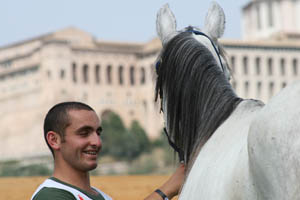
In the recent CEI Three-star 120km Bab Al Shams endurance ride held at Assisi in Italy, the organisers Assisi Endurance Lifestyle experiment with the new "Formula One Finish" which has been mooted to make endurance rides more attractive and spectator friendly.
As against the current practice of waiting for all the fit horses to complete the ride within the stipulated time, in Assisi the new move involved the closing of the out gates onto the course loops one hour after the arrival of the first horse to cross the finish line.
Any horse stopped by the use of the 'Formula 1' finish at a Vet Gate was still required to complete all Vet examinations and, in doing so, meet all of the parameters to continue even though not being required to do so.
FEI Press Relesase
[More ...]
M. Satya Narayan, Staff Reporter
In the recent CEI Three-star 120km Bab Al Shams endurance ride held at Assisi in Italy, the organisers Assisi Endurance Lifestyle experiment with the new "Formula One Finish" which has been mooted to make endurance rides more attractive and spectator friendly.
As against the current practice of waiting for all the fit horses to complete the ride within the stipulated time, in Assisi the new move involved the closing of the out gates onto the course loops one hour after the arrival of the first horse to cross the finish line.
Any horse stopped by the use of the 'Formula 1' finish at a Vet Gate was still required to complete all Vet examinations and, in doing so, meet all of the parameters to continue even though not being required to do so.
FEI Press Relesase
[More ...]
Friday, June 15, 2007
Meet one enduring family
 John Travers found the perfect way to spend more time with his teenage daughter Elise.
The Auburn resident took up ultramarathons more than 15 years ago. But this year's training for next Saturday's Western States Endurance Run has been especially gratifying.
"We ride and run together a lot," said Travers, who finished the 100-mile run from Squaw Valley to Auburn in 1992, '96 and '02. "The training takes up an incredible amount of time and it's a good way to try to keep the family together."
[More ...]
Wednesday, June 06, 2007
Carry On and Live your Dream

A WOMAN who dreamed of riding through the Spanish countryside while her life hung in the balance is going to finally have her moment.
In the long hours in hospital rooms waiting for treatment for her breast cancer, Wendy Tanton vowed that she would ride through the Spanish mountains when she recovered.
The gardener said: "It is such a boring time and a bit depressing and I suppose you can't help being reflective. You think about your children and how long you are going to be around. It wasn't where I wanted to be and I started to think about the things I did want to do.
[More ...]
Friday, May 18, 2007
[Merri Travels] Australian Endurance Conclusion
From: Merri <merri@endurance.net>
Subject: [Merri Travels] Australian Endurance Conclusion
| First of all, same as New Zealand, I met some wonderful people who took time out of their busy lives to host me and give me a glimpse into their worlds. In New Zealand I met some of the smaller trainers and endurance riders; in Australia I met some of the icons of international endurance and the Arabian horse. Many thanks to Meg Wade and Chris Gates of Castlebar, the Tofts of Toft Endurance, (and all their workers), and Ron and Val Males of Ralvon Arabian Stud, and I hope to meet many more people on my next visit! There are quite a few similarities in endurance riding in Australia and the US. Most notably, though a majority of endurance riders don't participate in FEI, most people don't mind it, or support it. We're both losing trails we used to have easy access to, to housing developments and people closing their land because of insurance. There's rumors in both countries (and others) about people cheating: drugging horses, taking shortcuts on course. Only those who might do it know if the rumors are true, and only they have to live with themselves. Did you really win if you did any of this? The differences: Australia and New Zealand have logs books for every horse, which seem to be a good idea. In the book, every ride is recorded, every vet check and the results of the vet's evaluation, and where the horse finished or when he vetted out (pulled) and why. The US doesn't - we only have vet cards for each ride, which we present to the vets at the vet checks, and carry with us during the ride, and turn it over to the vets (ride manager) after the ride. If you want these after the ride, you can have them. However, we in the US have the great resource of online records, for horses and riders, with our AERC organization online, which is very handy and convenient, which is not available in Australia (or New Zealand), though I've heard that it might be available in the future. It takes a great deal of work, and our AERC people do a great job of keeping it up to date as soon as possible. While Australian 40 km rides (25 milers) are strictly Training Rides, have a time limit of not finishing faster than 6 hours (and not slower than 8 hours), US training rides, or Limited Distances (LDs), have become quite competitive and many LD riders want placings, awards, and Best Conditioned judging just like the 50 mile and over rides. As for the 160 km FEI rides, especially the FEI rides, where the ride is supposed to be 6 loops, it seems that strategy and speed are the focus of the ride, and the strappers and veterinarians carry more responsibility for the welfare of the horse. In 100 mile US rides where there are, say, 3 long loops, with 3 hour-long vet checks and maybe another 15-minute hold on one of the loops, the rider has more time where he or she must be responsible for the horse out on the trail and adjust his or her riding accordingly. In the US now, at many rides, 30 miles, 50 miles, 100 miles or multi-days, at least in the West and Pacific Southwest where I ride, the trend is becoming so that every head veterinarian of every ride will give a pre-ride speech deferring the responsibility of the horse's wellbeing on the RIDER. The vet sees the horse for maybe 2 minutes at each vet check - and likely not the same vets see the same horses - and he or she is there to HELP the rider assess the condition of the horse during those two minutes. The rider has been on the horse the last few hours and should know how the horse is feeling, and the rider should know if the horse needs slowing down or stopping. The veterinarian can't possibly be expected to know how the horse feels underneath the rider, nor predict what might happen another 20 miles down the trail, even if the horse does look good in those two minutes. If you don't know your horse, you really shouldn't be riding it, their opinion. Of course, anything can happen at any time out on the course, but it's certainly not the vet who should blamed for anything that goes wrong. Fairly recently in the US one vet was sued by a rider who, after his horse passed a vet check, went back out on trail, over-rode his horse, and the horse died. Whose fault was it? If actions like this become common it will threaten rides, because what vet would possibly consent to vetting a ride if he's held responsible for a rider killing his horse? Australia has commentators broadcasting at vet checks throughout the rides (as does New Zealand). Of course that's for the strappers, so they know when their riders are approaching, since time in the vet check gates into holds is crucial, especially for those out to compete, not just complete. The US has some radio check people, which do number checks out on course for some rides, but it's just to guard against emergencies, and to turn the list into ride management later to make sure people have stayed on course. In the US, we don't put a lot of work into strapping, especially at the non-FEI rides. Personally I hadn't even heard of 'strapping' and had to look up what the heck it meant. Sure, we put water on our horses if their heart rates need bringing down, but normally we don't have a crew of people and a slew of buckets doing it. We might have a 'crew,' who will maybe be carrying a bucket of water and a sponge in one hand for the horse, and a beer or Dr Pepper J in the other hand for the rider. Most people I visited in Australia heavily use electrolytes, and by 'heavily,' I mean feeding in feed before and during rides, and electrolyting by mouth syringe going out on every loop. Plenty of people in the US do that also, but some of the 'old school' endurance riders, whom I learned from, might add electrolytes to feed before and during rides (if then), but don't syringe additional electrolytes during the rides. I know that with a couple of horses I rode a couple hundred miles on each, we tried it both ways, and there was no difference, although of course I was not doing hundreds in 12 hours, nor 50 milers in 4 hours. There is a corroborating study I just read about, in one of the Australian States' endurance newsletters. The French endurance team had always, prior to the year - I think it was around 2002 - given their horses oral electrolytes going out on every loop in 160 km endurance rides. For the 2-year study, they completely stopped supplementing the horses during the rides, and it was found that every single horse had better completion rates and less metabolic problems once they stopped administering the electrolytes. From my observations, my conclusion is, both people - those who use a lot of electroytes, and those who don't - swear by their methods. Again, I didn't spend nearly enough time in Australia either, to come to enough concrete conclusions about the endurance world there. I will just have to return one day and continue my studies! |
Wednesday, May 02, 2007
Comments on Saddle Pads and Blankets
From: "Sisu West Ranch" <ranch@sisuwest.us>
Date: May 2, 2007 5:32:01 PM PDT
There are several things to consider with pads vs blankets.
1. Pads do not make a poor saddle fit better, sort of like having a human boot to tight and putting on an extra pair of socks.
2. What design is the saddle? If there is room, some saddle pads will spread the rider's weight over a larger area which is a good thing.
3. When you ride hard, are there dry spots on the back? If so you have a saddle fit issue, a pad might help.
4. If you have a flexible panel saddle, a wool blanket is all you need. It does help keep the saddle cleaner.
5. Wool is great next to a horse. I have always used wool next to the horse. You can wash it every 4 rides.
6. I'd be more worried about changing things (that is putting on a pad) than riding the horse farther in his usual tack. Things changed at a ride tend to bite.
Ed
Ed & Wendy Hauser
2994 Mittower Road
Victor, MT 59875
ranch(at)sisuwest(dot)us
Sunday, April 15, 2007
Monday, April 09, 2007
Absorbing horse sense at Stanford's School of Medicine
 On the first day of course No. 252 at the Stanford University School of Medicine, a pack of horses will be brought down from pasture near Portola Valley and herded into a corral, so the students can lean against the fence like wranglers and study at the stock.
They are looking for both leadership and followership in the horse hierarchy, as indicated by ear pinning, tail swishing, nudging and nipping. After observations, five horses will be culled from the herd and walked up to a sand arena where the medical students will get inside the fence and either hug the rails or tiptoe in among them.
They are not here to diagnose what might be bothering the animals. Medicine and Horses, an interdisciplinary course, is not that kind of class. The students are here to learn how to deal with humans. Clinical Instructor Dr. Beverley Kane's job is to help them find the clues.
"Horses are not socially repressed like human patients are," Kane says. "They are superb at nonverbal communication." So are people, if the doctor knows where to look. That is the theory behind this spring quarter elective. Horsemanship isn't a prerequisite. It is more of a hindrance.
[More ...]
Friday, April 06, 2007
Online Equine Education from Michigan State
My Horse University is a national online program for horse enthusiasts based at Michigan State University, one of the top U.S. universities in equine science and management. This program offers equine education courses and resources that you can tailor to achieve your horse-management goals.
Wednesday, April 04, 2007
Main Divide - endurance challenge
I want to thank Kat Swigart for taking on the challenge of managing a 100 mile ride where the ride logistics were as difficult as the trail course itself. There is absolutely no doubt in my mind that this course would have been impossible to complete if Kat had not provided the enormous amount of ride support in regards to water drops, manned aid stations for horse/rider and a large vet check volunteer staff. There is no doubt that the logistics of getting to these aid stations and vet checks was more difficult for the volunteers than the course was for the horses and riders. After the ride, I learned about all the flat tires, broken transmissions, damaged trailers, etc that the volunteers and crew had to endure to help give support to the riders. The horses definitely faired better than the ride help/volunteers for this event.
This ride was probably the most difficult and challenging ride I have ever completed. To me, this kind of ride is what endurance is all about, the challenge of the trail. There was no guarantee that this course could be completed in 24 hours and 11 riders accepted the challenge to find out if it was possible. Six riders proved that it was possible. The interesting “facts” about this ride are that five out of the six horses that finished were FIRST TIME 100 mile horses and four out of the six riders were FIRST TIME 100 mile riders. One of these FIRST TIME 100 mile riders on their FIRST TIME 100 mile horse was riding a NON ARAB. These FIRST TIME horses and riders were able to complete a true 100 mile course with about 18,000 feet of elevation change with footing that would not be considered ideal. I think that a ride like this and statistics like this prove that using common sense, doing your homework, and practicing good horsemanship will result in success. The team effort between the ride support staff (including crews), great veterinarians, and riders who listened to the advice of the vets definitely added to the high completion rate. All the horses, even the ones that pulled early, looked great! Let this ride prove that being prepared, good horsemanship, and a team effort between ride staff and the rider will overcome many of the perceived obstacles that can keep riders away from 100 mile rides.
You know, every rider that considers themselves an “endurance” rider should accept a challenge like the one offered through Main Divide every so often. You will learn many things about yourself and your horse by riding a ride like this whether you complete or pull early. The things that so many of us seem to value in endurance rides today like # of completions, mileage milestones, wins, placings, points, doable courses, manicured trails or trimmed trails, awards, frills, courses that can be finished in X # of hours, etc. just loose their significance when you ride a challenge like this and are successful. It is really a neat feeling when the “competition” is really the trail. It puts endurance riding/racing into perspective and redefines accomplishment.
Kim Fuess
AERC #6648
This ride was probably the most difficult and challenging ride I have ever completed. To me, this kind of ride is what endurance is all about, the challenge of the trail. There was no guarantee that this course could be completed in 24 hours and 11 riders accepted the challenge to find out if it was possible. Six riders proved that it was possible. The interesting “facts” about this ride are that five out of the six horses that finished were FIRST TIME 100 mile horses and four out of the six riders were FIRST TIME 100 mile riders. One of these FIRST TIME 100 mile riders on their FIRST TIME 100 mile horse was riding a NON ARAB. These FIRST TIME horses and riders were able to complete a true 100 mile course with about 18,000 feet of elevation change with footing that would not be considered ideal. I think that a ride like this and statistics like this prove that using common sense, doing your homework, and practicing good horsemanship will result in success. The team effort between the ride support staff (including crews), great veterinarians, and riders who listened to the advice of the vets definitely added to the high completion rate. All the horses, even the ones that pulled early, looked great! Let this ride prove that being prepared, good horsemanship, and a team effort between ride staff and the rider will overcome many of the perceived obstacles that can keep riders away from 100 mile rides.
You know, every rider that considers themselves an “endurance” rider should accept a challenge like the one offered through Main Divide every so often. You will learn many things about yourself and your horse by riding a ride like this whether you complete or pull early. The things that so many of us seem to value in endurance rides today like # of completions, mileage milestones, wins, placings, points, doable courses, manicured trails or trimmed trails, awards, frills, courses that can be finished in X # of hours, etc. just loose their significance when you ride a challenge like this and are successful. It is really a neat feeling when the “competition” is really the trail. It puts endurance riding/racing into perspective and redefines accomplishment.
Kim Fuess
AERC #6648
Monday, March 26, 2007
2006AAEP Articles (PDF) available online

Special Report: Health News and Information From the AAEP 2006 Convention
by: The Horse.Com
Article # 9190
Sponsored by OCD Equine
Get the latest research and health news from the American Association of Equine Practitioners 2006 Convention in The Horse's AAEP 2006 Wrap-UP sponsored by OCD Equine. You can download these PDF files separately or as one file at no charge. We hope you enjoy these educational articles.
Individual Articles:
# News and Awards (6 pages, 582 KB)
# Medicine (7 pages; 612 KB)http://www.thehorse.com/pdf/aaep/digestion.pdf
# Digestive Health (5 pages, 567 KB)
# Obese Horses (5 pages, 932 KB)
# Lameness (8 pages, 642 KB)
# Muscle Disorders (6 pages, 514 KB)
# Skin Diseases (3 pages, 469 KB)
# Reproduction (11 pages, 1.7 MB)
# Horse Care and Management (7 pages, 579 KB)
# And Much More (7 pages, 690 KB)
Download the Articles
Friday, March 23, 2007
[RC] RC:Core Temp
As to the electrolytes. Steph said:
>> ... messes with osmotic balance in gut (high concentration of
salt in
one dose). <<<
Angie Asked:
What happened to the old line that if a horse's electrolytes were
depleted, that drinking clear water would disrupt the osmotic balance?
==========================================================
and Steph Answered:
it's been a while since college, so please take my comments as those
of a
lowly rider, not a vet or physiologist.
but - the principle is: water follows salt. wherever the
concentration of
salt is highest, water will go and seek equilibrium, given the
channel/ability to do so. without enough water the body can't circulate
substrate adequately (blood becomes thick/sludgy) and if the guts are
not
active (can also be a result of over-exertion)then stuff, including
salt may
simply stay in the gut rather than get circulated to the cells that
need it.
(or even worse case scenario draw water back into the gut to
normalize the
salt concentration).
the risk of over-hydration (diluting the amount of salt in the body
fluid)
by drinking too much is (I think) much lower than the risk of
dehydration.
There have been many studies demonstrating that horses lose great
amounts of
salt during exertion. And we know there are also studies (the French)
that
demonstrate that drenching with electrolytes doesn't improve
performance...
and we know of many cases where horses have done well w/o electrolyte
supplementation. (I just rode 120km in very hot and humid conditions in
Malaysia with no e-lyte supplementation during the ride - the horse
drank/ate all night, hydration was excellent). So this begs the
question: if
e-lytes are lost in exertion, but horses can still perform well w/o
supplementation, then why are we told that we must actively replace the
salts that are lost, during the exertion? How do these horses do it w/o
replacement during competition. Is there enough of an e-lyte reserve
in a
fully loaded gut to re-supply the system during exertion?
hmmmmm??
>
> Steph
======== Terry Comments ======
How do these horses do it w/o replacement during competition.
Remember, they are EATING FOOD at the vet checks!
As long as the horse is fit for the distance (this influences how efficiently a horse can regulate temperature and cool off during or after hard workl) and eating/drinking at the vet checks (this replenishes their elytes) as it does normally.
Below from the Texas A&M Univ. "Scientific Principles for Conditioning Race and Performance Horses":
"Horses in moderate condition (body condition score of 5) are better able to effectively use DIETARY and STORED energy specifically toward the performance activity, with a SLOWER ONSET OF FATIGUE and IMPROVED THERMAL REGULATION."
Terry
"May the Horse be with you"
Thursday, March 22, 2007
FEI Press: Horse Transport, Beijing Olympics

Tuesday, March 20, 2007
Diagnosis of Back and Sacroiliac Pain - Nancy Loving
Chris Ray, DVM, MS, Dipl. ACVS, of Weatherford, Texas struck off the discussion about lameness and performance problems associated with back and sacral area pain at the Western Performance Horse Forum held in Nampa, Idaho, on Feb. 15-17. He recommended the importance of listening to the trainer or owner, as many back problems only appear when a horse is performing his athletic activity.
Some horses are so sore they don't want to unload off the trailer. A veterinarian will perform a visual and palpation exam of the back. When a horse is asked to bend, his response is assessed as to whether there is a difference between directions. About 90% of the time, problems are found at the top of the sacrum along the midline.
[More ...]
Some horses are so sore they don't want to unload off the trailer. A veterinarian will perform a visual and palpation exam of the back. When a horse is asked to bend, his response is assessed as to whether there is a difference between directions. About 90% of the time, problems are found at the top of the sacrum along the midline.
[More ...]
Finding and Managing Back Injuries and Pain - Nancy Loving
How do you locate the source of back pain in the horse? Once you find the source, how do you manage the pain? At the Western Performance Horse Forum held in Nampa, Idaho, on Feb. 15-17, a panel of three veterinarians discussed options for finding and managing back and sacroiliac injuries that create pain, lameness, and/or performance issues. Panelists were Robert Schneider, DVM, MS, equine orthopedic surgeon at Washington State University; Van Snow, DVM, from Santa Ynez, Calif.; and Chris Ray, DVM, MS, Dipl. ACVS, of Weatherford, Texas.
[More ...]
[More ...]
Sunday, March 18, 2007
Scientific Principles for Conditioning Performance Horses
The equine athlete undergoes significant musculo-skeletal changes during conditioning and competition. Unfortunately, lameness and losses are higher than desirable and the industry is challenged to use field-and-laboratory-based principles for improving the well-being of race and performace horses. Body condition can be adjusted to delay fatigue and influence thermal regulation. Body weight estimates can aid in feeding horses more effectively. Preride checks and adequate warm-up are vital to the initial conditioning and specificity of training phases horses must undergo to be cmpetitive. Heart rate provides a good monitor of how horses respond to exersize and can be used to minimize injury through effectively regulated overloading techniques. Diet plays a major role in conditioning and energy can be provided in a fashion to increased time to fatigue and improve heat dissipation. Cardiovascular fitness remains with horses longer than skeletal strenth during off-periods and both ground surfaces and exercise schedules impact the length of time needed to prepare for the rigors of competition.
The Complete Paper (PDF)
The Complete Paper (PDF)
Friday, March 16, 2007
Endurance flourishes in Argentina
By M. Satya Narayan, Staff Report
 Buenos Aires: Almost every venue that hosts an endurance ride in modern day has a link with the UAE in some form or the other. That the UAE is one of the leading endurance nations is a well confirmed fact but the impetus it has provided to the sport, even far-flung ranches in this part of the world have felt the positive ripple-effect.
Horses have been part of the cultures here but breeding of Arabian horses in the recent past have become more focused. And during the regional, national and international championships, owners participate with a double aim - victory on one side but more importantly they hope that their horses will be roped in by prospective buyers.
Today's World Endurance Championship for Junior and Young Riders is no exception. A day prior to this the Argentine National Championship ride was held and it was more a display of the young and promising endurance horses, mainly Arabian, on offer.
Quite a few riders and stable representatives from the UAE and other endurance nations are here on a poaching mission.
And ranch owners and breeders like the Garcias from Uruguay are looking forward to sell prospective endurance stars. "We have 32 stallions which cater to both show horses, endurance horses and race horses," said Federico Garcia, owner of El Oasis, a 6000-acre ranch breeding Arabian horses since 1939 in Paysandu, north of Uruguay. "Our horses have total freedom and graze freely with the cattle and sheep. The gauchos ride them and once we realise their potential then they are broken and trained in that particular sport - shows, endurance or racing.
"The fact that they are free in a natural environment have helped in them becoming better endurance horses," said Garcia Sr., who has sold 18 horses to the Al Aasfa stables based in Uruguay, owned by His Highness Shaikh Mohammad Bin Rashid Al Maktoum, Vice President and Prime Minister of the UAE and Ruler of Dubai.
Ro Fabiola the best
Ro Fabiola, which emerged as the top-ranked horse in the tough UAE domestic season of 2005-06 is another product of Uruguay.
Initially Arabian horses bred in Australia, the US and South Africa apart from France and Spain were in great demand.
Now the focus has shifted to Arabian bred horses from Uruguay, Argentina and Chile.
Buenos Aires: Almost every venue that hosts an endurance ride in modern day has a link with the UAE in some form or the other. That the UAE is one of the leading endurance nations is a well confirmed fact but the impetus it has provided to the sport, even far-flung ranches in this part of the world have felt the positive ripple-effect.Horses have been part of the cultures here but breeding of Arabian horses in the recent past have become more focused. And during the regional, national and international championships, owners participate with a double aim - victory on one side but more importantly they hope that their horses will be roped in by prospective buyers.
Today's World Endurance Championship for Junior and Young Riders is no exception. A day prior to this the Argentine National Championship ride was held and it was more a display of the young and promising endurance horses, mainly Arabian, on offer.
Quite a few riders and stable representatives from the UAE and other endurance nations are here on a poaching mission.
And ranch owners and breeders like the Garcias from Uruguay are looking forward to sell prospective endurance stars. "We have 32 stallions which cater to both show horses, endurance horses and race horses," said Federico Garcia, owner of El Oasis, a 6000-acre ranch breeding Arabian horses since 1939 in Paysandu, north of Uruguay. "Our horses have total freedom and graze freely with the cattle and sheep. The gauchos ride them and once we realise their potential then they are broken and trained in that particular sport - shows, endurance or racing.
"The fact that they are free in a natural environment have helped in them becoming better endurance horses," said Garcia Sr., who has sold 18 horses to the Al Aasfa stables based in Uruguay, owned by His Highness Shaikh Mohammad Bin Rashid Al Maktoum, Vice President and Prime Minister of the UAE and Ruler of Dubai.
Ro Fabiola the best
Ro Fabiola, which emerged as the top-ranked horse in the tough UAE domestic season of 2005-06 is another product of Uruguay.
Initially Arabian horses bred in Australia, the US and South Africa apart from France and Spain were in great demand.
Now the focus has shifted to Arabian bred horses from Uruguay, Argentina and Chile.
Tuesday, February 20, 2007
FEI International Forum on Medication Control
February 14, 2007Fairmont Hotel, Dubai UAE
 The first FEI forum on equine medication control was opened by FEI Secretary General, Michael Stone. He introduced the speakers, thanked everybody for their presence at this important meeting, and explained the purpose of the forum: to educate riders, trainers, veterinarians and officials, and to create an open dialogue between FEI and the equestrian sport community. The forum would include a series of slide presentations by various FEI officers and staff and an open discussion session, with opportunity for questions and concerns to be aired.
HRH Princess Haya Bint Al Hussein, President of the FEI, would be in attendance at the forum, to share in the goal of education and dialog between the FEI, the governing body of International Equestrian sport, and equestrian community - those whose lives, sports and careers are integral to the future of the sport.
Full Report
The first FEI forum on equine medication control was opened by FEI Secretary General, Michael Stone. He introduced the speakers, thanked everybody for their presence at this important meeting, and explained the purpose of the forum: to educate riders, trainers, veterinarians and officials, and to create an open dialogue between FEI and the equestrian sport community. The forum would include a series of slide presentations by various FEI officers and staff and an open discussion session, with opportunity for questions and concerns to be aired.HRH Princess Haya Bint Al Hussein, President of the FEI, would be in attendance at the forum, to share in the goal of education and dialog between the FEI, the governing body of International Equestrian sport, and equestrian community - those whose lives, sports and careers are integral to the future of the sport.
Full Report
Saturday, February 17, 2007
FEI to Research Endurance Horses in Competition
 15/02/2007
Study on Endurance horses in competition
The FEI is pleased to announce, with the cooperation of the Dubai Equestrian Club, the scientific study on Endurance horses in competition.
A number of horses, who will compete at an FEI event to be held in Dubai on 24 February, will be studied by a group of Scientists, headed by Dr David Marlin (GBR) and assisted by a panel of Vets headed by Dr Bobby Surendra Babu BL (IND).
Information will be obtained both before, during and after the event to enable the FEI to investigate the effects of top level endurance sport on competition horses.
Dr David Marlin comments: “We are very grateful for this wonderful opportunity provided to us by the Dubai Equestrian Club which will allow us to study elite endurance horses under truly competitive desert ride conditions. We have recently studied elite horses competing in the UK and this work will allow us to build up a clearer picture of the elite horse, especially in relation to warmer conditions. A small International team of respected scientists and veterinary surgeons (Dr Pat Harris, UK; Dr Hal Schott, USA; Dr Rod Fisher, UK; Dr Ray Geor, USA) will join me in Dubai next week to carry out the work. We will be examining weight loss, water consumption, heart function and looking at changes in the blood during and following the ride. This information will form part of the overall review of endurance being undertaken by the FEI and help ensure we protect the health and welfare of the horses in this fast developing and highly competitive sport”.
The FEI is grateful to the Dubai Equestrian Club for the valued assistance in the project.
Thursday, February 15, 2007
Drug Testing and 'Zero Tolerance' concept
thehorse.com
by: Tom LaMarra
February 12 2007 Article # 8919
Lousiana research project that shows racehorses can come into contact with drug residue just about anywhere on the backstretch has some horsemen calling for an end to "zero tolerance" drug-testing policies and creation of a national panel to examine data before inadvertent positives are called.
The study, presented by Steven Barker, PhD, during the National Horsemen's Benevolent and Protective Association Medication Committee meeting Feb. 9 in Hot Springs, Ark., revealed small quantities of six drugs were found in samples taken from ship-in stalls, the test barn, and pools of water at Louisiana racetracks. Even dust samples were tested and trace amounts of substances were found.
Barker, the chemist for the Louisiana State Racing Commission who plans to publish his findings, said small amounts of phenylbutazone, flunixin, naproxen, caffeine, furosemide, and cotinine, a metabolite of nicotine, were discovered in samples. Flunixin, a widely used non-steroidal anti-inflammatory drug, was the most prevalent, the study showed.
Some drugs were detected from just wiping the interior of stalls.
"We could have gone to other areas of that stall and found other drugs," Barker said during his presentation to horsemen. "Clearly, the backside of a racetrack is heavily contaminated with drugs. Hopefully, you're scared."
With highly sensitive testing methods and zero-tolerance policies, a trainer could be charged with a positive for having one molecule of a substance in a sample, Barker said. Other potential sources of trace amounts of drugs are feed, pasture grasses, improper handling of samples, and mistakes by veterinarians, he said.
Barker said even with precautions in stable areas, drug residue wouldn't be eliminated. Therefore, he said threshold levels for drugs are a necessity.
"First of all, we need to abolish the concept of zero tolerance," Barker said. "It's an over-simplified attempt to regulate drugs. There's no sense to continue that nonsense. You can't eliminate drug contamination, so you have to approach it at the interpretation-of-data end."
Kent Stirling, executive director of the Florida HBPA and chairman of the National HBPA Medication Committee, criticized laboratories and regulators. He said labs get business "by showing regulators they can find things," and regulators "believe any time there is a (positive) it was an attempt by the trainer to compromise a race. A lot of people judge labs by number of calls."
Stirling said the suggestion of a drug-positive review panel should be taken to the Racing Medication and Testing Consortium for consideration. Barker said the panel would "offer some kind of political cover for the industry to establish better thresholds."
The RMTC is in the process of having research performed to establish threshold levels for almost 50 therapeutic medications. Barker, Stirling, and other said thresholds are important given regulations that don't keep in step with technology.
Barker claimed about 80% of drug positives fall under the category of having no impact on a horse outside of 24 hours. "These comments I've heard that any level (of a substance) could potentially have an impact on performance ... oh, crap."
In another presentation, Thomas Tobin, MVB, PhD, Dipl. ABT, of the University of Kentucky discussed caffeine and its metabolites. Tobin, an adviser to the National HBPA, noted the variation in threshold levels for caffeine in various jurisdictions--30 nanograms per milliliter in urine in Hong Kong to 1,000 nanograms per milliliter in Canada.
"Caffeine is the most widely consumed psychoactive substance on earth," said Tobin, who is continuing to research the drug. "It's a hunting license for a chemist."
Robert Lewis, DVM, a former president of the American Association of Equine Practitioners and currently the organization's representative on the RMTC, said the RMTC has been effective at getting people to focus on the issues. He cited the group's recommendation to regulate steroids, an action he called proactive.
"The RMTC at first had competing agendas, but no one group dominated," Lewis said. "It has been a largely educational process. It has been rewarding to watch the evolution."
As for Barker's research project, Lewis said it should be presented to the RMTC.
"It opens everybody's eyes to hear this kind of material," Lewis said. "I think it takes peer pressure from the leaders of this industry to get the attention of regulators in these different states. The disparity in the way labs in this country handle post-race samples has been a huge problem."
by: Tom LaMarra
February 12 2007 Article # 8919
Lousiana research project that shows racehorses can come into contact with drug residue just about anywhere on the backstretch has some horsemen calling for an end to "zero tolerance" drug-testing policies and creation of a national panel to examine data before inadvertent positives are called.
The study, presented by Steven Barker, PhD, during the National Horsemen's Benevolent and Protective Association Medication Committee meeting Feb. 9 in Hot Springs, Ark., revealed small quantities of six drugs were found in samples taken from ship-in stalls, the test barn, and pools of water at Louisiana racetracks. Even dust samples were tested and trace amounts of substances were found.
Barker, the chemist for the Louisiana State Racing Commission who plans to publish his findings, said small amounts of phenylbutazone, flunixin, naproxen, caffeine, furosemide, and cotinine, a metabolite of nicotine, were discovered in samples. Flunixin, a widely used non-steroidal anti-inflammatory drug, was the most prevalent, the study showed.
Some drugs were detected from just wiping the interior of stalls.
"We could have gone to other areas of that stall and found other drugs," Barker said during his presentation to horsemen. "Clearly, the backside of a racetrack is heavily contaminated with drugs. Hopefully, you're scared."
With highly sensitive testing methods and zero-tolerance policies, a trainer could be charged with a positive for having one molecule of a substance in a sample, Barker said. Other potential sources of trace amounts of drugs are feed, pasture grasses, improper handling of samples, and mistakes by veterinarians, he said.
Barker said even with precautions in stable areas, drug residue wouldn't be eliminated. Therefore, he said threshold levels for drugs are a necessity.
"First of all, we need to abolish the concept of zero tolerance," Barker said. "It's an over-simplified attempt to regulate drugs. There's no sense to continue that nonsense. You can't eliminate drug contamination, so you have to approach it at the interpretation-of-data end."
Kent Stirling, executive director of the Florida HBPA and chairman of the National HBPA Medication Committee, criticized laboratories and regulators. He said labs get business "by showing regulators they can find things," and regulators "believe any time there is a (positive) it was an attempt by the trainer to compromise a race. A lot of people judge labs by number of calls."
Stirling said the suggestion of a drug-positive review panel should be taken to the Racing Medication and Testing Consortium for consideration. Barker said the panel would "offer some kind of political cover for the industry to establish better thresholds."
The RMTC is in the process of having research performed to establish threshold levels for almost 50 therapeutic medications. Barker, Stirling, and other said thresholds are important given regulations that don't keep in step with technology.
Barker claimed about 80% of drug positives fall under the category of having no impact on a horse outside of 24 hours. "These comments I've heard that any level (of a substance) could potentially have an impact on performance ... oh, crap."
In another presentation, Thomas Tobin, MVB, PhD, Dipl. ABT, of the University of Kentucky discussed caffeine and its metabolites. Tobin, an adviser to the National HBPA, noted the variation in threshold levels for caffeine in various jurisdictions--30 nanograms per milliliter in urine in Hong Kong to 1,000 nanograms per milliliter in Canada.
"Caffeine is the most widely consumed psychoactive substance on earth," said Tobin, who is continuing to research the drug. "It's a hunting license for a chemist."
Robert Lewis, DVM, a former president of the American Association of Equine Practitioners and currently the organization's representative on the RMTC, said the RMTC has been effective at getting people to focus on the issues. He cited the group's recommendation to regulate steroids, an action he called proactive.
"The RMTC at first had competing agendas, but no one group dominated," Lewis said. "It has been a largely educational process. It has been rewarding to watch the evolution."
As for Barker's research project, Lewis said it should be presented to the RMTC.
"It opens everybody's eyes to hear this kind of material," Lewis said. "I think it takes peer pressure from the leaders of this industry to get the attention of regulators in these different states. The disparity in the way labs in this country handle post-race samples has been a huge problem."
Wednesday, February 14, 2007
Do Horses Spread Non-Native Plants on Trails?
by: Stith T. Gower, PhD
February 11 2007 Article # 8846
[From THE HORSE http://www.thehorse.com/viewarticle.aspx?ID=8846 ]
Can plant and weed seeds contained in horse manure, hooves, and hay cause nonnative plant species (plants that were introduced to that ecosystem but do not grow there naturally) to spread along trails and into parks and forests? This is an ecological question that often arises. Stith T. Gower, PhD, of the Department of Forest Ecology and Management at the University of Wisconsin-Madison, has determined that while there are seeds from weed and non-native plant species in horse manure and hay, the plants that result don't survive or spread on trails. Therefore, horses do not appear to be a major source for the introduction of nonnative species.
"Nonnative plant species pose a serious ecological and economic threat to managed and natural ecosystems," said Gower. "Therefore, there is a great need to identify major sources for the introduction of non-native species and implement management plans to reduce or eliminate their introduction. Horses have been suggested to be an important source for the introduction of nonnative plant species along trails, but the data are largely anecdotal."
The objectives of two studies were to determine if horse hay, manure, and hoof debris samples contained seeds from nonnative species, and if so, whether their seeds would germinate and establish on the trails.
February 11 2007 Article # 8846
[From THE HORSE http://www.thehorse.com/viewarticle.aspx?ID=8846 ]
Can plant and weed seeds contained in horse manure, hooves, and hay cause nonnative plant species (plants that were introduced to that ecosystem but do not grow there naturally) to spread along trails and into parks and forests? This is an ecological question that often arises. Stith T. Gower, PhD, of the Department of Forest Ecology and Management at the University of Wisconsin-Madison, has determined that while there are seeds from weed and non-native plant species in horse manure and hay, the plants that result don't survive or spread on trails. Therefore, horses do not appear to be a major source for the introduction of nonnative species.
"Nonnative plant species pose a serious ecological and economic threat to managed and natural ecosystems," said Gower. "Therefore, there is a great need to identify major sources for the introduction of non-native species and implement management plans to reduce or eliminate their introduction. Horses have been suggested to be an important source for the introduction of nonnative plant species along trails, but the data are largely anecdotal."
The objectives of two studies were to determine if horse hay, manure, and hoof debris samples contained seeds from nonnative species, and if so, whether their seeds would germinate and establish on the trails.
Sunday, February 11, 2007
Subscribe to:
Posts (Atom)