Thehorse.com - Full Article
In the past 30 years, researchers have made great strides in understanding gastric ulcers. Those findings and ones yet to be made can help improve horse health and welfare now and into the future.
Posted by Erica Larson, News Editor | Nov 30, 2018
Today, we know horses are prone to developing gastric (or stomach) ulcers. We know an estimated 50-90% of horses suffer from gastric ulcers and that performance and racehorses are some of the most susceptible. We even know what treatment and management options can help ulcers heal and reduce their changes of returning.
But concern about gastric ulcers weren’t always common. In fact, not long ago, relatively speaking, veterinarians published some of the first research on these stomach lesions. Al Merritt, DVM, Dipl. ACVIM, a professor emeritus at the University of Florida College of Veterinary Medicine, in Gainesville, described what researchers have learned about equine gastric ulcers in the past three decades at the 2018 Kentucky Equine Research Conference, held Oct. 29-30 in Lexington, Kentucky...
Read more here:
https://thehorse.com/163371/gastric-ulcers-in-horses-30-years-of-research/
Monday, December 31, 2018


6 Tips for Riding in Wild Horse Country
 SagebrushRider.com - Full Article
July 1 2018
Story and Photos by Samantha Szesciorka
Whenever I give talks in other states about long distance horseback travel in Nevada, someone always asks about dangerous encounters with wildlife. Were you ever attacked by bears or wolves?, they ask with a look on their face that’s a mixture of hope and horror. I enjoy watching their expression become quizzical once I respond. In my opinion, the most likely, and potentially dangerous, wild animal encounter you can have riding in Nevada… is wild horses.
In the course of riding thousands of miles around this wonderful state, my horse and I have had run-ins with countless wild horses. They are not always pleasant encounters. I don’t think anyone has been charged by wild horses more than us! We’ve dealt with wild horses on the trail, in camp, and even in the middle of the night.
Nevada is home to more wild horses than any other state – more than 40,000 according to the Bureau of Land Management’s last count in March of this year – so chances are good that you’ll run into some if you’re out riding on public land. Wild horses are territorial and they can be aggressive, so it’s important to be prepared to keep yourself and your horse safe. Here are six tips for riding among wild horses:...
Read more here:
https://sagebrushrider.com/good-horsekeeping/6-tips-for-riding-in-wild-horse-country/
Saturday, December 22, 2018
Legendary Kabardian Horses Galloping To Comeback
 Rferl.org - Full Article
DECEMBER 22, 2018 11:25 GMT
By Pete Baumgartner
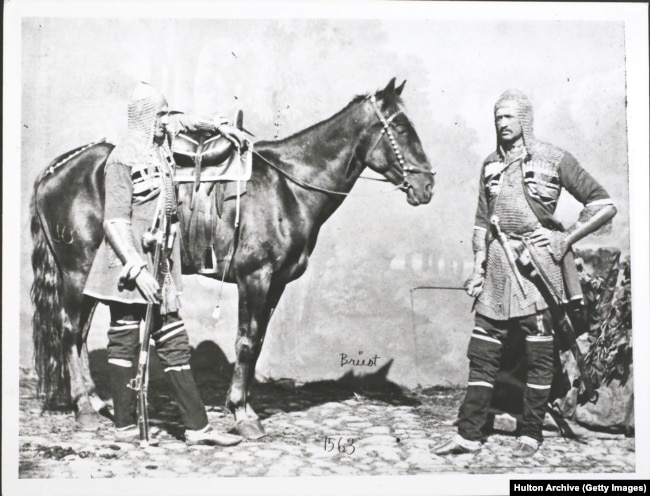
The Kabardian horse's strength and endurance were legendary as it carried Circassian warriors battling Imperial Russian forces in the high mountains of the Caucasus in the 1800s.
But the animal was in a dire situation as the U.S.S.R. collapsed in 1991, nearly vanishing into obscurity.
Now, breeders and animal registries suggest the Kabardian has been resurrected in its home region and is even flourishing in stables farther West. "At the fall of the Soviet Union, the breed was close to extinction," Pawel Krawczyk, who has bred, trained, and raced Kabardian horses, tells RFE/RL.
Hundreds of animals from a dwindling population were being transported at the time to countries like Italy for meat, he says, "essentially to make sausage" -- as the Soviet and then Russian breeding programs broke down amid the chaos.
Russian stud farms were soon left with "thousands of horses, no money to feed them, and expenses such as the salaries of the workers," he says.
"It was a very difficult situation..."
Read more here:
https://www.rferl.org/a/legendary-kabardian-horses-galloping-to-comeback/29670854.html
Wednesday, December 19, 2018
Endurance Riding: Start Slow to Finish Strong
TheHorse.com - Full Article
Riding at fast speeds at the start of endurance rides often leads to elimination during veterinary checks, researchers have learned. And while that might seem like common sense, many riders continue to ride too fast in rides’ early stages, one scientists said.
Posted by Christa Lesté-Lasserre, MA | Dec 18, 2018
The age-old adage says “slow and steady wins the race,” and researchers have found that it rings true for endurance riding—at least at the beginning of the ride.
While that might seem obvious or “common sense,” the fact is many riders continue to ride fast in the early stages of endurance events, said Euan David Bennet, PhD, a research associate at the University of Glasgow School of Veterinary Medicine’s Weipers Centre for Equine Welfare, in Scotland. And as his new study shows, a too-quick start frequently leads to failure to qualify (FTQ) to continue the ride during veterinary checks.
“This should certainly help develop a speed strategy to help avoid FTQ outcomes,” Bennet said. “That’s not quite the same as developing a strategy for a win, but for riders that want to win, safely finishing the ride would be a good start...”
Read more here:
https://thehorse.com/164299/endurance-riding-start-slow-to-finish-strong/
Riding at fast speeds at the start of endurance rides often leads to elimination during veterinary checks, researchers have learned. And while that might seem like common sense, many riders continue to ride too fast in rides’ early stages, one scientists said.
Posted by Christa Lesté-Lasserre, MA | Dec 18, 2018
The age-old adage says “slow and steady wins the race,” and researchers have found that it rings true for endurance riding—at least at the beginning of the ride.
While that might seem obvious or “common sense,” the fact is many riders continue to ride fast in the early stages of endurance events, said Euan David Bennet, PhD, a research associate at the University of Glasgow School of Veterinary Medicine’s Weipers Centre for Equine Welfare, in Scotland. And as his new study shows, a too-quick start frequently leads to failure to qualify (FTQ) to continue the ride during veterinary checks.
“This should certainly help develop a speed strategy to help avoid FTQ outcomes,” Bennet said. “That’s not quite the same as developing a strategy for a win, but for riders that want to win, safely finishing the ride would be a good start...”
Read more here:
https://thehorse.com/164299/endurance-riding-start-slow-to-finish-strong/
Monday, December 17, 2018
Risk Factors for Endurance Riding Eliminations
Thehorse.com - Full Article
Knowing elimination risk factors can help veterinarians, riders, and trainers make informed decisions to safeguard endurance horses’ welfare, researchers say.
Posted by Christa Lesté-Lasserre, MA | Dec 17, 2018
If your endurance horse is a stallion, older than 9, and competing in a ride against more than 60 other horses, he’s at increased risk of being eliminated from the race due to lameness at an obligatory veterinary check. And if you, the rider, are male, the risk is even higher.
That’s one of the main findings from a recent study in which researchers in the U.K. investigated risk factors for vet check failures in endurance horses. Their recent study focused on data from all Fédération Equestre Internationale (FEI) endurance events held worldwide from 2010 and 2015—nearly 83,000 starts.
Meanwhile, a race distance of more than 100 kilometers (about 62 miles) is associated with an increased risk of vet check failure due to metabolic issues such as cardiac problems, high temperatures, or respiratory distress. Having a male rider increases the risk of a metabolic issue during a race by 82% compared to female riders, said Euan David Bennet, PhD, research associate in the Weipers Centre for Equine Welfare in the School of Veterinary Medicine at the University of Glasgow, in Scotland...
Read more here:
https://thehorse.com/164245/risk-factors-for-endurance-riding-eliminations/
Knowing elimination risk factors can help veterinarians, riders, and trainers make informed decisions to safeguard endurance horses’ welfare, researchers say.
Posted by Christa Lesté-Lasserre, MA | Dec 17, 2018
If your endurance horse is a stallion, older than 9, and competing in a ride against more than 60 other horses, he’s at increased risk of being eliminated from the race due to lameness at an obligatory veterinary check. And if you, the rider, are male, the risk is even higher.
That’s one of the main findings from a recent study in which researchers in the U.K. investigated risk factors for vet check failures in endurance horses. Their recent study focused on data from all Fédération Equestre Internationale (FEI) endurance events held worldwide from 2010 and 2015—nearly 83,000 starts.
Meanwhile, a race distance of more than 100 kilometers (about 62 miles) is associated with an increased risk of vet check failure due to metabolic issues such as cardiac problems, high temperatures, or respiratory distress. Having a male rider increases the risk of a metabolic issue during a race by 82% compared to female riders, said Euan David Bennet, PhD, research associate in the Weipers Centre for Equine Welfare in the School of Veterinary Medicine at the University of Glasgow, in Scotland...
Read more here:
https://thehorse.com/164245/risk-factors-for-endurance-riding-eliminations/
Feeding Fats to Horses: Not Just a Diet Fad
Thehorse.com - Full Article
Fats serve many important functions for horses, from increasing calorie consumption to reducing gastric ulcer severity.
Posted by Kristen M. Janicki, MS, PAS | Dec 10, 2018
Fats serve many important functions for your horse, from increasing calorie consumption to reducing gastric ulcer severity
Society has seen its share of diet crazes, even in the past decade. From low-carb and high-protein to low-fat and high-fiber, trends have come and gone and come again, making food selection challenging. Luckily, horse owners don’t have as many options when they’re picking their charges’ feed. As herbivores, our horses’ diets must be high-fiber complemented by a commercial product fit to meet their life stage (performance, breeding, growing, etc.). The high-fat diet era began as a way to effectively increase calories without drastically increasing feed volume and, as researchers learn more about the benefit of fats for our four-legged friends, it appears that high-fat diets are here to stay...
Read more here:
https://thehorse.com/18459/feeding-fats-to-horses-not-just-a-diet-fad/
Fats serve many important functions for horses, from increasing calorie consumption to reducing gastric ulcer severity.
Posted by Kristen M. Janicki, MS, PAS | Dec 10, 2018
Fats serve many important functions for your horse, from increasing calorie consumption to reducing gastric ulcer severity
Society has seen its share of diet crazes, even in the past decade. From low-carb and high-protein to low-fat and high-fiber, trends have come and gone and come again, making food selection challenging. Luckily, horse owners don’t have as many options when they’re picking their charges’ feed. As herbivores, our horses’ diets must be high-fiber complemented by a commercial product fit to meet their life stage (performance, breeding, growing, etc.). The high-fat diet era began as a way to effectively increase calories without drastically increasing feed volume and, as researchers learn more about the benefit of fats for our four-legged friends, it appears that high-fat diets are here to stay...
Read more here:
https://thehorse.com/18459/feeding-fats-to-horses-not-just-a-diet-fad/
Wednesday, December 12, 2018
Q&A: Kids and Dogs in the Barn—Who is Liable?
HorseNetwork.com - Full Article
December 10 2018
by ARMAND LEONE
Q: I own and operate a boarding stable at which I’ve always allowed boarders to happily bring their children along, however, I’ve never allowed them to bring their dogs. But I’m now getting an increasing number of requests to change that rule! I just worry about scenarios such as a dog spooking a horse and the rider getting hurt. Should I keep my no dog rule as is, or, if I change the rule how do I protect myself against those situations?
A: Great question. In my opinion, there is no reason that you can’t allow dogs if it is something that your boarders have requested, and if you take the necessary precautions.
First, put up signs stating your rules regarding dogs on the property. Common sense comes into play a lot here. Signage that states that dogs must be on a leash puts people on notice that dogs cannot run loose. That’s the first step in protecting yourself from liability from an injury.
The second step is actually enforcing those rules. If you hang up signs stating that dogs must be on a leash but then allow dogs to roam the property at will, you are opening the door to issues...
Read more here:
https://horsenetwork.com/2018/12/qa-kids-dogs-barn-liable/?utm_source=MASTER&utm_campaign=3a868a5504-HNS_2018_12_11_18&utm_medium=email&utm_term=0_5694ca6b0c-3a868a5504-84641243&mc_cid=3a868a5504&mc_eid=b3c9897994
December 10 2018
by ARMAND LEONE
Q: I own and operate a boarding stable at which I’ve always allowed boarders to happily bring their children along, however, I’ve never allowed them to bring their dogs. But I’m now getting an increasing number of requests to change that rule! I just worry about scenarios such as a dog spooking a horse and the rider getting hurt. Should I keep my no dog rule as is, or, if I change the rule how do I protect myself against those situations?
A: Great question. In my opinion, there is no reason that you can’t allow dogs if it is something that your boarders have requested, and if you take the necessary precautions.
First, put up signs stating your rules regarding dogs on the property. Common sense comes into play a lot here. Signage that states that dogs must be on a leash puts people on notice that dogs cannot run loose. That’s the first step in protecting yourself from liability from an injury.
The second step is actually enforcing those rules. If you hang up signs stating that dogs must be on a leash but then allow dogs to roam the property at will, you are opening the door to issues...
Read more here:
https://horsenetwork.com/2018/12/qa-kids-dogs-barn-liable/?utm_source=MASTER&utm_campaign=3a868a5504-HNS_2018_12_11_18&utm_medium=email&utm_term=0_5694ca6b0c-3a868a5504-84641243&mc_cid=3a868a5504&mc_eid=b3c9897994
Sunday, December 09, 2018
Learned Helplessness
GreyHorseLLC Blog - Full Article
November 9 2018
Quite a few years ago, I was idling away some time reading the then-current issue of The Chronicle of the Horse magazine (a weekly sport-horse publication). While skimming a pretty dry article about the United States Dressage Federation (USDF) annual convention, I ran across a mention of a guy named Andrew McLean who had been invited to speak to the attendees about the possibility that a thing called “learned helplessness” might be causing “dullness in dressage horses.” I didn’t think another thing of it, skimmed the rest of the magazine and threw it out.
A year later, I found myself in much the same position, at the same time of year, skimming articles in The Chronicle. There was another article about that year’s USDF convention, and another mention of Andrew McLean. But this time, reading between the lines, it sounded like they’d invited him back to take back what he’d said the year before about learned helplessness in dressage horses. NOW they had my attention!
I spent that weekend madly Googling learned helplessness (LH) and Andrew McLean (he’s from Australia). Once I’d gotten a handle on that, I continued to read about LH and think about how it might or might not relate to hundreds of horses I’d seen over the years. I did more research, and more reading.
Now, according to an equine behaviorist I consulted, it is not necessarily scientifically sound to assume that LH occurs in horses. This has not been scientifically proven by scientists, in studies. The seminal studies on LH were done with dogs, and scientists agree it occurs in humans, so scientists would agree that it can occur in dogs and humans. But studies on horses have NOT been done. So strictly speaking, we are going out on a bit of a limb assuming that horses can experience LH. Even so, I think it’s a useful exercise.
So before we can go any further, it’s best if you go read the Wikipedia entry on Learned Helplessness, which is still about the most efficient and succinct definition that I have found so far. If you skip this step, none of the rest of this article will make any sense, so please now read this: https://en.wikipedia.org/wiki/Learned_helplessness
Okay, you’re back! So basically, when a being is in a state of LH, they feel like there is nothing they can do to improve their situation in the moment or “make it stop”. So they give up. Like the dogs in the study, they figuratively and literally lay down and take it. They don’t fight, they don’t try to escape, they surrender, which can look like “agreement” or “submission” or “obedience” to some folks...
Read more here:
https://greyhorsellc.wordpress.com/2018/11/09/learned-helplessness/
November 9 2018
Quite a few years ago, I was idling away some time reading the then-current issue of The Chronicle of the Horse magazine (a weekly sport-horse publication). While skimming a pretty dry article about the United States Dressage Federation (USDF) annual convention, I ran across a mention of a guy named Andrew McLean who had been invited to speak to the attendees about the possibility that a thing called “learned helplessness” might be causing “dullness in dressage horses.” I didn’t think another thing of it, skimmed the rest of the magazine and threw it out.
A year later, I found myself in much the same position, at the same time of year, skimming articles in The Chronicle. There was another article about that year’s USDF convention, and another mention of Andrew McLean. But this time, reading between the lines, it sounded like they’d invited him back to take back what he’d said the year before about learned helplessness in dressage horses. NOW they had my attention!
I spent that weekend madly Googling learned helplessness (LH) and Andrew McLean (he’s from Australia). Once I’d gotten a handle on that, I continued to read about LH and think about how it might or might not relate to hundreds of horses I’d seen over the years. I did more research, and more reading.
Now, according to an equine behaviorist I consulted, it is not necessarily scientifically sound to assume that LH occurs in horses. This has not been scientifically proven by scientists, in studies. The seminal studies on LH were done with dogs, and scientists agree it occurs in humans, so scientists would agree that it can occur in dogs and humans. But studies on horses have NOT been done. So strictly speaking, we are going out on a bit of a limb assuming that horses can experience LH. Even so, I think it’s a useful exercise.
So before we can go any further, it’s best if you go read the Wikipedia entry on Learned Helplessness, which is still about the most efficient and succinct definition that I have found so far. If you skip this step, none of the rest of this article will make any sense, so please now read this: https://en.wikipedia.org/wiki/Learned_helplessness
Okay, you’re back! So basically, when a being is in a state of LH, they feel like there is nothing they can do to improve their situation in the moment or “make it stop”. So they give up. Like the dogs in the study, they figuratively and literally lay down and take it. They don’t fight, they don’t try to escape, they surrender, which can look like “agreement” or “submission” or “obedience” to some folks...
Read more here:
https://greyhorsellc.wordpress.com/2018/11/09/learned-helplessness/
Rings and Ridges: What Horse Hooves Reveal
KER.com - Full Article
May 25, 2017
By Kentucky Equine Research Staff
Just as coat condition serves as an indication of health status in horses—sheen and dapples suggest vitality, whereas dull, rough, or half-shed coats imply unthriftiness or disease—changes in hooves may provide clues to a horse’s historical well-being.
The hoof wall is subject to any number of imperfections, and it is commonplace for horses to be beset with shallow or deep cracks, chipped toes, or flares, especially if they are not under the scheduled care of a professional farrier. These flaws are obvious. More subtle changes in the hoof wall, including horizontal rings and ridges, tell more about a horse’s health than the regularity of hoof care.
Hoof rings and ridges sound synonymous, but they are not. In fact, one is a normal feature of even the best-managed hooves; the other, though, is a sign of pathology and potential toxicity...
Read more here:
https://ker.com/equinews/rings-ridges-horse-hooves-reveal/?utm_source=KER+Newsletter&utm_campaign=53b730c445-Focus_December18_HoofHealth&utm_medium=email&utm_term=0_0d95781dfc-53b730c445-11166&mc_cid=53b730c445&mc_eid=6283eb0e4a
May 25, 2017
By Kentucky Equine Research Staff
Just as coat condition serves as an indication of health status in horses—sheen and dapples suggest vitality, whereas dull, rough, or half-shed coats imply unthriftiness or disease—changes in hooves may provide clues to a horse’s historical well-being.
The hoof wall is subject to any number of imperfections, and it is commonplace for horses to be beset with shallow or deep cracks, chipped toes, or flares, especially if they are not under the scheduled care of a professional farrier. These flaws are obvious. More subtle changes in the hoof wall, including horizontal rings and ridges, tell more about a horse’s health than the regularity of hoof care.
Hoof rings and ridges sound synonymous, but they are not. In fact, one is a normal feature of even the best-managed hooves; the other, though, is a sign of pathology and potential toxicity...
Read more here:
https://ker.com/equinews/rings-ridges-horse-hooves-reveal/?utm_source=KER+Newsletter&utm_campaign=53b730c445-Focus_December18_HoofHealth&utm_medium=email&utm_term=0_0d95781dfc-53b730c445-11166&mc_cid=53b730c445&mc_eid=6283eb0e4a
Saturday, December 08, 2018
10 Plants and Chemicals That are Toxic to Horses
TheHorse.com - Full Article
Learn about 10 common plants and chemicals your horse should never eat.
Posted by Lindsay Day, REMT | Oct 20, 2018
Review these substances your horse should never eat
There are many things horses should never eat. Certainly, toxic plants rank high on the list of things to avoid, but other substances, organisms, and chemicals can pose risks as well. While poisoning in horses is relatively rare compared to other causes of ill health, when it does occur the consequences can be dire.
“People often assume that horses know what to eat and what not to eat, but that’s just not true in a lot of cases,” says Cynthia Gaskill, DVM, PhD, Dipl. ABVP, associate professor and veterinary clinical toxicologist at the University of Kentucky Veterinary Diagnostic Laboratory. From a curious nibble of a tree branch to accidental consumption of a contaminated grain meal, there are a number of ways horses can ingest toxic substances that put their health—and lives—at risk. Here are our top 10:
Read more here:
https://thehorse.com/148667/10-plants-and-chemicals-that-are-toxic-to-horses/
Learn about 10 common plants and chemicals your horse should never eat.
Posted by Lindsay Day, REMT | Oct 20, 2018
Review these substances your horse should never eat
There are many things horses should never eat. Certainly, toxic plants rank high on the list of things to avoid, but other substances, organisms, and chemicals can pose risks as well. While poisoning in horses is relatively rare compared to other causes of ill health, when it does occur the consequences can be dire.
“People often assume that horses know what to eat and what not to eat, but that’s just not true in a lot of cases,” says Cynthia Gaskill, DVM, PhD, Dipl. ABVP, associate professor and veterinary clinical toxicologist at the University of Kentucky Veterinary Diagnostic Laboratory. From a curious nibble of a tree branch to accidental consumption of a contaminated grain meal, there are a number of ways horses can ingest toxic substances that put their health—and lives—at risk. Here are our top 10:
Read more here:
https://thehorse.com/148667/10-plants-and-chemicals-that-are-toxic-to-horses/
Friday, December 07, 2018
8 Ways to Be a Good Trail-Riding Buddy
Thehorse.com - Full Article
We all want to be the kind of person other trail riders enjoy being around. Use these eight simple techniques to be a fun and safe riding buddy on the trail.
Posted by Kim McCarrel | Nov 29, 2018
You’re out on a pleasant trail ride with several other riders. Without a word, one of the riders suddenly urges her horse forward and gallops off down the trail. The left-behind horses frantically try to follow. The riders struggle to control their mounts. Pandemonium ensues.
This kind of thoughtless behavior on the trail is no fun to deal with and could cause someone to get seriously hurt. Clearly, leaving your fellow riders in the dust isn’t what you’d expect of a good riding buddy. “Never again!” you say to yourself. “I’ll never ride with her again!”
We all want to be the kind of person other trail riders enjoy being around. By using the eight simple techniques below, you can be a good riding buddy who is fun and safe to ride with on the trail...
Read more here:
https://thehorse.com/163124/8-ways-to-be-a-good-trail-riding-buddy/
We all want to be the kind of person other trail riders enjoy being around. Use these eight simple techniques to be a fun and safe riding buddy on the trail.
Posted by Kim McCarrel | Nov 29, 2018
You’re out on a pleasant trail ride with several other riders. Without a word, one of the riders suddenly urges her horse forward and gallops off down the trail. The left-behind horses frantically try to follow. The riders struggle to control their mounts. Pandemonium ensues.
This kind of thoughtless behavior on the trail is no fun to deal with and could cause someone to get seriously hurt. Clearly, leaving your fellow riders in the dust isn’t what you’d expect of a good riding buddy. “Never again!” you say to yourself. “I’ll never ride with her again!”
We all want to be the kind of person other trail riders enjoy being around. By using the eight simple techniques below, you can be a good riding buddy who is fun and safe to ride with on the trail...
Read more here:
https://thehorse.com/163124/8-ways-to-be-a-good-trail-riding-buddy/
Wednesday, December 05, 2018
Feeding Before Exercise
Fiber-fresh.com - Full Article
By Dr Nerida Richards B. Rur Sc PhD (RAnNutr)
The question of whether you should feed a horse before exercise is one that is commonly asked. Most of us were told over and over again by our parents not to swim for 30 minutes after eating or we would get a muscle cramp, so we generally tend to think that eating before exercise is not a wise thing to do. But is this the case for horses? The answer is yes and no…
Empty stomach or full stomach before exercise
The horse is a monogastric and a continuous grazer, so logic says that a horse’s stomach should never be empty. Having a full stomach is important for the horse as it stops gastric acids from the lower part of the stomach splashing around and irritating the upper sections of the gastrointestinal tract. This acid splash that occurs in horses exercised on an empty stomach is thought to contribute to the development of gastric ulcers.
Therefore, if a horse is stabled without constant access to forage, or if it has been more than 2 hours since the horse last grazed or fed, you should feed your horse before exercise. A small feed will protect a horse from gastric ulcers in 2 ways. Chewing the feed will stimulate saliva production and saliva acts as a buffer in the stomach. And the feed will fill up the stomach and prevent gastric acids from splashing around (for more information on Gastric Ulcers you should read FeedXL Newsletter #8 Preventing Gastric Ulcers).
What should you feed before exercise?
What you feed before exercise is very important...
Read more here:
http://www.fiber-fresh.com/equine/feeding-before-exercise/
By Dr Nerida Richards B. Rur Sc PhD (RAnNutr)
The question of whether you should feed a horse before exercise is one that is commonly asked. Most of us were told over and over again by our parents not to swim for 30 minutes after eating or we would get a muscle cramp, so we generally tend to think that eating before exercise is not a wise thing to do. But is this the case for horses? The answer is yes and no…
Empty stomach or full stomach before exercise
The horse is a monogastric and a continuous grazer, so logic says that a horse’s stomach should never be empty. Having a full stomach is important for the horse as it stops gastric acids from the lower part of the stomach splashing around and irritating the upper sections of the gastrointestinal tract. This acid splash that occurs in horses exercised on an empty stomach is thought to contribute to the development of gastric ulcers.
Therefore, if a horse is stabled without constant access to forage, or if it has been more than 2 hours since the horse last grazed or fed, you should feed your horse before exercise. A small feed will protect a horse from gastric ulcers in 2 ways. Chewing the feed will stimulate saliva production and saliva acts as a buffer in the stomach. And the feed will fill up the stomach and prevent gastric acids from splashing around (for more information on Gastric Ulcers you should read FeedXL Newsletter #8 Preventing Gastric Ulcers).
What should you feed before exercise?
What you feed before exercise is very important...
Read more here:
http://www.fiber-fresh.com/equine/feeding-before-exercise/
Tuesday, December 04, 2018
Looking back at one of the UAE's earliest film shoots with Revel Guest
 TheNational.ae - Full Article
Chris Newbould
December 2, 2018
Nowadays, it’s a regular occurrence to see international film and TV production crews on the streets, dunes and rooftops of the UAE. The past few years have seen major shoots from Hollywood, Bollywood, Korea, France, China, Finland and beyond land on these shores, with Star Wars: The Force Awakens, Tiger Zinda Hai and two instalments of the Mission Impossible franchise among the biggest names to set up shop here.
Twenty years ago, that was not the case, and veteran filmmaker Revel Guest was among the first international crews to touch down on these shores in 1998, when she made two documentaries – one an episode of the popular American Travel Channel show Trailblazers, and the other an episode of the 26-part documentary Horse Tales which looked at the stables of Sheikh Zayed, the Founding Father, and especially the work of horse whisperer Ali Al Ameri, as they prepared for the 1998 Endurance World Cup in Dubai...
Read more here:
https://www.thenational.ae/arts-culture/film/looking-back-at-one-of-the-uae-s-earliest-film-shoots-with-revel-guest-1.798304
Monday, December 03, 2018
Impact of Abrupt Diet Changes in Horses
KER.com - Full Article
February 1, 2018 By Kentucky Equine Research Staff
Due to the risk of laminitis, horses should not be subjected to abrupt feed changes. The rapid ingestion of unfamiliar concentrates or other feeds high in starch can induce the painful, life-threatening disease, which is characterized by the separation of the hoof wall from the coffin bone.
“Aside from the potential for laminitis, the sudden addition of feeds rich in dietary starch may cause an alteration in the intestinal microbiome,” explained Kathleen Crandell, Ph.D., a nutritionist with Kentucky Equine Research.
The microbiome includes bacteria, fungi, and other microorganisms that help digest fiber and maintain the health of the intestinal tract. That population of microbes forms early in a horse’s life and fluctuates based on diet, transport, stress, exercise, weight loss, and disease state, among other factors.
“In the case of sudden diet changes, that microbiome will also change and not always in a positive way,” Crandell said. “Alterations can adversely affect digestive health and lead to diarrhea, colic, and other forms of intestinal upset...”
Read more here:
https://ker.com/equinews/impact-abrupt-diet-changes-horses/?utm_source=KER+Newsletter&utm_campaign=3f30f42216-KER_Equinews_2_21_18&utm_medium=email&utm_term=0_0d95781dfc-3f30f42216-11166&mc_cid=3f30f42216&mc_eid=6283eb0e4a
February 1, 2018 By Kentucky Equine Research Staff
Due to the risk of laminitis, horses should not be subjected to abrupt feed changes. The rapid ingestion of unfamiliar concentrates or other feeds high in starch can induce the painful, life-threatening disease, which is characterized by the separation of the hoof wall from the coffin bone.
“Aside from the potential for laminitis, the sudden addition of feeds rich in dietary starch may cause an alteration in the intestinal microbiome,” explained Kathleen Crandell, Ph.D., a nutritionist with Kentucky Equine Research.
The microbiome includes bacteria, fungi, and other microorganisms that help digest fiber and maintain the health of the intestinal tract. That population of microbes forms early in a horse’s life and fluctuates based on diet, transport, stress, exercise, weight loss, and disease state, among other factors.
“In the case of sudden diet changes, that microbiome will also change and not always in a positive way,” Crandell said. “Alterations can adversely affect digestive health and lead to diarrhea, colic, and other forms of intestinal upset...”
Read more here:
https://ker.com/equinews/impact-abrupt-diet-changes-horses/?utm_source=KER+Newsletter&utm_campaign=3f30f42216-KER_Equinews_2_21_18&utm_medium=email&utm_term=0_0d95781dfc-3f30f42216-11166&mc_cid=3f30f42216&mc_eid=6283eb0e4a
Friday, November 30, 2018
Scientists are now trying to clone the 40,000-year-old baby horse found frozen in Siberia
BGR.com - Full Article
Mike Wehner @MikeWehner
September 6th, 2018
It was just a couple of weeks ago that the discovery of a frozen baby horse began to spread. The animal, which is thought to be as old as 40,000 years, was found frozen in Siberia, and the well-preserved remains offered researchers a glimpse at a species of wild horse that has long been extinct.
Now, with such a pristine specimen in their possession, scientists are attempting to sample the horse’s cells for material they can use to clone it. Yes, they are actually attempting to bring an extinct species back from the death… or are they?
The Siberian Times reports that the researchers are hard at work hunting for cells that would facilitate the cloning process. The team, made up of scientists from Russia and South Korea, plan to harvest an egg from a modern horse in order to artificially manufacture a cloned embryo of the ancient foal. That embryo would then be placed in a surrogate mother who would carry it to term and, if all goes well, give birth to a creature that hasn’t set foot on this planet in thousands of years.
The team seems remarkably confident that they’ll be able to pull off this remarkable series of accomplishments. They even go so far as to suggest that this is really just a stepping stone to an even more monumental achievement: cloning a woolly mammoth...
Read more here:
https://bgr.com/2018/09/06/ancient-horse-clone-south-korea-woo-suk/
Mike Wehner @MikeWehner
September 6th, 2018
It was just a couple of weeks ago that the discovery of a frozen baby horse began to spread. The animal, which is thought to be as old as 40,000 years, was found frozen in Siberia, and the well-preserved remains offered researchers a glimpse at a species of wild horse that has long been extinct.
Now, with such a pristine specimen in their possession, scientists are attempting to sample the horse’s cells for material they can use to clone it. Yes, they are actually attempting to bring an extinct species back from the death… or are they?
The Siberian Times reports that the researchers are hard at work hunting for cells that would facilitate the cloning process. The team, made up of scientists from Russia and South Korea, plan to harvest an egg from a modern horse in order to artificially manufacture a cloned embryo of the ancient foal. That embryo would then be placed in a surrogate mother who would carry it to term and, if all goes well, give birth to a creature that hasn’t set foot on this planet in thousands of years.
The team seems remarkably confident that they’ll be able to pull off this remarkable series of accomplishments. They even go so far as to suggest that this is really just a stepping stone to an even more monumental achievement: cloning a woolly mammoth...
Read more here:
https://bgr.com/2018/09/06/ancient-horse-clone-south-korea-woo-suk/
Arabians: The Ultimate Trail Horse
ArabianHorseLife.com - Full Story
November 13, 2018
Emma Kersey-Doherty
The Arabian horse is the perfect candidate for a trail riding partner. Their endurance is well known, and their bravery, surefootedness, and willing nature all serve them well going down the trail. Breed characteristics such as dense bone, large nostrils, deep heart girth, and solid construction make it no surprise that the Arabian is a steadfast partner for riding over a distance. This was first proven by the Bedouins in the desert and continues to be that way today as many explore the world from the backs of their Arabian horses.
Barbara Lowell, who is in her mid-thirties, currently resides in Texas, though she moves often as her husband serves as a U.S. Marine. The pair have three Purebred Arabians that they endeavor to ride through as many National parks as possible, Sera (SA Seraphim), Reggie (Silvern Idol) and Manny (Baha Crescent). “We have ridden our horses at the Grand Canyon, Bryce, Yosemite, and Olympic National parks as well as countless more,” Barbara shares. “We also compete in AERC (American Endurance Ride Conference) and NATRC (North American Trail Ride Conference) events.”
For Barbara, it’s the people-oriented nature and willingness to work with his rider that makes the Arabian horse the ultimate choice of trail horse. “They’re a partner,” she explains. “I’ve had a couple different breeds, but have never had a trail horse as good as my Arabians. In my experience, they are an intelligent animal who asks questions and accepts my answers. They’re soft, willing, and happy to explore. They take care of us..."
Read more here:
https://www.arabianhorselife.com/single-post/2018/11/13/Arabians-The-Ultimate-Trail-Horse
November 13, 2018
Emma Kersey-Doherty
The Arabian horse is the perfect candidate for a trail riding partner. Their endurance is well known, and their bravery, surefootedness, and willing nature all serve them well going down the trail. Breed characteristics such as dense bone, large nostrils, deep heart girth, and solid construction make it no surprise that the Arabian is a steadfast partner for riding over a distance. This was first proven by the Bedouins in the desert and continues to be that way today as many explore the world from the backs of their Arabian horses.
Barbara Lowell, who is in her mid-thirties, currently resides in Texas, though she moves often as her husband serves as a U.S. Marine. The pair have three Purebred Arabians that they endeavor to ride through as many National parks as possible, Sera (SA Seraphim), Reggie (Silvern Idol) and Manny (Baha Crescent). “We have ridden our horses at the Grand Canyon, Bryce, Yosemite, and Olympic National parks as well as countless more,” Barbara shares. “We also compete in AERC (American Endurance Ride Conference) and NATRC (North American Trail Ride Conference) events.”
For Barbara, it’s the people-oriented nature and willingness to work with his rider that makes the Arabian horse the ultimate choice of trail horse. “They’re a partner,” she explains. “I’ve had a couple different breeds, but have never had a trail horse as good as my Arabians. In my experience, they are an intelligent animal who asks questions and accepts my answers. They’re soft, willing, and happy to explore. They take care of us..."
Read more here:
https://www.arabianhorselife.com/single-post/2018/11/13/Arabians-The-Ultimate-Trail-Horse
Thursday, November 29, 2018
Strangles Vaccine Breakthrough
Equinescienceupdate.com - Full Article
It has been a long time coming, but now an effective vaccine for strangles may finally be on the horizon.
Strangles is one of the most common bacterial infections of horses. Streptococcus equi, the organism responsible, causes horses to suffer from large pus-filled abscesses in their throat and neck. It is found throughout the world.
The disease causes significant economic losses due to the prolonged recovery time and the quarantine measures needed to restrict the spread of the disease.
Although vaccines have been available before, they have not been universally effective and have often produced unacceptable side effects. Reported problems have included abscesses at the site of injection, and clinical disease in vaccinated horses. An additional problem is that the immune response to current vaccines cannot be differentiated from that of infected animals. This complicates the management of outbreaks.
Now scientists at the Swedish University of Agricultural Sciences, the Karolinska Institute and Intervacc AB, and the Animal Health Trust (AHT), have developed a new protein-based vaccine to protect horses from strangles...
Read more here:
http://www.equinescienceupdate.com/articles/svb.html
It has been a long time coming, but now an effective vaccine for strangles may finally be on the horizon.
Strangles is one of the most common bacterial infections of horses. Streptococcus equi, the organism responsible, causes horses to suffer from large pus-filled abscesses in their throat and neck. It is found throughout the world.
The disease causes significant economic losses due to the prolonged recovery time and the quarantine measures needed to restrict the spread of the disease.
Although vaccines have been available before, they have not been universally effective and have often produced unacceptable side effects. Reported problems have included abscesses at the site of injection, and clinical disease in vaccinated horses. An additional problem is that the immune response to current vaccines cannot be differentiated from that of infected animals. This complicates the management of outbreaks.
Now scientists at the Swedish University of Agricultural Sciences, the Karolinska Institute and Intervacc AB, and the Animal Health Trust (AHT), have developed a new protein-based vaccine to protect horses from strangles...
Read more here:
http://www.equinescienceupdate.com/articles/svb.html
Tuesday, November 27, 2018
FEI Terminates Cooperation Agreement With NRHA & AQHA
Quarterhorsenews.com - Full Article
November 20, 2018 by Molly Montag
Reining classes for older horses and medication regulations were among the sticking points that led the Fédération Equestre Internationale (FEI) to end a cooperation agreement with the American Quarter Horse Association (AQHA) and National Reining Horse Association (NRHA), officials said.
Although many details are still unclear, officials say FEI-approved reining events are expected to continue in the United States in spite of the termination.
The FEI announced the termination Monday, Nov. 19, during the FEI General Assembly in the Middle Eastern country of Bahrain. A statement posted at FEI.org said the organization’s secretary general informed delegates the two U.S. groups had breached the terms of their agreement and, as a result, the cooperation agreement was terminated...
Read more here:
https://www.quarterhorsenews.com/2018/11/fei-terminates-cooperation-agreement-with-nrha-aqha/
November 20, 2018 by Molly Montag
Reining classes for older horses and medication regulations were among the sticking points that led the Fédération Equestre Internationale (FEI) to end a cooperation agreement with the American Quarter Horse Association (AQHA) and National Reining Horse Association (NRHA), officials said.
Although many details are still unclear, officials say FEI-approved reining events are expected to continue in the United States in spite of the termination.
The FEI announced the termination Monday, Nov. 19, during the FEI General Assembly in the Middle Eastern country of Bahrain. A statement posted at FEI.org said the organization’s secretary general informed delegates the two U.S. groups had breached the terms of their agreement and, as a result, the cooperation agreement was terminated...
Read more here:
https://www.quarterhorsenews.com/2018/11/fei-terminates-cooperation-agreement-with-nrha-aqha/
Sunday, November 25, 2018
More Evidence to Support Manuka Honey Use in Horse Wounds
Thehorse.com - Full Article
Manuka honey contains biologically active compounds that appear to help horse wounds heal, particularly hard-to-treat wounds on the lower limbs.
Posted by Stacey Oke, DVM, MSc | Mar 11, 2018
It can take a frustrating amount of time and energy to ensure some horse wounds—especially those in challenging locations—heal. Veterinarians and owners alike are often willing to try an array of salves, sprays, and biological dressings to facilitate a positive outcome. But a researcher recently reminded equine practitioners to reach for a particular product, one that created some “buzz” a few years ago.: Honey, particularly manuka honey, can also help wound healing.
“Manuka honey comes from honeybees that collect nectar from this manuka bush’s flowers,” said Albert Tsang, BVSc (Hons.), a research student at the University of Sydney School of Veterinary Science, in New South Wales, Australia, during a presentation at the 2017 American Association of Equine Practitioners Convention, held Nov. 17-21, in San Antonio, Texas. “This type of honey has antibacterial and immunomodulatory effects, and recent studies support the use of manuka honey on wound healing in the equine distal (lower) limb—a notoriously challenging location to treat effectively and economically...”
Read more here:
https://thehorse.com/155607/evidence-support-manuka-honey-use-horse-wounds/
Manuka honey contains biologically active compounds that appear to help horse wounds heal, particularly hard-to-treat wounds on the lower limbs.
Posted by Stacey Oke, DVM, MSc | Mar 11, 2018
It can take a frustrating amount of time and energy to ensure some horse wounds—especially those in challenging locations—heal. Veterinarians and owners alike are often willing to try an array of salves, sprays, and biological dressings to facilitate a positive outcome. But a researcher recently reminded equine practitioners to reach for a particular product, one that created some “buzz” a few years ago.: Honey, particularly manuka honey, can also help wound healing.
“Manuka honey comes from honeybees that collect nectar from this manuka bush’s flowers,” said Albert Tsang, BVSc (Hons.), a research student at the University of Sydney School of Veterinary Science, in New South Wales, Australia, during a presentation at the 2017 American Association of Equine Practitioners Convention, held Nov. 17-21, in San Antonio, Texas. “This type of honey has antibacterial and immunomodulatory effects, and recent studies support the use of manuka honey on wound healing in the equine distal (lower) limb—a notoriously challenging location to treat effectively and economically...”
Read more here:
https://thehorse.com/155607/evidence-support-manuka-honey-use-horse-wounds/
Saturday, November 24, 2018
Composting Toilets
 Trailmeister.com - Full Article
Adventures with Composting Toilets.
November 14 2018
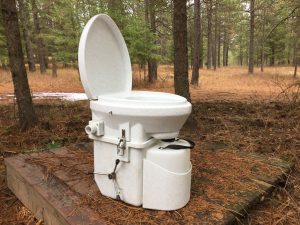
One of our earliest questions with the Trailer project was how were we going to handle the “facilities.” You know, poop happens. Horses do it. Birds do it. And children of a certain age find the subject fascinating. Here’s my scoop on poop.
Most of the places where we venture are devoid of any hookups, and many don’t have toilet facilities, sometimes when they do they aren’t something that you’d want to use. Although the Forest Service often refers to vault toilets as “Sweet Smelling Toilets” or SST’s. The first “S” is frequently not so sweet.
Also, as dry campers, a huge concern is stretching our fresh water supply. We want to stay at remote trailheads as long as possible, anything that helps with that is a plus.
Our main concerns with a lavatory for the trailer were:
Reduce Water usage – Fresh water usually isn’t available when boondocking so we wanted to conserve as much as possible.
Eliminate holding tanks – Forest Service roads in the west are notoriously rough. I’ve seen first-hand where holding tanks and sewage pipes have met rocks and left a calling card of green goo trailing behind.
Avoid RV dumps – In the west, full service facilities are few and far between. On extended trips having to find an RV dump every few days seemed like a hassle.
I found three different types of commodes that address these concerns:
Bucket Toilets – Ultra cheap – Fills quickly
Cassette Toilets – Fills quickly – The horrors of dumping.
Dry or Composting Toilets – No Smell – 3 to 4 weeks between unloading solids...
Read more here:
https://www.trailmeister.com/composting-toilets/
Friday, November 23, 2018
Queen Elizabeth, 92, Went Horseback Riding This Weekend—What Did You Do?
HarpersBazaar.com - Story and Photos
The monarch has way more energy than all of us.
By Amy Mackelden
Nov 19, 2018
For many of us, the weekends are a chance to kick back, unwind, and recover from a busy week at work. For Queen Elizabeth, it's the perfect opportunity to go horseback riding.
The Queen has long been a fan of horseback riding, and has often been photographed with horses throughout her long reign. But it's particularly impressive that Queen Elizabeth spent her downtime this past weekend just chilling on a horse alongside her son, Prince Edward. After a busy week celebrating son Prince Charles' 70th birthday, the Queen still found time to live the equestrian life...
See cute photos here:
https://www.harpersbazaar.com/celebrity/latest/a25218760/queen-elizabeth-horseback-horse-riding-photos/?utm_medium=40digest.ad25.20181120.home&utm_source=email&utm_content=&utm_campaign=campaign
The monarch has way more energy than all of us.
By Amy Mackelden
Nov 19, 2018
For many of us, the weekends are a chance to kick back, unwind, and recover from a busy week at work. For Queen Elizabeth, it's the perfect opportunity to go horseback riding.
The Queen has long been a fan of horseback riding, and has often been photographed with horses throughout her long reign. But it's particularly impressive that Queen Elizabeth spent her downtime this past weekend just chilling on a horse alongside her son, Prince Edward. After a busy week celebrating son Prince Charles' 70th birthday, the Queen still found time to live the equestrian life...
See cute photos here:
https://www.harpersbazaar.com/celebrity/latest/a25218760/queen-elizabeth-horseback-horse-riding-photos/?utm_medium=40digest.ad25.20181120.home&utm_source=email&utm_content=&utm_campaign=campaign
Saturday, November 17, 2018
All Breeders’ Cup Equine Drug Tests Come Back Clean
Thehorse.com - Full Article
Breeders’ Cup’s extensive out-of-competition and pre- and post-race testing program at this year’s World Championships involved testing 289 horses.
Posted by Edited Press Release | Nov 9, 2018
There were no positive drug tests—on out-of-competition and pre- and post-race—at this year’s Breeders’ Cup World Championships, the organization announced Nov. 8.
Breeders’ Cup completed an extensive out-of-competition and pre- and post-race testing program at this year’s World Championships, held Nov. 2-3 at Churchill Downs, in Louisville, Kentucky, which included the testing of 289 horses.
This year the organization continued its expansion of its most comprehensive testing program. Out-of-competition testing began in June with all Breeders’ Cup Challenge winners and other targeted possible starters in both North America and overseas and continued right up until the Championship races.
Breeders’ Cup engaged an out-of-competition testing coordinator, William Farmer, DVM, who worked with regulatory associations and with testing laboratories around the world, including the British Horse Racing Authority’s Lab LGC, France Galop’s official Lab LCH, and the Kenneth L. Maddy Equine Analytical Chemistry Laboratory at the University of California, Davis. All three labs are certified by the International Federation of Horseracing Authorities (IFHA). The executive council of the IFHA also specifically endorsed the updated protocols of the Breeders’ Cup which were put in place in advance of last year’s World Championships...
Read more here:
https://thehorse.com/162669/all-breeders-cup-equine-drug-tests-come-back-clean/
Breeders’ Cup’s extensive out-of-competition and pre- and post-race testing program at this year’s World Championships involved testing 289 horses.
Posted by Edited Press Release | Nov 9, 2018
There were no positive drug tests—on out-of-competition and pre- and post-race—at this year’s Breeders’ Cup World Championships, the organization announced Nov. 8.
Breeders’ Cup completed an extensive out-of-competition and pre- and post-race testing program at this year’s World Championships, held Nov. 2-3 at Churchill Downs, in Louisville, Kentucky, which included the testing of 289 horses.
This year the organization continued its expansion of its most comprehensive testing program. Out-of-competition testing began in June with all Breeders’ Cup Challenge winners and other targeted possible starters in both North America and overseas and continued right up until the Championship races.
Breeders’ Cup engaged an out-of-competition testing coordinator, William Farmer, DVM, who worked with regulatory associations and with testing laboratories around the world, including the British Horse Racing Authority’s Lab LGC, France Galop’s official Lab LCH, and the Kenneth L. Maddy Equine Analytical Chemistry Laboratory at the University of California, Davis. All three labs are certified by the International Federation of Horseracing Authorities (IFHA). The executive council of the IFHA also specifically endorsed the updated protocols of the Breeders’ Cup which were put in place in advance of last year’s World Championships...
Read more here:
https://thehorse.com/162669/all-breeders-cup-equine-drug-tests-come-back-clean/
What to look for in a horse trailer
Trailmeister.com - Full Article
October 31 2018
by Robert Eversole
As published by Saddle Up Magazine
A horse trailer is a big investment and comes with a lot of big decisions to ensure that we make the right choices for us and our mounts.
Let’s break down these decisions into the main factors to consider. Here are my top considerations for what to look for in a horse trailer.
Size is Important – Does the trailer fit both your animals and you?
horse and mule by trailerYour horse or mule doesn’t get to decide on whether it’s going for a ride so we need to make sure that they’re as comfortable as possible. If the space is too small, he’ll will be cramped, likely unhappy, and may decide that he doesn’t like trailers in the future. Measure your horse from nose to rump (height, length, and width) before going trailer hunting. And consider how many horses you’ll be hauling.
The right trailer is not only comfy for your horse(s), it should be the right size to tow safely behind your vehicle, and hold all the gear you need for your riding and camping adventures. Size is one of my first considerations in what to look for in a horse trailer...
Read more here:
https://www.trailmeister.com/what-to-look-for-in-a-horse-trailer/?utm_source=MailingList&utm_medium=email&utm_campaign=Nov2018-general
October 31 2018
by Robert Eversole
As published by Saddle Up Magazine
A horse trailer is a big investment and comes with a lot of big decisions to ensure that we make the right choices for us and our mounts.
Let’s break down these decisions into the main factors to consider. Here are my top considerations for what to look for in a horse trailer.
Size is Important – Does the trailer fit both your animals and you?
horse and mule by trailerYour horse or mule doesn’t get to decide on whether it’s going for a ride so we need to make sure that they’re as comfortable as possible. If the space is too small, he’ll will be cramped, likely unhappy, and may decide that he doesn’t like trailers in the future. Measure your horse from nose to rump (height, length, and width) before going trailer hunting. And consider how many horses you’ll be hauling.
The right trailer is not only comfy for your horse(s), it should be the right size to tow safely behind your vehicle, and hold all the gear you need for your riding and camping adventures. Size is one of my first considerations in what to look for in a horse trailer...
Read more here:
https://www.trailmeister.com/what-to-look-for-in-a-horse-trailer/?utm_source=MailingList&utm_medium=email&utm_campaign=Nov2018-general
Thursday, November 15, 2018
100-Mile Musings
 GoPony.me - Full Story
NOVEMBER 13, 2018 / ASHLEY WINGERT
I don’t spend a ton of time on Facebook discussion groups, endurance-related or otherwise. I tend to “lurk” — I read and pay attention, but don’t often chime in, mostly because I’ve always tended to keep a fairly low public profile and social media, and use it more for direct interaction with friends and people I know. But I digress. Long story short, a thread on one of the endurance groups popped up in my newsfeed this afternoon and caught my attention.
The gist of the topic? What is stopping people from doing 100s?
Good question. Wish I knew the answer. Especially because I could probably be the poster child for a skeptical eyebrow raise of “Why do you keep doing this?” with all of the ups and downs I’ve experienced along the way. Maybe I’m just a slow learner, because I still have a love affair with wanting to try 100s. I got into endurance with the specific wish and desire to do 100s. Especially Tevis, but all of the 100s (particularly the “buckle” 100s) have appeal to me and are on my “I hope I don’t have to wait until the unforeseeable future to get to do them” list. With my current set-up as a catch-rider, the 100-mile goal becomes that much more elusive, but it doesn’t stop me from hoping/wishing/scheming...
Read more here:
https://gopony.me/2018/11/13/100-mile-musings/
The Unsung Heroes of WWI
 FEI.org - Full Artice
9 November 2018
As we mark 100 years since the Armistice Day of November 11, 1918, we look back at the important role that horses and mules played during World War I…
The animals were used as the primary means of achieving military mobility during the First World War.
Mechanisation was in its infancy; so there were few trucks or lorries available and they were mechanically unreliable and road-bound. Every branch of service – infantry, artillery, cavalry, engineers, logistics - was dependent on equids.
They were employed either as riding animals (primarily, but not exclusively, in the cavalry) or, in greater numbers, as draught animals, so they fulfilled both a combatant role in battle, and in supporting logistics.
In fact, the scale of animal use was extraordinary, with the British army alone boasting 510,000 horses by 1918...
“We always think of modern wars as being ‘mechanised’ but in fact the scale of animal use during both world wars was unprecedented. Never before have so many animals been mobilised for military service – unless we recognise this, we fail to understand how modern wars were actually fought,” Gervase Phillips, Principal Lecturer in History at Manchester Metropolitan University, told FEI.org.
Phillips said the greatest single demand was probably for gun-teams to haul artillery pieces. North American mules and North American light draught horses proved especially useful to the British in this role and tens of thousands were brought across the Atlantic.
Throughout the conflict, the British Army deployed more than a million horses and mules, though there weren’t enough horses in Britain to meet demand, so over 1,000 horses a week were shipped from North America...
Read more here:
https://www.fei.org/stories/unsung-heroes-wwi
Subscribe to:
Posts (Atom)