Monday, January 29, 2007

HORSE-HUMAN RELATIONSHIP SURVEY

HORSE-HUMAN RELATIONSHIP SURVEY

The Survey

This survey collects information to help us research the types of relationships between people and horses and the kinds of things that influence those relationships. It includes all equids -- horses, miniature horses, ponies, burros, mules, and others. It's possible that -- if you choose to -- your experiences may be cited in the book that results from this work.

Because we are collecting important information that has never been collected for analysis before the survey is fairly long, but it will help us all learn more about horses and humans if you can take the time to answer all questions. Of course, you can skip ones that don't apply to you, although we ask you to write "none" in boxes you would otherwise leave blank so it's easier to sort large volumes of data. But you may skip questions and submit a partial survey (or quit at any time and simply close the window) since you are under no obligation to take the survey to begin with.

Unless you fill out optional contact information, the survey is anonymous; we do not know who submitted any particular set of answers. However, if you would like to be cited by name in any publications that result from this research, fill out the optional contact information at the end of the survey so we can notify you if any of your comments are to be used in publications.

Frequently asked questions about the survey are answered here. If you have additional questions about the survey or how the data will be stored, analyzed, or used, please contact dawnadams at tapestryinstitute.org. Besides publication, initial survey results will be presented at the live-webcast Voice of the Horse Conference in Ames, Iowa on June 30-July 1, 2007. The page that comes up after you submit your survey responses tells you how to ask for notification when survey results are ready, if you want to see them.

Due to the overwhelming response we have received to the survey, it is necessary for us to limit this to an Internet-only survey. We hope to expand to mail-in surveys in the future.

Thank you for participating in this research project! We hope you will find the questions interesting and thought-provoking, and that you will come away from completing the survey with exciting new ideas about the horses you relate to and the partnerships you share.

Dawn Adrian Adams, Ph.D., President and Founder
Jo Belasco, Esq., Director of Horse-Human Relationship Program
Tapestry Institute

Friday, January 19, 2007

Use of electrolytes during long distance endurance rides in France


J.L. LECLERC* AND C. ROBERT
* Association Française des Vétérinaires d'Endurance Equestre, France,
Ecole Vétérinaire d'Alfort, Maisons-Alfort, France.

Introduction

To replace electrolytes lost in sweat during endurance competition, riders frequently supplement horses with hypertonic oral electrolyte pastes. Sweat losses in Na+, Cl- and K+ during a 10 hour endurance competition can be grossly estimated respectively to 300g, 550g and 120g. Oral pastes administered to endurance horses usually bring less than 5g of each ion per syringe. Therefore, their utility during long distance endurance rides is questionable.
Material and methods A prospective and retrospective study was conducted on horses from the French endurance team during international competitions. Since 2002, during the 160 km rides, horses received no oral electrolytes except those contained in food and water. The frequency of metabolic troubles and the
performance of the horses (speed, place at the arrival and medals) were compared with those obtained previously when horses were systematically supplemented.

Results
Before 2002, on each international event, at least one horse and most often several horses presented anorexia or stopped voluntary drinking during the ride. In the absence of electrolyte supplementation, no horse stopped drinking or eating; consequently, the horses were considered easier to manage by the
riders. The frequency of elimination or withdrawals for metabolic troubles was significantly reduced (P <>

Conclusion
Electrolyte supplementation in well-conditioned horses is not essential during long distance endurance rides.

Over the Santa Fe Trail: 1858

Tuesday, January 16, 2007

Study: How horses and people connect


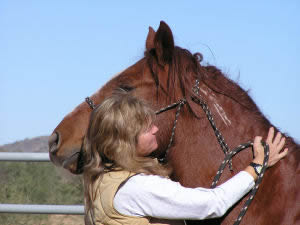
Alliant Professor Dr. Ellen Gehrke with one of her horses.
January 16, 2007

A horse's heart rhythms reflect their emotional state and can respond to the emotional state of a nearby human, according to a pilot study conducted by Alliant International University Professor Ellen Gehrke and the Institute of HeartMath.

When in contact, a horse's heart rate may mirror a human's emotions, signifying a close unspoken form of communication between man and beast. The horse as emotion detector may be the key to eliminating invasive procedures such as those that measure cortisol, a stress hormone.

Horses have long been known to be sensitive to their environments. The preliminary research project "Horses and Humans Energetics: The study of Heart Rate Variability (HRV) between horses and Humans" is the first step to proving horses to be as equally sensitive to the humans within that environment.

For years humans have reported emotional bonds with animals. Horses are often used therapeutically with emotionally and mentally ill and handicapped children and adults. This pilot study is the beginning of many studies to provide the research and data to support these reported bonds.

The study took place at Dr. Gehrke's San Diego ranch where ECG recorders were placed on her and four of her horses. The subjects were monitored during a 24-hour period in which the horses experienced normal conditions and activities such as eating, grooming, being alone, and being ridden and accompanied by Dr. Gehrke.

The ECG recorders projected increased coherent heart rate variability (HRV) patterns for the horses during times of close, calm contact between them and Dr. Gehrke. Coherent HRV patterns are the result of positive emotions and facilitate brain function.

"Horses receive information from body language and give feedback. They don't think very much, they feel. They are very emotional and honest," said Dr. Gehrke. "They also have a powerful impact on your sense of self and ability to lead."

As a professor at the Business Management Division of Alliant's Marshall Goldsmith School of Management, Dr. Gehrke often brings students to her horse ranch for human development, leadership and team-building.

Dr. Gehrke continues to collect more data and plans to eventually conduct similar studies with canines to better match humans with service dogs.

Full article, Horsetalk

Wednesday, January 10, 2007

Endurance Aussie Style

Hi All

I have been inundated with emails from many of you, so decided it would be
better to address your questions on the list, instead of personally. I will
send info on the 4 main questions you all have:

1. 30 minute recovery
2. electrolyte use
3. logbooks
4. penalties

This is my answer to Question Number 1......

In Australia, all Australian Endurance Riders Association (AERA) rides
currently operate on a 30 minute recovery time at the end of each
leg/stage/phase of the ride, including the finish. For an 80km (50mile)
ride, for instance, the first leg is approximately 40km which finishes back
at ride base, and from the moment you cross the line you have 30 minutes in
which to pulse down and then report to the Vetting area.

All but 2 of the rides I have ever attended here have the finish line of
each leg of the ride (including the end of the ride) at the ride base,
within easy walking distance of your campsite. The 2 rides that were the
exceptions had their end-of-ride finishing line only about 200 - 300 metres
away from the actual ride base, on a straight, flat road leading into the
ride base. This alternative finish line was only to allow a safe area for a
gallop finish, and was only really aimed at the front-runners. All those
coming in later had to actually cross the 'real' finish line at ride base.

For rides where a suitable gallop finish area is not available, many
Organising Committees rule that "no gallop finish" is allowed, and that
riders must either a) sort out their placings on track, or b) are only
allowed a trot finish, with disqualification being the penalty for people
breaking this rule!

All AERA rides here require the rider to cross the finish line, receive a
time slip from the in gate time keeper, and then return to your campsite,
where the crewing takes place. At the 30 minute mark you MUST be at the
Vetting area, ready to present to the Vets. You cannot present to the Vets
any earlier than 30 minutes, and you cannot present to the Vets any later
than 30 minutes. As you can imagine, this can cause some congestion in the
Vetting area if there are many horses finishing all at the same time!

If a horse cannot recover to 60 bpm within this 30 minutes, it is Vetted Out
(eliminated). In fact, the required recovery pulse is 55 bpm on the first
leg of any ride, with 60 bpm allowed on all subsequent legs.

As of this year, there has been much discussion on the possibility of
amending the current AERA rule to read that horses may present to the Vet
WITHIN 30 minutes, instead of AT 30 minutes. This will alleviate the
congestion at the Vetting area, and will allow riders to present earlier
than normal if their horse has recovered easily. Whatever time you present
at, that is the time that the Vets will do a complete clinical examination,
including pulse, respiration, trot-up, gut sounds, mucous membranes, heart
sounds, etc, etc...

This is not an official rule as yet, however I believe that some Organising
Committees will be 'trialling' this proposed amendment prior to it going to
a vote of all members late this year.

This is my answer to Question Number 2:

The use of electrolytes is very widespread in Australian endurance
competition. There are many different brands of e-lytes uses, however the
most common would have to be EnduraMax. Some people use (to me) extreme
amounts of electrolytes, and most seem to use about 40-60 grams per dose,
prior to departure on each leg of the ride. Some also e-lyte during each
leg of the ride, carrying pre-mixed syringes for the purpose.

Now, although our competition season is generally throughout the winter,
many of our rides can still be quite hot and dry. (I think they're calling
it "global warming"!) Our leading endurance Veterinarians in the sport
heavily endorse e-lyte useage, and there have been many papers written on
the topic!

Personally, I vary e-lyte useage depending upon the individual horse. I
probably am on the "lower end" of useage amounts, as I don't tend to dose
prior to each leg, just at the beginning. However, this changes depending
upon the weather on the day! I'm sure that the other Aussies on this list
could give you their own dosing rates for e-lytes.

During regular training, however, I do add a small amount of e-lytes (as
well as salt, magnesium and a mineral mix) to every feed. This is because
of the area in which I live, the amount of work the horses do in training,
and the type of natural pasture we have here. However it is probably
because I am dosing the horses every day in training, that I don't tend to
dose them heavily at rides.

I have certainly had horses here that have had a bad reaction to e-lytes,
and who have performed better with no e-lytes at all. I do believe that
e-lytes are a major causal factor in the development of ulcers in otherwise
healthy horses, but I also believe that by introducing (slowly) a regular
dosage of e-lytes, many of my horses have not developed any side effects.

Just my opinion......

Question Three: Logbooks

In Australia, every horse has a permanent logbook. This logbook is
mandatory for any horse entered in an 80km (or longer) ride.

Horses can enter 40km training rides on a card only, but I have always found
that these cards are easily lost, easily crumpled, and extremely easy to get
wet/torn/damaged, etc. A logbook is much easier to manage!

BUT... we don't carry our logbooks with us! The logbook is taken to
pre-ride vetting, where the details are filled out, and then it goes to the
Secretary's Box. Upon the horse completing each leg of the ride, and then
presenting to the Vetting area at the 30 minute mark, the logbook is given
to the rider by the Steward at the Vetting area. The rider holds the
logbook for as long as it takes the Vet to complete the clinical
examination, and then the Vet completes the details in the logbook,
whereupon it is then *magically* transported back to the Secretary's Box.
(This is a job usually handled by "runners"..... in the main, young kids
who are roped into using their energy for the good of mankind).

So, we end up with logbooks that are usually clean, neat, and tidily
completed. Many riders have clear plastic covers on them, some have tooled
leather covers, but mine are just covered with clear contact paper, which
really does protect them. Additionally, I then cover individual pages with
clear contact paper, making them a really secure document.

The advantage of having a logbook is that your horse has a permanent record
all in one place. One of the disadvantages is that any Vet can flip back
through previous pages of your logbook and some of them can actually develop
an unfair opinion of your horse as a result. For example, a horse that was
eliminated at a ride due to a lameness problem, could then be unfairly
"picked upon" by a Vet who sees that previous entry and decides that the
horse is still lame in the same leg... even though it is patently obvious
that it is NOT!!

But over all, I believe that a logbook is an advantage to have. I would
hate to have to organise and maintain a record of a bunch of ride cards.

And now for Question Number 4:

We are extremely lucky in Australia to have quite a good system of
record-keeping within the AERA. If a horse and/or a rider incurs a penalty,
this penalty is recorded and the information on the penalty is then
distributed to Ride Organisers on a regular basis, allowing them to know the
status of any horse/rider.

This system of penalties is called the Early Warning System. The horse
and/or rider accumulates points against them, which can be redeemed in a
number of ways.

REASON FOR NON-COMPLETION POINTS
Vet out pulse under 66bpm 10
Vet out pulse 66bpm or over 15
Vet out non invasive metabolic 10
Vet out mild metabolic 15
Vet out sever metabolic 30
Vet out lame - first 6
Vet out lame - second consecutive 12
Vet out lame - third consecutive 18
Vet out other - back 6
Vet out gall or injury 4

The rider only attract consecutive points for lameness if riding the same
horse that vets out lame consecutively.

Horses withdrawn (pulled) in accordance with the appropriate rule as well as
out-of-riding-time non-completion which pass the veterinary inspection do
not attract non-completion penalty points.

Non-completion points are reduced by:
a) 6 points on the anniversary of each penalty
b) 6 points for subsequent successful completion of rides up to 90km
10 points for subsequent successful completion of rides of 91 - 159 km
12 points for subsequent successful completion of rides of 160km and
above

Metabolic disorders as described above are defined as:
a) 10 points - mild metabolic disorders that do not require invasive
treatment
b) 15 points - mild metabolic disorders such as Ty-Up (Exertional
Rhabdmyolysis), other mild muscle conditions, Synchronous Diaphragmatic
Flutters (Thumps), mild heat distress, very mild GIT conditions
c) 30 points - more severe metabolic disorders, including Exhaustive Horse
Syndrome (fatigue related), Endotoxaemia, the more severe GIT crises ie.
Diarrhoea, colitis, impactions, paralytic ileus, hyper/hypomotility colics,
moderate to severe heat stroke.

If a horse accumulates 30 or more non-completion penalty points, the owner
and/or rider generally receives a written caution from the State Management
Committee.

Any horse that has been cautioned, who then accumulates more than 45 but
less than 60 penalty points must enter all affiliated endurance rides under
novice horse/novice rider rules until two novice rides are completed
successfully.

Any horse that has been cautioned, who then accumulates 60 penalty points or
more, will be asked to show cause why the horse (or rider) should not be
suspended.

Horses that are known to progress to laminitis, renal failure,
hepatophathies, CNS related disturbance, will be asked to show cause why the
horse should not be suspended.

Horses that vet out on gait at three consecutive rides will be asked to show
cause why the horse should not be suspended.

REST ORDERS

The Head Veterinarian at any ride may impose a rest order on a horse, if the
horse is injured and/or stressed and/or in need of protection from further
abuse, or the life, health or welfare of the horse may be jeopardised if it
continued to compete.

The rest order generally means that the horse in not permitted to compete at
further endurance rides for a period of time sufficient for that horse to
recover from its injury or stress (up to a maximum of twelve months).

When a rest order has been issued to a horse, the length of the rest order
is written in the appropriate page in the logbook, and a highly visible red
sticker is put onto that page. This is easily noticeable when the horse
enters subsequent rides.

Any rider/owner of a horse on a rest order who breaches the rest order faces
disclipinary action. The horse and rider will then be disqualified from the
ride where the breach has occured.

Any questions?

Best regards

Jay Randle
SPLENDACREST ENDURANCE TRAINING
www.freewebs.com/splendacrest
Certification Protocol Established for USEF licensed shows


PRESS RELEASES FROM THE INTERNATIONAL SPORTS MOVEMENT

U S Equestrian
Due to EHV-1 Virus Outbreak Health Certification Protocol Established for USEF Licensed Shows in Florida

(Lexington, KY) - In response to the recent EHV-1 virus outbreak in Florida, and in the best interest of horses, USEF members and competition organizers, the USEF has approved the implementation of precautionary health restrictions for entry into show grounds holding USEF licensed competitions in the State of Florida. This is a temporary measure and it is anticipated this will not be necessary once the virus outbreak is under control.

These protocols have been implemented at the shows locally where the EHV-1 outbreak has been the most concentrated. We are not suggesting that all show grounds in Florida (other than the locally affected ones) would need to implement any of these restrictions. We suggest that all other organizers have this document as an informational basis only.

The USEF, the Florida Department of Agriculture, Stadium Jumping, Inc. and Littlewood Farms, have cooperated to create this health certification form which will accompany every horse upon its initial arrival at a USEF licensed competition show grounds in Florida. It must be stamped and signed by a licensed veterinarian. This certification is in addition to the Official Interstate Health Certificate required to enter the State of Florida, it does not substitute for the Interstate Health Certificate.

Use the hyperlink below to paste into your browser to view and print the form called “EHV-1 Sample Protocol”

http://www.usef.org/documents/competitions/2007/EHV.pdf

The form can also be accessed on the USEF website www.usef.org, by going to the home page and clicking on the red area at the top “Florida EHV-1 Press Releases and Updates.” The form is the first item in that area.

While neither the USEF nor competition organizers can make any guarantees that any horse will not be exposed to the EHV-1 virus, we can all join together to make every effort to provide a safe environment. It is the decision and responsibility of every owner, exhibitor and trainer as to whether they wish to assume the risk of competing his/her horse in Florida at this time in light of the recent outbreak.

For information and questions please call Leigh Anne Claywell at the USEF headquarters in Lexington, Kentucky, 859-225- 6959, or lclaywell@usef.org.

Press Release

Towing a Horse Trailer: How to stay out of trouble


by Neil Clarkson
Article © Horsetalk 2006

Make sure those outings to the beach or horse show become treasured memories and not nightmares. Neil Clarkson offers some advice for safe floating.

Towing a horsefloat is not without risks. A pleasant outing for horse and rider can turn into the day from hell if things start going wrong.

It's impossible, of course, to eliminate every potential problem, but it's surprising how many factors we do have control over. By applying a little common sense and knowing how to deal with some of the problems, we can greatly reduce the chances of disaster.

Here are 10 areas to think about:

See full article at Horsetalk

Malaysia: Radzi Sapiee considers Endurance

Excerpt from Radzi Sapiee's writings on Endurance


1. Endurance Riding should come easy for the common folk


FOR most Malaysians, owning a horse is a luxury almost like owning a Ferrari. Equestrian is viewed as a privilege of high-society and when people think of horse-riding, they tend to think of Royalties playing polo or proud well-dressed gentry manoeuvring horses over bars in showjumping or daintily putting it through small paces for dressage.
But in countries like the United States, Australia and Europe, equestrian is a way of life as a horse is just another farm animal like a cow or a goat. Except that they are much more enjoyable, rideable and respond better to human call.
Thus endurance riding, basically riding a horse over a distance, comes naturally to the commonfolk rather than polo, showjumping or dressage.
Malaysia, too, have an equestrian culture in parts of Kelantan where farmers still breed horses from the old days of the Pattani kingdom (now part of Thailand) and Sabah, famous for their traditional Bajau horsemen. But they have mostly ponies and are confined to their groups.
The modern history of endurance racing started when a Wendell T. Robie set up the 160km Tevis Cup in America in 1955. He wanted a sport which `involved rapport with one's horse, companionship on a trail and the opportunity to share the incomparable scenery of my home territory', referring to his native countryside near Lake Tahoe. It was a huge success and more races followed in America. Australia embraced the sport in the 60s and Britain and the rest of Europe followed by the 70s.
Soon the Arab countries followed suit. Arab-bred horses became the only type used for endurance racing, due to their strength and fitness, and it is only natural for countries like United Arab Emirates (UAE) to subsequently become huge promoters.
In 1998, they invited countries affiliated to the FEI (world equestrian body) to compete in the World Endurance championship which they hosted in Dubai. They even paid for boarding and flight for those who qualified.
Malaysia were invited and five locals - Datuk Awang Kamaruddin Abdul Ghani, Dr Nik Ishak Wan Abdullah and Police mounted unit's Azhar Abu Bakar, Sharaf Ibrahim and Zulkefli Sudin - were selected.
Equestrian Association of Malaysia (EAM) endurance committee chairman SM Shuhaimi Shamsuddin said several riders went through the selection process held over increasing distances to qualify under FEI rules.
"This resulted in the five completing a 120km course near Bangi. We were the first Malaysians to get involved with the sport," he said.
Bear in mind that an endurance race is not very straightforward. Not only is it gruelling, there are veterinarian checks held at stages where horses which failed to meet certain fitness conditions are disqualified with the riders. More than 30 countries sent five riders each to Dubai. After the initial vet check, 162 riders were allowed to compete in the World championship.
Malaysia became the butt of their jokes when our riders arrived with Criollos, Argentinian-bred horses said to be good only for farm work, but managed to silence the critics when Azhar became one of the 77 finishers.
Whatever, the seed for endurance racing in Malaysia has been planted. A year later, Sabah set up their own endurance body and started their own short distance races and by 2000, they have conducted 80km races, equivalent to the pinnacle of junior championships on the world calendar.
The Malaysian Endurance Racing Society (MERS) were formed later that year. Shuhaimi said MERS came into being to allow ordinary folks to participate. Otherwise, one must go through EAM and only those who are affiliated with riding clubs (read: with money or support) can join the association. Thus starts a chapter in the Malaysian equestrian history and this would
soon culminate in an event that could well do what polo, showjumping and
dressage have failed - to bring the field to the masses.

* NEXT: 2. Creating an equestrian culture in Malaysia

Sunday, January 07, 2007

I Ride - The Mystery

Beccy - Anybody know who wrote this?


I Ride


I ride. That seems like such a simple statement. However as many women who ride know it is really a complicated matter. It has to do with power and empowerment. Being able to do things you might have once considered out of reach or ability. I have considered this as I shovel manure, fill water barrels in the cold rain, wait for the vet/farrier/electrician/hay delivery, change a tire on a horse trailer by the side of the freeway, or cool a gelding out before getting down to the business of drinking a
cold beer after a long ride.

The time, the money, the effort it takes to ride calls for dedication. At least I call it dedication. Both my ex-husbands call it 'the sickness'. It's a sickness I've had since I was a small girl bouncing my model horses and dreaming of the day I would ride a real horse. Most of the women I ride with understand the meaning of 'the dickness'. It's not a sport. It's not a hobby. It's what we do and, in some ways, who we are as women and human beings.

I ride. I hook up my trailer and load my gelding. I haul to some trailhead somewhere, unload, saddle, whistle up my dog and I ride. I breathe in the air, watch the sunlight filter through the trees and savor the movement of my horse. My houlders relax. A smile rides my sunscreen smeared face. I pull my ball cap down and let the real world fade into the tracks my horse leaves in the dust.

Time slows Flying insects buzz loudly, looking like fairies. My gelding flicks his ears and moves down the trail. I can smell his sweat and it is perfume to my senses. Time slows. The rhythm of the walk and the movement of the leaves become my focus. My saddle creaks and the leather rein in my hand softens with the warmth.

I consider the simple statement; I ride. I think of all I do because I ride. Climb granite slabs, wade into a freezing lake, race a friend through the manzanita all the while laughing and feeling my heart in my chest. Other days just the act of mounting and dismounting can be a real accomplishment. Still I ride, no matter how tired or how much my seat bones or any of the numerous horse related injuries hurt. I ride.
And I feel better for doing so.

The beauty I've seen because I ride amazes me. I've ridden out to find lakes that remain for the most part, unseen. Caves, dark and cold beside rivers full and rolling are the scenes I see in my dreams. The Granite Stairway at Echo Summit, bald eagles on the wing and bobcats on the prowl add to the empowerment and joy in my heart.

I think of the people, mostly women, I've met. I consider how competent they all are. Not a weenie amongst the bunch. We haul 40ft rigs, we back into tight spaces without clipping a tree. We set up camp. Tend the horses. We cook and keep safe. We understand and love our companions, the horse. We respect each other and those we encounter on the trail. We know that if you are out there riding, you also shovel,
fill, wait and doctor. Your hands are a little rough and you travel with out makeup or hair gel. You do without to afford the 'sickness' and probably, when you were a small girl, you bounced a model horse while you dreamed of riding a real one. Now you’re there�.ride.

Saturday, January 06, 2007

FEI- About Endurance

FEI: Introduction to Endurance


Endurance is a competition against the clock where the speed and endurance of a horse is put to the test, but where riders are also challenged with regards to effective use of pace and thorough knowledge of their horses and cross country. Indeed, although the rides are timed, the emphasis is on finishing in good condition rather than coming first. Endurance is a genuine test of horsemanship which began as a necessity rather than a sport. Horseback riding was the main form of transportation for centuries and reliable horses that could travel long distances while remaining healthy and fit were much sought after. Since necessity was replaced by many other means of transportation, Endurance has thrived as a sport.


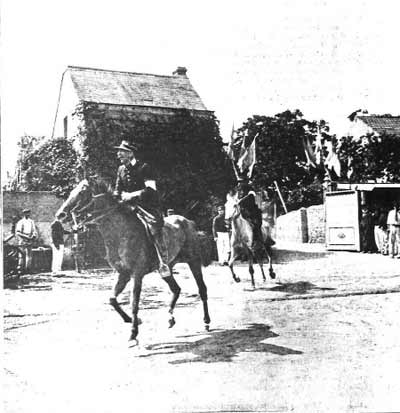
1904, Lyon - Vichy, the first two finalists Capitaine Muguet and M. George


In its 24th year with the FEI – Endurance became an FEI discipline in 1982 – Endurance has come to be the Federation’s fastest growing discipline. In 1982, there were four international rides. This number slowly increased to an average of 18 rides per year up until 1998 when the World Championships were held in the United Arab Emirates. Thanks to the sponsorship of the UAE National Federation, 47 NFs came from all over the world to compete. This huge attendance proved to be the catalyst for an amazing growth in participation. This tendency was confirmed in 2005, when the 353 international competitions made Endurance second only to Jumping and Eventing. The area with the biggest growth being South America.

Modern competitions consist of a number of sections called phases. At the end of each phase, in principle at least every 40 km, there is a compulsory halt for veterinary inspection, usually referred to as a vetgate. Riders are free to choose their own pace between the start and the finish of the competition. They may lead or follow their horses, but must be mounted crossing the starting line and the finish line. Each horse, which is thoroughly examined before it is allowed to start the ride, must be presented for inspection within a set time of reaching each vetgate. The aim of the check is to determine whether the horse is fit to continue the ride.A final veterinary inspection occurs at the end of all rides to ensure that horses completing the ride are not overly fatigued or lame. Excessive fatigue, signs of lameness and other indications of problems are grounds for elimination.

It can take years for a combination to be ready to compete in a 160 km ride. Endurance requires extensive preparation and a deep knowledge and understanding between horse and rider. In this way the well being of the horse can be maintained at all times.

The minimum distance for a one day competition is between 40 and 160 km, depending on the type of competition. For competitions of more than one day, the minimum average distance for each day is 40 - 79 km for FEI * rides, 80 km to 119 km for FEI 2* and 120 km or more for FEI 3* events. For a Championship FEI 4* one-day competition, the distance is usually 160 km and the winning riding time about ten to twelve

Full Page


FEI Endurance Factsheet


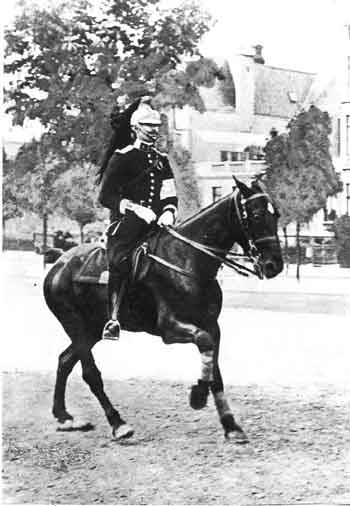
1905, Bruxelles, Capt. Bausil

Thursday, January 04, 2007

Understanding Your Horse Insurance Responsibilities

Provided by The American Association of Equine Practitioners

Whether a horse is purchased for personal or business reasons, ownership represents a significant investment of time, money and resources. While no one likes to think about the potential for tragedy, horses seem to be prone to illness, accidents and injury. Should some peril befall your horse, nothing may ease the emotional burden, but wise planning can help reduce the economic impact.

Insurance policies are legal contracts between the underwriter (the company) and the insured (horse owner). While individual policies vary so much from company to company and circumstance to circumstance, it is important to note is that each policy has its own terms, conditions and requirements, which may necessitate action from you, your veterinarian and your insurance company. To better safeguard yourself and your horse, follow these guidelines from the American Association of Equine Practitioners (AAEP):

* Read the contract thoroughly before you apply for coverage.
* Ask the insurance representative to explain any words, phrases or provisions you do not understand completely.
* Know your responsibilities. What is required should your horse fall ill, become injured or die?
* Understand any specific guidelines for emergency situations. A crisis is not the time to be trying to interpret your policy's fine print or to look for contact phone numbers.
* If euthanasia is recommended, know what steps must be taken in order for a claim to be valid.
* Make a list of questions to ask your insurance agent or company.
* Define your needs.
* Comparison shop. Besides cost, buyers should look at the longevity and reputation of both the agency and the insurance carrier.

Common types of coverage available for horses include but are not limited to:

* Mortality: Paid if the horse dies.
* Loss of Use: Paid on a percentage basis if horse is permanently incapacitated for its intended use or purpose.
* Major Medical: Like health insurance, offsets costs of veterinary care for catastrophic conditions.
* Surgical: Policies that cover only specific procedures such as colic surgery.
* Breeding Infertility: Covers stallions or mares for reproductive failure.
* Specified Perils: Includes any number of things such as lightning, fire or transportation.

For more information about equine insurance, ask your equine veterinarian for “Understanding Horse Insurance Responsibilities: Guidelines to Consider,” a brochure provided by the AAEP in conjunction with Bayer Animal Health, an AAEP Educational Partner. Additional information is available on the AAEP’s horse-health Web site, www.myHorseMatters.com.

The American Association of Equine Practitioners, headquartered in Lexington, Ky., was founded in 1954 as a non-profit organization dedicated to the health and welfare of the horse. Currently, the AAEP reaches more than 5 million horse owners through its over 9,000 members worldwide and is actively involved in ethics issues, practice management, research and continuing education in the equine veterinary profession and horse industry.

EquestrianMag article

Aligning Horse Owners with Conservationists

Equestrian News Release

America cannot afford to lose the horse industry; its economic alone impact is huge. According to the American Horse Council’s study, the horse industry directly produces goods and services of $25.3 billion and has a total impact of $112.1 billion on U.S. gross domestic product. This same study reveals that there are 7.1 million people involved in the horse industry, with 1.9 million of those actually owning horses.

All over the country, equestrians are faced with the impending loss of their open land. Leading horse organizations have identified loss of open land as the greatest threat to their future and the need to address this problem is urgent. According to David O’Connor, president of the U.S. Equestrian Federation, “With the suburban sprawl that is going on around the country, people who ride horses are losing vital resources. Partnerships … are needed to guarantee the future of equestrian sports and all types of equestrian access.”

Equestrians share a special privilege: the permission to ride over magnificent open spaces on private land. They owe a debt of gratitude to the landowners who have conserved their land for future generations. The good news is that the rate of land has tripled in the last five years.

Private voluntary land conservation is an important American tradition. The future of America’s natural heritage and the horse industry may well depend on it.

It is time for members of the horse industry and land conservationists to align forces to protect the land that sustains the soul as well as the economy. Equestrians can generously contribute to land conservation organizations as members, donors and volunteers, and everyone can support policies that promote land conservation at the national and state level. In 2006, $6.7 billion in public funding was approved in 133 ballot initiatives across the country, including California, Georgia, New Jersey, North Carolina and Texas. This compares to $1.5 billion in new conservation ballot initiatives in 2005.

Horse farm owners, among other landowners, have the additional choice of placing a conservation easement on their land. The first step is to approach the experts at saving land in America: land trusts. A land trust is a private, nonprofit organization that protects land through acquisition of development rights or land fee simple. Land trusts work with willing landowners to complete voluntary transactions. 1,667 land trusts are operating at the local, regional, state, or national level in the United States. Together, these groups have protected more than 37 million acres.

Successful Partnerships:

The running of the Kentucky Derby each May is a reminder of the great interest Americans have in horses. For decades, champion horses like Seattle Slew, the Triple Crown winner in 1977, and Smarty Jones, the 2004 Kentucky Derby and Preakness Stakes winner, have thrived on the bluegrass and calcium-rich water of central Kentucky at Three Chimneys Farm. Through the donation of two voluntary conservation agreements to the Bluegrass Conservancy, Three Chimneys Farm owners Mr. and Mrs. Robert N. Clay have chosen to permanently preserve their land as a working farm for America’s great champion thoroughbreds.

Another example is the protection of 421 acres of Horizon Farm in Barrington Hills, Illinois created possibly the largest private land conservation easement in the state of Illinois. The Farm has been owned and operated by William J. McGinley and his family since 1983 as an extensive and active Thoroughbred breeding and foaling farm. At one time, seven stallions were standing and eighty mares were foaled each year. However, Barrington Hills is a developer’s dream.

“Horizon Farm is a wonderful place that deserved to be preserved on its own merit. When you add in the factor that it is also a major horse farm, it makes ELCR doubly delighted that it was saved,” says Kandee Haertel, Executive Director of ELCR. “This was a case where ELCR can do what it does best – Put the parties together and keep them focused on their goals. In this case the goal was preserving Horizon Farm.” The completed easement was the product of efforts by the McGinley family, the Barrington Hills Conservation Trust, The Conservation Foundation and the Equestrian Land Conservation Resource.

The preservation of Horizon Farm is a clear illustration of what people dedicated to preserving land can accomplish. How did it happen? With motivation, partnership, trust and commitment shared by all parties.

Pace Of Land Conservation Triples From 2000 – 2005:

A new report released by the Land Trust Alliance finds that the pace of private land conservation by local and state land trusts more than tripled between successive five-year periods from 2000 to 2005. America’s 1,667 state and local land trusts have doubled their conservation acres from 6 million to 11.9 million acres in the past five years – an area twice the size of the state of New Hampshire. The National Land Trust Census quantifies private, voluntary land conservation efforts in America and is the nation’s only such tabulation.

“The success of private land conservation boils down to this: When people appreciate the natural qualities of their environment, they are increasingly taking steps in each of their communities to conserve what makes that land unique,” said Rand Wentworth, President of the Land Trust Alliance. “With the federal government reporting that we lose about two million acres to development sprawl each year, private, voluntary conservation gives everyday Americans the tools and resources they need to protect their natural heritage.”

New Federal Conservation Tax Incentive:

Last August, Congress and the President sent a strong message of support to citizens who work to preserve our natural and rural heritage. The President recently signed into law new land conservation tax benefits for landowners, especially family farmers and ranchers. The new regulations, included in pension reform legislation, combine an adjusted tax incentive for land conservation with common sense reforms to ensure the public benefit of conservation donations.

Voluntary conservation agreements, known as conservation easements, are an important tool for land conservation. When landowners donate voluntary conservation agreements to a land conservation organization or land trust, they protect resources important to the public by permanently giving up future development rights, while retaining ownership and management of the land. A conservation easement is a legal agreement between a landowner and a qualified conservation organization or government agency that runs with the land’s title and permanently limits a property's uses in order to protect its conservation values.

This new law will help landowners and land trusts protect important lands and traditional land uses across America. The law extends the carry-forward period for tax deductions for voluntary conservation agreements from 5 to 15 years and raises the cap on those deductions from 30 percent of a donor's adjusted gross income to 50 percent - and to 100 percent for qualifying farmers and ranchers. This allows landowners of all income levels to get a much larger benefit for donating very valuable development rights to their land. It is important to note that the incentive only applies to easements donated in 2006 and 2007. A strong and diverse coalition of hunters, farmers, ranchers, hikers and land trust supporters led by the Land Trust Alliance are hard at work to make the new incentive permanent.

Empowered with a conservation vision, new federal tax incentives, and the love of a horse, landowners and land trusts can take – must take – a running start in 2007.

About the Equestrian Land Conservation Resource: ELCR has been bringing awareness and literacy in land protection techniques to horse people for years. Thus, informed horse owners will take action themselves in their local communities. ELCR is here to help you! Contact: info@elcr.org or 815-858-3501, website: http://www.elcr.org.

About Land Trust Alliance: Land Trust Alliance was formed in 1982 to advance the mission of land trusts. Since its inception, Land Trust Alliance has trained thousands of conservation leaders, won new federal tax incentives for conservation on private lands, and developed standards and practices to professionalize and safeguard land trust work. Land Trust Alliance connects land trusts, so that every land trust can benefit from the collective wisdom and innovations of the entire community. It is based in Washington, D.C. with field offices in most regions of the country. For more information, please visit http://www.lta.org.

EquestrianMag

Friday, December 29, 2006

Endurance.Net 10 Years Ago

http://web.archive.org/web/19970330035633/http://www.endurance.net/

Wednesday, December 27, 2006

Forest Service to take stock of facilities

Agency faces "tough decisions" to close some sites, add fees to others

By Patrick Hannigan

Beginning in April 2007, the Okanogan and Wenatchee National Forests will rank all of its 300-plus developed recreation sites spread out across the four-million acre forest.

"Maybe the bottom 10 percent of sites need to be closed," said Jim Archambeault, recreation planner for the forest.

The process, officially known as Recreation Site Facility Master Planning (RSFMP), was initiated by an administrative rule change within the Forest Service in 2002. The directive required that every one of the roughly 15,000 campgrounds, picnic areas, scenic overlooks and trailheads with bathrooms on the 193 million acres under the agency’s authority be evaluated.

Those sites that fail to meet certain criteria will either be upgraded to fee sites, be turned over to private concessionaires for management or be closed.

"The broad goal is to take a close look at what it costs to operate developed sites in the forest, and try to align the facilities with the budget," said Archambeault. "Those ones that fall out of the bottom, we’ll need to make some real tough decisions."

Archambeault said the RSFMP plan for the Okanogan and Wenatchee National Forests would be completed by September 2007. He said outcomes of the plan might include closing lesser-used recreation sites, imposing new operating fees, or managing existing recreation sites differently.

Currently, the combined Okanogan and Wenatchee National Forests have roughly 300 developed recreation sites that will be included in the RSFMP review. That includes campgrounds, trailheads, overlooks, picnic areas, boat launches and interpretive sites.

The closures and new fees will mainly affect simple, remote facilities, wrote Dick Artley. Before retiring from the Forest Service in 2003, Artley spent the last 12 years of his career as a forest planner at the Nez Perce National Forest in central Idaho.

"This seems totally illogical and absurd," wrote Artley in an open letter published on the Internet Sept. 30. "We all know these "simple", "remote" facilities: 1) have very few improvements and 2) are easy to maintain and are maintained at minimum cost."

Crystal Perrow of Winthrop expressed similar concerns.

"A lot of the sites they are going to close are the unimproved sites that are the favorites of locals," said Perrow. "When we’re out camping, we don’t need hot running water and flush toilets – that’s not what we’re about in the Methow."

Perrow said she believes the RSFMP inventory is being conducted so the Forest Service can close down recreation sites that don’t make money. She said it seems to her as if the process is being conducted "on the sly."

"When does the public get a chop on this? Are our comments even going to make a difference?" asked Perrow. "There’s just not much that’s known."

Archambeault said the public eventually would have an opportunity to comment on the process, but conceded that Forest Service had not developed specific plans for public feedback.

"We haven’t really thought about it yet in terms of how to involve the public, but there will be public involvement," said Archambeault. "It could involve some public meetings or an open house. I can’t say right now how we’re going to do that."

Other national forests have already completed their RSFMP plans and have begun implementation with little or no public notice, said Kitty Benzar, co-founder of the Western Slope No Fee Coalition, a Colorado-based group that opposes new user fees on public lands.

"They’ve offered no opportunity for meaningful public comment," said Benzar. "The end result is going to be the privatization of our national forests for operation as for-profit enterprises."

Since the RSFMP process for the Okanogan and Wenatchee National Forests has not started, it unclear what specific implications the resulting plan will have for recreation opportunities in the national forest surrounding the Methow. Currently in the Okanogan and Wenatchee National Forests, 80 of the approximately 160 campgrounds charge fees, and 102 of roughly 140 (or 73 percent) of the major trailheads charge fees.

Isabelle Spohn of Twisp said she is concerned the RFSMP will result in more new fees and the closure of many free recreation sites that Methow locals have been visiting for decades.

"The irony is that a lot of people have stopped going to the national forests because of all the user fees, so now the Forest Service is going to close down these sites because people use them less," said Spohn. "It’s sort of a self-fulfilling prophecy."

Methow Valley News

Saturday, December 23, 2006

Herpesvirus-Exposed Horses Located in 10 States

Herpesvirus-Exposed Horses Located in 10 States from “The Horse”

by: Erin Ryder, Staff Writer

December 19 2006 Article # 8463

The 14 horses imported and quarantined with the animal believed responsible for the outbreak of equine herpesvirus type-1 (EHV-1) in Wellington, Fla., have been located, according to Jim Rogers, media coordinator for the USDA's Animal and Plant Health Inspection Service (APHIS).

Rogers said the state veterinarians of Massachusetts, New Hamphsire, Rhode Island, Pennsylvania, Tennessee, Kentucky, North Carolina, and South Carolina have been notified that horses exposed to EHV-1 were shipped to their states. There have been three deaths in Florida and one in California, all of which can be traced back to contact with horses on this shipment.

According to Rogers, no clinical cases of EHV have been reported other than those in Florida and California. As EHV is not considered a reportable disease it is up to state veterinarians---not the USDA--to monitor and control any outbreaks.

The imported horses arrived at the USDA New York Animal Import Center (NYAIC) in Newburgh, N.Y., from Germany on Nov. 24 and left Nov. 27. Rogers said that one horse had a fever while in quarantine, but the horse improved and was not showing any clinical signs at the time it was released.

"The horses were released based on no clinical evidence of disease at the time of release," Rogers said. "They did not have fevers and all appeared healthy."

According to Rogers, no changes to the quarantine procedures at the NYAIC are expected in the wake of this outbreak. The facility remains open.

"Each shipment is quarantined by itself in one barn," Rogers explained. "There were 15 horses in this shipment, and these horses did not come into contact with any other horses. In NYAIC there are multiple barns, and only one shipment of horses goes into a barn at a time. Once the shipment is released, the barn is cleaned and disinfected before the next shipment is placed in that space."

Thursday, December 21, 2006

Saturday, December 16, 2006

The Twelve Days of Basecamp

On the Twelfth Day of Basecamp, my true love gave to me:

Twelve Port-a-Potties,
Eleven Pipes a-Freezin',
Ten Horses Leaping,
Nine Ladies Dancing, (the pee-pee dance)
Eight Oversleepers,
Seven Generators,
Six LD's Racing,
Five Horses LOOOOOOSE!
Four Falling Turds,
Three trashed pens,
Two Purple Gloves,
I Won't Ride 'Til I Have My Coffee!!!!!!!!!!!!!!!!!!!!!!!!!!

submitted by Bruce Weary

Tuesday, December 12, 2006

FEI ENDURANCE QUESTIONNAIRE – 2006

By Leonard Liesens
Endurance-Belgium.com

[Leonard: In preparation for the FEI Endurance Forum that will take place in Paris in march, the FEI drafted a questionnaire. FEI asks every rider to fill this questionnaire. It seems nevertheless that the action is not completely 'innocent' as the FEI seems to want to dilute strong opinions in the mass. Is the intention of the FEI to cancel the decisions made when the Toulouse Group put a lot of pressure on the FEI? The Toulouse group led by Pierre Cazes and Suzanne Dollinger spontaneously gathered to fight against some bending of the FEI regulations. The 160km distance as the Championship distance was the warhorse of the Group. And now, the question comes again in the spotlights. It is great time for the defenders of the 160Kms to come out of the shade..
Your thoughts?]


For completion by FEI Endurance Registered Riders

The FEI requests the assistance of all FEI Registered Endurance riders by completing this questionnaire. The information provided will give a more complete picture of what is happening within the sport at this time and, further, what is considered important for the development of FEI Endurance in the years to come.

The statistics produced from the questionnaire will be published on the FEI web site and tabled at the 2007 World Endurance Forum in Paris in March.

The FEI would like to thank you for taking the time to complete the document and for returning it by email to : Emilie Leyvraz at e.leyvraz@horsesport.org


Original Endurance-Belgium Report
View The Questionnaire

Treating Metabolic Problems at Endurance Rides

By Langdon Fielding, DVM, and Gary Magdesian, DVM, DACVECC, DACVIM, DACVP (clinical pharmacology)

The following article describes an approach to the treatment of horses presenting for veterinary medical care at an endurance ride. This outline is based on our experiences from the Western States 100 mile trail ride (Tevis Cup) for the 2005 and 2006 year as well as horses referred to our respective hospitals over the last five to 10 years from rides in the northern California area. We have been fortunate to work with a number of experienced veterinarians in this sport who have shared their insight and experience and we offer this article as a collective summary of this knowledge.

Endurance horses are pulled from rides and present for medical treatment for a variety of causes, but they are typically categorized as a metabolic or lameness problem. This article will focus on horses with metabolic problems. It describes a general approach to all of these horses and then adds specific notes for some of the more common conditions.

General approach


The treatment of endurance horses with metabolic problems can be summarized: To identify those horses with inadequate perfusion (oxygen delivery to muscle, intestine, etc.) and to restore it as quickly as possible.

[More: AERC Vet Newsletter #2]

Statisics on the Use of the CRI at the Tevis Cup

The Western States Trail Ride veterinary staff, led by Greg Fellers, DVM, collected cardiac recovery index (CRI) data on horses at the 2005 Tevis. The data was collected on horses during an exit exam at the first one hour hold at mile 36. The pulse criteria at this check point was 60 bpm. The data was collected in order to determine if an exit CRI was a useful indicator for performance of the horse later in the ride. Following are the results:

Total # CRIs performed146Completion rate - HR up by 4 bpm over resting HR58% (33)
Total # horses out of check point147Completion rate - HR up by 8 bpm over resting HR43% (23)
Overall completion rate59%Completion rate - recovery HR 48 bpm or less62% (74)
Completion rate - no change in CRI63% (90)Completion rate - recovery HR 60 bpm or greater44% (25)


These figures point out the positive correlation between a passing CRI and the probability that the horse will complete the ride. This suggests riders and veterinarians should watch horses more closely with a questionable CRI as the statistical odds of completing decreases with a CRI that does not return to resting heart rate.

(Editor's note: It should be noted though the CRI is a very valuable tool in assessing a horse's ability to continue, it should be just one of our tools that we use as part of the whole picture to evaluate the horse's ability to continue and not used solely on its own.)

Source: AERC Vet Newsletter #2
a>

Monday, December 11, 2006

FEI Athlete Doping Control Stations

To: Show management, secretaries and organizers of FEI level shows
From: Sara Ike, USADA/WADA liaison
Date: December 11, 2006
Re: Athlete Doping Control Stations

Please be advised that as per the FEI General Regulations Article 145.5, any International competitor may be tested for prohibited substances according to the World Anti-Doping Code in competition with no advance notice.

Therefore it is possible that Doping Control Officers (DCOs) may arrive at your show with no advance notice and you will be asked to provide a venue for athlete drug testing.

Guidelines for a suitable doping control station are:

· reserved solely for doping control
· handicap accessible
· restricted access by authorized personnel only
· secure enough to store drug testing equipment
· private
· ideally comprised of a waiting room, processing room, and male/female bathrooms
· at least two tables for processing
· chairs
· a trash can
· appropriate lighting

If you have any further questions, please don’t hesitate to contact me at 908-326-1164 or via email sara.ike@usef.org

Happy Holidays!

Sincerely,
Sara Ike

Friday, December 08, 2006

Saturday, November 18, 2006

Thoughts on the WEC

Here's a real challenge: there are many in the sport(and in FEI as well) who feel that endurance courses need a greater level of 'technical' challenge. Some of the other disciplines were rather appalled after the Endurance competition in Aachen - the general press was not kind. They described it as 'too demanding, not enough horsemanship, too impersonal (grooms and pit crews), too disorganized, too hard on the horses...etc. There will be an FEI endurance forum sometime in the future where people can talk about issues of concern with each other and with those who are in the position to create or change the rules of the sport. One of the issues of concern (both within and outside of the FEI) is the nature of the sport as it has developed over the past decade. That is, a fast 'race track' course has replaced the traditional (Tevis course) concept of Endurance riding. It takes less horsemanship to jockey a horse over a flat track than over a challenging technical trail.

So, given the fact that some places simply don't have the terrain for the classic technical challenge, how can we, or even 'can we' regulate the sport so that it is more appealing, less demanding on the horses, something greater than a 50% completion rate, a sport requiring more horsemanship?

Can we regulate the amount of 'technical trail' in any given event? i.e. x number of miles of difficulty or natural obstacle(hill, sand, rock, x-country, etc). How about scattering slalom sections along the trail (can those horses turn?).

any ideas??

Steph

2008 WEC in Malaysia

To Dr Nik Isahak Wan Abdullah

I do not know much at all about endurance in Malaysia, but would like to learn. You said in a recent post:

You say, "We do not know the undercurrent of politics behind this but having the right people saying the right things for Malaysia is not a loss .The PR job has yet to be done internationally otherwise we may find WEC 2008 shifted to Doha or Dubai .PR savvy does not mean we need to expand a lot of money but the right press and endurance people need to be 'invited' ."

What can I do here in Australia to "say the right thing for Malaysia"?
What do you want said in order to convince all endurance riders that the WEC should stay in Malaysia?

How can I help make sure that Australians know about what riding conditions are like where the WEC is scheduled for, and how can I explain to Australians the best conditions in which to train their horses for a ride there? We don't know what the track will be like, and we don't know what the conditions will be like.

I know many Australian endurance riders who are hoping to qualify for this ride, however they would like more detailed information about it. What can I do to help?

I train horses in Queensland, with some measure of success, and am also hoping to have horses qualified for this ride. I am also willing to visit the area in advance in order to get a first-hand view.

Please let me know what I need to know. Please let me know who to contact for this information if you are unable to help.

Best regards

Jay Randle
SPLENDACREST ENDURANCE TRAINING
www.freewebs.com/splendacrest

All About Bitless Bridles