Thenakedhoof.com - Full Article
Posted on September 7, 2010 by thenakedhoof
Does every human have the same foot? Can you say that for us to walk, run, dance or jump we must all have feet that follow the same exact structure and shape? Do we create the same footprint? Of course not: that would be ridiculous.
Some of us have narrow feet, some wide, some with the second toe longer than the big toe and some of us have higher arches than others. We mange to be ballerinas, gymnasts, ultra runners and hikers with these variations. Beauty is found when form and function come together to create movement.
Why, then, is it that we seem to get stuck in the shod paradigm of thinking, even when barefoot, that all hooves must follow the same rules? Is it possible to have hooves that are not perfect as we have been trained to see, yet perfect in function?
Read more here:
http://thenakedhoof.com/2010/09/07/formandfunction/
Tuesday, September 07, 2010


Sunday, September 05, 2010
Hoof and thermographic images: What is Normal?
Duncan's ramblings: http://easycarenews.com/08-30-2010/articles/what-is-normal/
Thermography provides you with a non-invasive, objective reading of the circulatory and inflammatory status of your horse by measuring heat. In conjunction with EasyCare, I am using thermographic techniques to investigate any differences in the heat distribution through the hoof and lower limb of horses using different hoof protection protocols (barefoot, booted and shod). As it will be a while before we finish collecting and collating that data, I thought you might be interested in viewing a few images in the interim.
Dorsal view of a near fore hoof belonging to a well performed barefoot endurance horse. The middle image is a thermograph of the hoof prior to a half hour of barefoot (unbooted), low-intensity exercise on a sand surface. The third image is a themograph of the same hoof immediately on cessation of exercise.
... more at http://easycarenews.com/08-30-2010/articles/what-is-normal/
Thermography provides you with a non-invasive, objective reading of the circulatory and inflammatory status of your horse by measuring heat. In conjunction with EasyCare, I am using thermographic techniques to investigate any differences in the heat distribution through the hoof and lower limb of horses using different hoof protection protocols (barefoot, booted and shod). As it will be a while before we finish collecting and collating that data, I thought you might be interested in viewing a few images in the interim.
 |  |  |
Dorsal view of a near fore hoof belonging to a well performed barefoot endurance horse. The middle image is a thermograph of the hoof prior to a half hour of barefoot (unbooted), low-intensity exercise on a sand surface. The third image is a themograph of the same hoof immediately on cessation of exercise.
... more at http://easycarenews.com/08-30-2010/articles/what-is-normal/
Thursday, September 02, 2010
Tending to Tender Feet
Thehorse.com - Full Article
by: Karen Briggs
October 03 2001, Article # 395
Although the equine hoof is a marvel of resiliency, it's not made of rubber, or titanium, or diamond. As a living structure, it has its vulnerabilities, and when faced with unusual stresses, it shows them. Stone bruises, those reddish-purple (on a white hoof) or dark gray (on a dark hoof) spots sometimes visible on the soles of your horse's feet, especially right after the farrier's knife has removed the surface crud, are one of the most common signs that the hoof has taken some abuse. But by the time you see the bruise, it's just a reminder of a long-past trauma; the injury is already several months old.
Fortunately, stone bruises usually aren't serious. When they're fresh, they can cause minor lameness, for a few minutes or a few days. Some horses seem to be able to ignore them better than others. But if a stone bruise happens right before an important competition, it's a crisis. If your horse shows a predilection for repeatedly bruising his soles, it's a chronic problem that you'll want to solve.
Stone bruises generally are the product of your horse's environment. Traveling on hard, rocky ground can batter your horse's soles, especially if he's used to more manicured conditions. (Remember as a kid how you tiptoed very gently over a gravel driveway early in the summer, yelping, "Ouch, ouch, OUCH!" before your bare feet had gotten tough?) But a hard knock against a solid object (a fence rail or a tree root, for instance), can have the same effect. So can shoes that are too small, or those equipped with caulks, grabs, or trailers that alter the foot's natural flight path, or concentrate an unusual amount of pressure on a small area...
Read more here:
http://www.thehorse.com/ViewArticle.aspx?ID=395
by: Karen Briggs
October 03 2001, Article # 395
Although the equine hoof is a marvel of resiliency, it's not made of rubber, or titanium, or diamond. As a living structure, it has its vulnerabilities, and when faced with unusual stresses, it shows them. Stone bruises, those reddish-purple (on a white hoof) or dark gray (on a dark hoof) spots sometimes visible on the soles of your horse's feet, especially right after the farrier's knife has removed the surface crud, are one of the most common signs that the hoof has taken some abuse. But by the time you see the bruise, it's just a reminder of a long-past trauma; the injury is already several months old.
Fortunately, stone bruises usually aren't serious. When they're fresh, they can cause minor lameness, for a few minutes or a few days. Some horses seem to be able to ignore them better than others. But if a stone bruise happens right before an important competition, it's a crisis. If your horse shows a predilection for repeatedly bruising his soles, it's a chronic problem that you'll want to solve.
Stone bruises generally are the product of your horse's environment. Traveling on hard, rocky ground can batter your horse's soles, especially if he's used to more manicured conditions. (Remember as a kid how you tiptoed very gently over a gravel driveway early in the summer, yelping, "Ouch, ouch, OUCH!" before your bare feet had gotten tough?) But a hard knock against a solid object (a fence rail or a tree root, for instance), can have the same effect. So can shoes that are too small, or those equipped with caulks, grabs, or trailers that alter the foot's natural flight path, or concentrate an unusual amount of pressure on a small area...
Read more here:
http://www.thehorse.com/ViewArticle.aspx?ID=395
Saturday, August 28, 2010
Signs of Poor Saddle Fit
Equisearch.com - Full Article
In the April 2010 issue of EQUUS magazine, Dr. Deb Bennett discusses back shape and saddle fit. Here are unmistakable signs of a mismatch.
By Christine Barakat
White spots on a horse’s otherwise dark withers are a telltale and unfortunately irreversible sign of an ill-fitting saddle. They appear because intense, localized pressure has so damaged the hair follicles that pigment no longer can be dispersed throughout the hair shaft.
Pressure spots can become apparent in a matter of days on particularly sensitive horses or it may take weeks of repeated trauma for them to emerge. They may become sharper as the hairs that were subjected to less pressure on the perimeter recover, but to some degree they always will remain.
Gray horses may develop black spots as a result of pressure injuries...
Read more here:
http://www.equisearch.com/horses_riding_training/tack_apparel/english/poor_saddle_fit_signs_031910/?utm_source=eqs&utm_medium=nl&utm_campaign=eqs
In the April 2010 issue of EQUUS magazine, Dr. Deb Bennett discusses back shape and saddle fit. Here are unmistakable signs of a mismatch.
By Christine Barakat
White spots on a horse’s otherwise dark withers are a telltale and unfortunately irreversible sign of an ill-fitting saddle. They appear because intense, localized pressure has so damaged the hair follicles that pigment no longer can be dispersed throughout the hair shaft.
Pressure spots can become apparent in a matter of days on particularly sensitive horses or it may take weeks of repeated trauma for them to emerge. They may become sharper as the hairs that were subjected to less pressure on the perimeter recover, but to some degree they always will remain.
Gray horses may develop black spots as a result of pressure injuries...
Read more here:
http://www.equisearch.com/horses_riding_training/tack_apparel/english/poor_saddle_fit_signs_031910/?utm_source=eqs&utm_medium=nl&utm_campaign=eqs
Seeking Solutions to Separation Anxiety
Thehorse.com - Full Article
by: Christa Lesté-Lasserre
August 26 2010, Article # 16868
When teaching young horses to accept separation from their pasturemates, it might seem like a good idea to train them in pairs first for a while before training them alone. However, new equitation science research suggests that pairing them up might just delay the anxiety of separation and, in the end, the results of this method don't differ much from those of immediate individual separation.
Elke Hartmann, PhD, researcher in the department of animal environment and health at the Swedish University of Agricultural Sciences in Uppsala, presented her team's research on the topic at the sixth International Equitation Science Conference in Uppsala on Aug. 2. She and her colleagues divided yearling and 2-year-old Warmblood mares into two groups for a monthlong test period of social separation methods. The test comprised three successive steps, with each step representing greater distance away from the herd. Before moving on to a new step, the horses had to succeed in the previous one (by showing calm feeding patterns).
Researchers separated the horses in one group from their pasture herd for daily individual training sessions. In the other group, investigators separated the animals in pairs first, but when these paired horses were feeding calmly at the final testing area, they repeated the training steps with each horse individually...
Read more here:
http://www.thehorse.com/ViewArticle.aspx?ID=16868
by: Christa Lesté-Lasserre
August 26 2010, Article # 16868
When teaching young horses to accept separation from their pasturemates, it might seem like a good idea to train them in pairs first for a while before training them alone. However, new equitation science research suggests that pairing them up might just delay the anxiety of separation and, in the end, the results of this method don't differ much from those of immediate individual separation.
Elke Hartmann, PhD, researcher in the department of animal environment and health at the Swedish University of Agricultural Sciences in Uppsala, presented her team's research on the topic at the sixth International Equitation Science Conference in Uppsala on Aug. 2. She and her colleagues divided yearling and 2-year-old Warmblood mares into two groups for a monthlong test period of social separation methods. The test comprised three successive steps, with each step representing greater distance away from the herd. Before moving on to a new step, the horses had to succeed in the previous one (by showing calm feeding patterns).
Researchers separated the horses in one group from their pasture herd for daily individual training sessions. In the other group, investigators separated the animals in pairs first, but when these paired horses were feeding calmly at the final testing area, they repeated the training steps with each horse individually...
Read more here:
http://www.thehorse.com/ViewArticle.aspx?ID=16868
Monday, August 16, 2010
That Big Trot
http://blog.easycareinc.com/blog/easycare/0/0/that-big-trot
Monday, August 16, 2010 by Duncan McLaughlin
Endurance riders love a BIG trot. When looking at your upcoming superstar or admiring how your favourite horse trucks down the trail, nothing excites more Oohs and Aahs amongst endurance riders than that big trot. Many endurance horses, maybe yours, undertake most of their competition miles in that big trot. I would like to suggest there are a number of reasons why the big trot is not the be-all and end-all and that more canter should be included when covering distance, for a number of reasons including:
1. Energy efficiency;
2. Scapular inhibition; and
3. Lumbar/sacral strain.

photo: This horse clearly demonstrates all the hallmarks and pitfalls of a big trot. Although momentum plays some part in his extravagant movement, this degree of limb hyperextension requres a significantly higher degree of muscular effort than would a more modest stride. His scapular (the large bone of the shoulder) is forced through an excessive range of motion with the scapular cartilage (at the top of the shoulder blade) hitting the saddle with each stride. His hind legs are widely separated - one forward, one backward - placing excessive strain on the joints of the pelvis/sacrum and the lumbar region of the back. For these reasons, his neck is short, his back is hollow and his hindlegs show minimal joint flexion at hip, stifle and hock; instead they swing, pendulum-like, outside the path of the forelegs.
1. Energy Efficiency
When your horse moves in hyperextension, that is lengthening more than provided for by momentum, excessive muscular effort is required: extended gaits are not energy efficient. The further forward the hoof lands relative to the body mass, the more braking action occurs. Generally, a hyperextended hoof also stays on the ground for a longer period of time; tempo decreases as stride length increases. Muscular effort is required to overcome both the increased braking action and the inertia of the grounded hoof. From an energetic point of view, for most horses, any work faster than 15km/hr (ca 9mph) should ideally be performed at the canter rather than trot.
..full article at http://blog.easycareinc.com/blog/easycare/0/0/that-big-trot
-
Monday, August 16, 2010 by Duncan McLaughlin
Endurance riders love a BIG trot. When looking at your upcoming superstar or admiring how your favourite horse trucks down the trail, nothing excites more Oohs and Aahs amongst endurance riders than that big trot. Many endurance horses, maybe yours, undertake most of their competition miles in that big trot. I would like to suggest there are a number of reasons why the big trot is not the be-all and end-all and that more canter should be included when covering distance, for a number of reasons including:
1. Energy efficiency;
2. Scapular inhibition; and
3. Lumbar/sacral strain.
photo: This horse clearly demonstrates all the hallmarks and pitfalls of a big trot. Although momentum plays some part in his extravagant movement, this degree of limb hyperextension requres a significantly higher degree of muscular effort than would a more modest stride. His scapular (the large bone of the shoulder) is forced through an excessive range of motion with the scapular cartilage (at the top of the shoulder blade) hitting the saddle with each stride. His hind legs are widely separated - one forward, one backward - placing excessive strain on the joints of the pelvis/sacrum and the lumbar region of the back. For these reasons, his neck is short, his back is hollow and his hindlegs show minimal joint flexion at hip, stifle and hock; instead they swing, pendulum-like, outside the path of the forelegs.
1. Energy Efficiency
When your horse moves in hyperextension, that is lengthening more than provided for by momentum, excessive muscular effort is required: extended gaits are not energy efficient. The further forward the hoof lands relative to the body mass, the more braking action occurs. Generally, a hyperextended hoof also stays on the ground for a longer period of time; tempo decreases as stride length increases. Muscular effort is required to overcome both the increased braking action and the inertia of the grounded hoof. From an energetic point of view, for most horses, any work faster than 15km/hr (ca 9mph) should ideally be performed at the canter rather than trot.
..full article at http://blog.easycareinc.com/blog/easycare/0/0/that-big-trot
-
Saturday, August 14, 2010
Prepping for the first 50, Eating
Go Diego, Go!
As noted in yesterday's post - eating and drinking are a necessity in order to keep ourselves going down the trail. As riders, we often concoct very elaborate and well thought-out mixes and mashes for our horses, with a sprinkle of this, and a dash of that - ensuring that everything is to Shnoopykins desire - and then scrounge around for that 3 year old granola bar that's been riding around in our saddle packs as an afterthought for ourselves. While it may be entirely possible to get through a 6 hour LD on nothing but fluids, you are going to feel and perform much better with some fuel on board. This will just prove more true over longer distances.
There are some simple characteristics that foods must meet before I personally will consider them for rides. I have a sensitive stomach, and getting stuff down is sometimes a challenge.
1.
Some people are able to happily eat anything during a ride; I am NOT one of those people. So I have some guidelines that foods must meet for me:
Must be easy to eat with one hand, generally without utensils. I'm lucky to even take the time to wash my hands during a ride, the idea of dragging out a fork and knife to consume anything is not that likely. If for some reason I DO eat these kinds of foods, such as during a 100 when I have crew, I'll most likely still be seen sitting or wandering around near my horse doing stuff with one hand and shoveling food in with the other. Much easier to have food that I can just hold in one hand and eat.
2.
Must be moist. No cakes, cookies, chips, or crackers for this girl. I want something that's got a lot of natural moisture, or enough sauce and/or condiments to get down without a lot of additional assistance from chewing and saliva production.
3.
Along those lines, must be easy to chew and get down. Nothing that requires a lot of mastication before it's ready to be swallowed - save the steaks for after the ride.
4.
Not too sweet. I have a sensitive stomach during rides and too much sugar doesn't go over well. I generally prefer more salty and/or savory choices.
With that in mind, lets move on to what I actually like to eat, these are my own personal recommendations, as well as suggestions from several friends. For food to eat ON THE TRAIL:
[...more at http://dreammakker.blogspot.com/2010/08/prepping-for-first-50-eating.html]
As noted in yesterday's post - eating and drinking are a necessity in order to keep ourselves going down the trail. As riders, we often concoct very elaborate and well thought-out mixes and mashes for our horses, with a sprinkle of this, and a dash of that - ensuring that everything is to Shnoopykins desire - and then scrounge around for that 3 year old granola bar that's been riding around in our saddle packs as an afterthought for ourselves. While it may be entirely possible to get through a 6 hour LD on nothing but fluids, you are going to feel and perform much better with some fuel on board. This will just prove more true over longer distances.
There are some simple characteristics that foods must meet before I personally will consider them for rides. I have a sensitive stomach, and getting stuff down is sometimes a challenge.
1.
Some people are able to happily eat anything during a ride; I am NOT one of those people. So I have some guidelines that foods must meet for me:
Must be easy to eat with one hand, generally without utensils. I'm lucky to even take the time to wash my hands during a ride, the idea of dragging out a fork and knife to consume anything is not that likely. If for some reason I DO eat these kinds of foods, such as during a 100 when I have crew, I'll most likely still be seen sitting or wandering around near my horse doing stuff with one hand and shoveling food in with the other. Much easier to have food that I can just hold in one hand and eat.
2.
Must be moist. No cakes, cookies, chips, or crackers for this girl. I want something that's got a lot of natural moisture, or enough sauce and/or condiments to get down without a lot of additional assistance from chewing and saliva production.
3.
Along those lines, must be easy to chew and get down. Nothing that requires a lot of mastication before it's ready to be swallowed - save the steaks for after the ride.
4.
Not too sweet. I have a sensitive stomach during rides and too much sugar doesn't go over well. I generally prefer more salty and/or savory choices.
With that in mind, lets move on to what I actually like to eat, these are my own personal recommendations, as well as suggestions from several friends. For food to eat ON THE TRAIL:
[...more at http://dreammakker.blogspot.com/2010/08/prepping-for-first-50-eating.html]
Tuesday, August 10, 2010
Dental Dilemmas: Cheek Tooth Fractures, Treatment Characterized
Thehorse.com - Full Article
by: Stacey Oke, DVM, MSc
October 14 2007, Article # 10591
Cheek teeth fractures can lead to a number of unpleasant problems in the horse, from chewing discomfort to bad breath, and they tend to show up most often in the upper jaw. Sometimes these fractures can even go undetected, say researchers who recently completed a survey-based study of horses in Ireland and Great Britain.
Professor Paddy Dixon, MVB, PhD, MRCVS, from the Division of Veterinary Clinical Sciences, University of Edinburgh, a co-author on the retrospective study, said the scientists' aim was to determine the nature, clinical effects, and prevalence of cheek teeth fractures in the general equine population in Britain and Ireland. Questionnaires were dispersed to experienced members of the British equine Veterinary Association (BEVA) Dental Working Party and BEVA-certified equine dental technicians. Nineteen surveys were returned, which described 147 horses with 182 cheek teeth fractures.
"This study found that cheek teeth fractures occurred in 0.07-5.9% of examined horses and the majority of fractures (73%) were identified in the maxillary (the upper jaw) cheek teeth," reported Dixon...
Read more here:
http://www.thehorse.com/ViewArticle.aspx?ID=10591
by: Stacey Oke, DVM, MSc
October 14 2007, Article # 10591
Cheek teeth fractures can lead to a number of unpleasant problems in the horse, from chewing discomfort to bad breath, and they tend to show up most often in the upper jaw. Sometimes these fractures can even go undetected, say researchers who recently completed a survey-based study of horses in Ireland and Great Britain.
Professor Paddy Dixon, MVB, PhD, MRCVS, from the Division of Veterinary Clinical Sciences, University of Edinburgh, a co-author on the retrospective study, said the scientists' aim was to determine the nature, clinical effects, and prevalence of cheek teeth fractures in the general equine population in Britain and Ireland. Questionnaires were dispersed to experienced members of the British equine Veterinary Association (BEVA) Dental Working Party and BEVA-certified equine dental technicians. Nineteen surveys were returned, which described 147 horses with 182 cheek teeth fractures.
"This study found that cheek teeth fractures occurred in 0.07-5.9% of examined horses and the majority of fractures (73%) were identified in the maxillary (the upper jaw) cheek teeth," reported Dixon...
Read more here:
http://www.thehorse.com/ViewArticle.aspx?ID=10591
Diagnosing Insulin Resistance: Q&A with Researchers
Thehorse.com - Full Article
by: Kathryn Watts, BS
August 28 2008, Article # 12588
Over the past few years researchers have described a strong association between insulin resistance and laminitis in equines. They are working now on defining standard testing protocols and interpretations to identify horses at highest risk for laminitis. Many questions remain unanswered. How should insulin resistance be defined and diagnosed? How do researchers interpret test results? Can blood tests alone determine the risk of our horse or pony to get laminitis? Until they have more solid science to configure a standard definition of equine insulin resistance, those attempting to define it might find themselves in the same predicament as the proverbial group of blind men describing an elephant.
A study in the United States showed that laminitis affected 2% of all horses, with the incidence going up to 5% in spring, which is when grass sugars peak. The ability to identify high risk animals before laminitis strikes is essential, as this can allow caretakers to implement appropriate management practices to prevent it. Sinking or rotation of the coffin bone requires treatment and rehabilitation regimes that can be difficult, long, expensive, and emotionally draining. Even then, the treatments often fail. But how do we identify the high-risk animal? Of course any horse that has had a brush with laminitis should have tests for underlying endocrine problems, but certain physical characteristics should lead proactive owners to test for insulin resistance.
A "cresty neck" is the classic sign of insulin resistance, and researchers note a solid correlation between neck circumference and the condition. Horses that gain weight much more quickly, often described as "blowing up on grass" than their herdmates under similar management, might be candidates for testing, especially if they also exhibit signs of foot tenderness. Additional signs are rings on the hoof wall, or a stretched white line with blood specks when the foot is viewed from the bottom, both which could be indications of a previous mild case of laminitis...
Read more here:
http://www.thehorse.com/ViewArticle.aspx?ID=12588
by: Kathryn Watts, BS
August 28 2008, Article # 12588
Over the past few years researchers have described a strong association between insulin resistance and laminitis in equines. They are working now on defining standard testing protocols and interpretations to identify horses at highest risk for laminitis. Many questions remain unanswered. How should insulin resistance be defined and diagnosed? How do researchers interpret test results? Can blood tests alone determine the risk of our horse or pony to get laminitis? Until they have more solid science to configure a standard definition of equine insulin resistance, those attempting to define it might find themselves in the same predicament as the proverbial group of blind men describing an elephant.
A study in the United States showed that laminitis affected 2% of all horses, with the incidence going up to 5% in spring, which is when grass sugars peak. The ability to identify high risk animals before laminitis strikes is essential, as this can allow caretakers to implement appropriate management practices to prevent it. Sinking or rotation of the coffin bone requires treatment and rehabilitation regimes that can be difficult, long, expensive, and emotionally draining. Even then, the treatments often fail. But how do we identify the high-risk animal? Of course any horse that has had a brush with laminitis should have tests for underlying endocrine problems, but certain physical characteristics should lead proactive owners to test for insulin resistance.
A "cresty neck" is the classic sign of insulin resistance, and researchers note a solid correlation between neck circumference and the condition. Horses that gain weight much more quickly, often described as "blowing up on grass" than their herdmates under similar management, might be candidates for testing, especially if they also exhibit signs of foot tenderness. Additional signs are rings on the hoof wall, or a stretched white line with blood specks when the foot is viewed from the bottom, both which could be indications of a previous mild case of laminitis...
Read more here:
http://www.thehorse.com/ViewArticle.aspx?ID=12588
Thursday, August 05, 2010
Tevis Run! Western States 2010, Patience Keeps ya Strong
I'm posting this article in the wake of the Tevis ride, just amazed that a human can do this! Steph
---
Western States 2010, Patience Keeps ya Strong
pureh2o | July 23, 2010 at 9:57 pm | Categories: 100 Mile, race report, trail run | URL: http://wp.me/pkRTw-7P
by Franz Dill
Everyone in the world of ultrarunning knows what the Western States 100 Mile Endurance run is, and if ya don't I'm not saying you're a freak (because we all are) but you are an oddity beyond the normal ultrarunner. In a nutshell, Western States is the equivalent of the Boston Marathon to marathons: Rich in history, runner loyalty, and one of a handful of events that, seemingly every ultrarunner attends in some capacity: running, crewing, pacing, or spectating.
To set the mood, this year's race morning began with a lunar eclipse followed by an evening's full moon - the magic of Western States was mounting in full force. Upon arrival I knew this 100 mile race was different, special. Walking legends were abound: Hal Koerner, Anton Krupicka, Kilian Jornet Burgada, Brian Morrison, Gordy Ansleigh, Geoff Roes, and loads more I couldn't recognize. During pre-race, the runner's faces read like a multi-year book of anticipation, the final chapter would begin today. How would each runner's story end?
My race day goal was to run the beginning of the race conservatively at a 25 - 26 hour finishing pace. Then at Michigan Bluff pick-up speed and finish sub-24, heeding the often thrown around phrase "the race begins at Foresthill". Given that the back-end of the race is extremely runnable if, and that's a big IF, you have the legs a lot of time can be made up. Making the decision to go sans pace chart I started the race with only time and heart rate to guide me. In retrospect a pre-race conversation that Jen and I was very foreshadowing: What finish time to you feel you've earned based on training alone? My answer 26 hours. Jen's answer 25 hours...
The initial climb to Escarpment was difficult and MANY went out extremely fast. I kept my heart rate below 160 most times and was passed in waves of runners. The snow slowed us and the climbs were steep, yet reaching the top was breath taking providing views of Squaw covered in wisps of morning fog under a cresting sunrise to one side and rolling peaks and canyons to Auburn and beyond on the other. I ran portions of this climb with good friend Jose Suarez and old-timer and multi-time grand slammer Bill Dodson (age 75) talking up the day ahead with childlike fervor. I saw flashes of good friend Eric Vaughan on the switchbacks ahead - he always zips out of the gate much faster than I.
Sumitting at 8,700 feet we were welcomed by a gong serenade and views spanning out to Auburn and beyond. It was a very Zen time in the race. Awaiting 1/4 mile down the trail was lots of snow, probably 7 miles of the stuff. I've never run in the snow but it was fun. The trails became a mix of running & skiing with a spattering of cartoon-like, leg flailing, falls. Being a 100 mile race I quickly noted a lot of energy can be expelled here and took it slow. Eventually the snow gave way but definitely not the terrain - it was replaced by numerous creek and river crossings. Our feet were soaked.
During a lengthy downhill run on a smooth fireroad leading to the Poppy Trailhead (mile 19.6) I ripped open a GU preceding my Garmin's 30 minute reminder beep, downed it, and immediately started my vomitous upheavals. I wondered off-trail in an attempt to hide it by pretending to ... "oh, just going to the bathroom over here... {upheave}". Oddly I wasn't panicked despite the best caloric weapon in my ultrarunning arsenal was now DOA. I did have my Suceed Ultra to keep the calories incoming but I needed to re-tool my fueling with only 20% of the race complete. Arriving at the aid station I found that fish crackers, saltines, fruit, and iced water worked well. As I later found, this is not the recipe for a fast race!
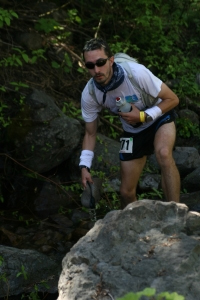 Cooling off Before Duncan Canyon. Photo by Facchino Photography
From Poppy Trailhead to Duncan Canyon (mile 23.8) I proceeded at a slow pace and let numerous runners pass. I took the time to dip my wide-brimmed trail hat in every stream crossing, warding off the rising heat. While running the banks of the French Meadows Reservoir, I shared the trail with Amy Palmiero-Winters who would later be the first amputee to complete the Western States 100. That day(s) she ran a course 2-3x more difficult than the one I ran yet she sustained an internal drive that was infectious. We ping-ponged back and forth as she stopped to make numerous adjustments to her prosthetic right leg, each adjustment varying between "hurt and hurt more" in her words. I would later run with her on the descent to the river.
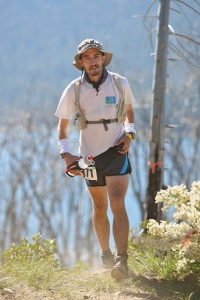 Duncan Canyon Just Ahead. Photo by Glenn Tachiyama
My fueling was supporting my slowed efforts reasonably well through Robinson Flat (mile 29.7) where I met my crew Jen, Sona, Brian, and Hao for the first time. After a snow covered maze leading into the aid station I heard the enthusiastic cheers erupt as I broke through the trees. Following the formal aid area I met my crew and was off with a wonderful turkey avocado wrap and my ipod playing Nutshell from Alice 'n Chains. I was helpless in holding back my tears, as that song links me to a past friend, Brian, that was taken by cancer at the age of 32. He was there with me that day call'n me crazy too.
The heat continued to increase on the wide sun baked fireroads leading to Miller's Defeat (mile 35.3). Yet, my body was well adapted because of my tri-weekly trips to the sauna and numerous bikram yoga classes that I started 4 weeks before race day. The heat was noticeable but not sapping - although I was seeing an increase in heat struggles with other runners.
I continued onward at a slow pace dictated by my low caloric fueling option and came into Last Chance (mile 43.3) slightly worn out and weighed in 2 lbs. light. A wonderful volunteer filled my bottles, walked me through the aid station, patiently waited as I picked over the food selection for fruit and crackers, then escorted me to the cold water bath and ice in my cool-off bandanna. Then she warned me with a stern voice, "You know what's next, right?" Yup, I knew and was looking forward to it... the climb up Devil's Thumb.
First the downhill. I was running the single track descent into the canyon a few steps behind another runner when he simultaneously stopped, screeched, and jumped up. I reacted fast enough to stop without tumbling down the cliff to our left. Peering around the startled runner I saw his source of fear, a 3 foot long rattlesnake in the trail ahead of him. He looked back and asked, "Is that a rattlesnake?" I clearly spotted the 4 buttons at the end of its tail and confirmed his fear. Fortunately the snake's primary concern was get off the trail. We skirted around it while I scoped the trail behind for other runners to warn. No one showed. I waited momentarily then scampered down the trail figuring the snake would be well clear when the next runner arrived.
I reached the Swinging Bridge and dipped my hat in the far-side water basin for the hot climb up Devil's Thumb. I knew I could climb this relatively hard based on my training runs. For 1/3 of the climb I power hiked aggressively and caught a number of runners. Then, well, my cracker fueling caught up and my Ferrari engine suddenly morphed into a Mack truck's diesel that was hauling a load over a Sierra mountain pass - I had the power but my was speed gone. And, I got really hungry and all I had was crackers. So I ate my goldfish and saltines, crumbled and soggy from the pre-climb head dunk. It was all I had to quench my sudden fueling uptake needs.
Making it to the top was wonderful. I sat for a moment while re-fueling with fruit, soda, and a popsicle. A runner next to me was suffer from moderate heat stroke, rocking back and forth rapidly and yelling "Oh God, Oh God, Oh God" while aid stations workers put cold water on his legs. It alarmed me enough to immediately stand and move on - aid station illness can be highly infectious!
I moved out to tackle the next canyon descent into El Dorado still feeling low on energy - soda slowly fell out of my menu too! At this point I was running on a fuel completely foreign to me during training, yet I knew eating was key in a successful finish. It was also this point that I pondered my finish time. 24 hours seemed fleeting yet I was still strong for 25. I had no worries though because choosing to run without a pace chart had the added benefit of allowing me the freedom to run to my body's signals which were telling me to take it slow and steady. I made it to El Dorado Creek (mile 59.2) and prepared for the climb to Michigan Bluff. Again, I fueled on fruit and crackers immediately feeling the drag of absent energy.
The climb passed and I emerged into Michigan Bluff (mile 55.7) with fresh legs but a stomach of hunger and pain. Seeing Jen, Hao, Sona, and Brian immediately perked me up. In fact I challenged Jen to a race back to the aid station! My immediate goal was to eat away my hunger pains. Going to it I hit the fruit and ordered some broth then sat down to chug some V8. Like a villain inching his way on stage, the dreaded nausea reared its head. I made some signal to my crew that I was in trouble, Hao reached over and performed a Vulcan nerve pinch on my hand. But nothing was slowing this assassin's strike. I had just enough time to stand, walk 5 feet, then clutch the chain-link fence and assume my most submissive bikram posture. In a series of 5-7 cat-like back arching upheavals I was done. Then one more to be sure. Mixed in the grass below me was my fruit buffet of 3 minutes earlier. All I could muster to say was, "There's some fruit compote for ya kids!" then I promptly walked over to the aid station and ate some more! It wasn't until I was leaving the aid station did I notice a small town news station interviewing runners directly in-line with where I just puked. What a background I provided!
Off I scuttled to Volcano canyon with a happy tummy and a peanut butter cookie to eat. I was feeling really good. Recover and Absorb was the motto but the spring in my step was infectious and I ran more than prescribed. I stopped for a moment to rearrange my ipod wiring and was greeted in a passing Don Charles Lundell of zombierunner.com aka Mr. Smooth, Straight Faced, and Quiet. I paced off him to Bath Road (mile 60.6) sharing small conversation. Both of us agreed, "It'll be great seeing George Miller's smiling face at Foresthill". Once on pavement DC took off with a very strong, long-strided, power walk. I was no slouch but watched the gap between him and I grow while still passing other runners.
I made the turn to Foresthill Elementary School and soon found Jen and Hao's smiling faces and pickled shirts. Foresthill was awash with excitement. For one I was with my wonderful crew, secondly I worked Foresthill medical last year and knew everyone, and third good friends and CRC runners George Miller and Mike Weston were there with gigantic grins! I darted into medical and weighed in at 3 lbs under (trending low) dished out some hugs then wandered down the street to the truck. I couldn't help but complain in jest, "Why'd you park so far away?" A quick shoe change, some cheese and salami, crackers, lights, and I was off. I left walking prior to Hao being ready, but I needed the time to warm up again and adjust to the new shoes - damn they hurt at first!
After a 15 minute slow down to allow for digestion, I lead the way to give Hao a "feeling" for my pace. His immediate feedback of my smooth and energetic stride confirmed how I was feeling, which was great. Things were lining up for a wonderful run through the night. Initially we were matched in pace again with Amy Palmiero-Winters (who runs with tremendous mental focus and strength) - ping ponging back and forth but in the progression of time I felt like we were running in a gear unlike those around us; Hao and I were breezing through the pages of a storybook finish. Aid stations came and went in a blur of Christmas lighting. I ate fruit, Tums, and the occasional grilled cheese wedge as we ventured into the dark to chase down headlamps sniper-style.
The river crossing was upon us, but first the weigh-in. Answering the medical workers questions coherently I stood on the scale then pronounced my starting weight of 145 lbs. Dropping my gaze down I read "133" on the scale in complete shock. What? I'm down 12 lbs! Medical was also confused as I wasn't acting out of sorts. I jumped off the scale and then back on for a re-weigh of "139". Okay, I could buy that but 6 lbs. down wasn't good either - yet I wasn't confident in that weigh-in either. Off to the life vests and boat ride to cross the river! And if I had it back Hao and I would have sang "Just the Two of Us, We can make it if we try" while crossing the river. We had planned it, but forgot! Next time!
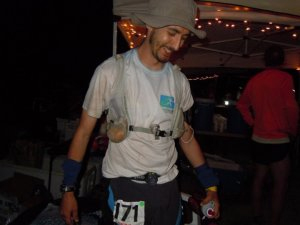 Smiling at Green Gate. Photo by Ron Little
One the other side was Jen having a grand time in the aid station greeting us with a smile and commenting, you guys are moving! After fueling up we began the steep hike up to Green Gate (mile 79.8). I came in with all smiles and was astounded at the sheer number of crew members lining the fire road around and following the aid station. While hitting my select aid station foods I was delighted to hear a familiar voice; it was Ron Little exclaiming, "Franz! You look great." I was delighted to hear Ron, but then I thought... "Isn't he suppose to be with Eric?" Ron motioned to a cot holding a sleeping bag clad figure. I noticed Eric's wife Denise with a worried look on her face that left me breathless. The figure was Eric surrounded with pure worried love from his family and friends. He assured me that everything was okay, yet his stomach was revolting. In fact he looked great compared to the trail carnage I was seeing. I offered to cut my legs of for him to borrow with the warning they aren't working too well. I think there was a smile... and he sent me off saying, "Go get that buckle".
Up the hill I climbed ahead of my crew and pacer Hao as he made some headlamp adjustments. I took the opportunity to use the porto-potty. On exit a volunteer asked, "Are you looking for a pacer?" "Yes, in fact I am". "Well, he just took off down the trail." In a strange sense of excitement I jokingly retorted, "Great not only did I just run 80 miles but now I have to run down my pacer!" And with that I took off. Fortunately Hao had my speed dialed in and turned back after about 1/4 mile. That moment was exciting... and kind of cool, after the fact.
The trail to ALT (mile 85.2) was a blur of trail and running, good running. I was still working on my hydration but felt wonderful. We ran consistently in 2-3 mile stretches, even uphills. I remembered a top 20 runner telling me during the WS training runs that if you're running here, you're doing really well. That felt damn good at that moment. Again we caught many runners and their pacers. Clare Abrams recognized me and we said hello (her runner had suffered from over hydration, lost consciousness, and was held at ALT for 1.5 hours and was now death marching, not saying a word). Typically while passing other runners I'd say "Good Job". I meant it in the nicest possible way however not all runners took it as such. I had one runner simply growl back at me after the intended compliment. He was clearly in a bad state, though.
We rolled closer to Brown's Bar (mile 89.9) while following the flour markings placed by the Hash House Harriers. Brown Eyed Girl was being blasted through the forest. Hao and I sang, out load, in the dark forest... it was sweet. This aid station had a neon beer sign, Christmas lights, and good music. The first gentleman I saw was dressed as a priest - I wasn't sure if I should hand him my water bottle or admit to my non-christian ways. Behind him were 3-4 guys in really ornate dresses possibly drinking beer. Hao and I were the only ones in the aid station so all eyes were on us and that 5 minutes of my life was very surreal. Then a dress clad man standing, what seemed like 12 feet tall, emerged saying "Franz Dill?" "Errr, yes?" What the hell! It was Ben from my Coastside Running Club! I felt like I starred up at him for 5 unblinking minutes. We chatted about the race, he asked about Eric, then we were off with a fabulous reminder: "You have less than 10 miles to go!"
In this section we passed 1 runner that was moving quick on the uphills in route to the Highway 49 crossing (mile 93.5) and the next place I'd see Jen. We came rolling into the lights as an announcer bellowed my name through the river's gorge to the eagerly awaiting, and very tired crew. The final weigh-in and I was down 5 lbs but passed the verbal test with flying colors as the doctor said, "I'm not holding you back. Go finish this!" I grabbed some food ran over to Jen, Sona, and Brian to drop off my backpack - went back and mulled around the aid station food, then it was on.
We hit a climb up to a large field of knee high grass cut only by a wandering single track dirt trail that lead us to a yellowing full moon perched inches above the distance oak trees. Dawn was coloring the sky with wisps of orange and the running was effortless. Hobbling figures of worn runners cast silhouettes on the Auburn summer backdrop. We were almost there! Again, we passed runner after runner. One pair gave us a challenge but finally succumbed to the urge in stepping aside. Hao stopped momentarily, and I can't remember why, but my body just opened up a bit. It felt good to open my gate and push the pace. Runner and pacer pairs were swept behind me as I dashed towards No Hands Bridge. After 3 minutes had passed Hao emerged and wrangled me in. We were moving amazingly well.
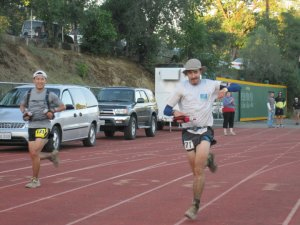 The WS100 2010 Finish. Photo by Sona Dill
The stop at No Hands Bridge (mile 96.8) was a flash then we bounced across the bridge to tackle Robie Point (mile 98.9). My energy retreated a bit here, especially on the hills but we still made good time up the final climb to the cheering aid station above. A quick stop then on to the paved streets of Auburn. I caught Jen walking down to greet and run with me which was a wonderfully pleasant surprise. We summited the final climb to the cheers of many touting signs like "Welcome to Auburn" ringing cow bells. A older lady sat in a lawn chair at the end of her driveway reading the morning paper, she peered up saying "Good Job, you made it!" It was almost too much to not cry.
I told Jen and Hao are you guys ready? I have some legs left and we're running this in, fast! At that we did, following the red shoe prints all the way to the track. Cars stopped, people waved, then seeing the track was special. I rushed through the archway setting foot on a glorious red rubber track. Jen was behind me somewhere - everything began to blur, words were smeared into cheers. In a muffled in-rush of sounds and emotions I made out Hao saying, "Don't worry about leaving me." So I ran. I ran a sub 6:30 min/mile pace in glorious bouncing strides that felt amazingly smooth. Thirty yards from the finish was George Miller and Mike Weston with George's grin big enough for the two of us, offering up the best feeling high-five I've ever shared. I crossed the finish line in 25:23 feeling amazing. I gave Jen a big hug (after zoning out a bit 1st) then was ushered over for final medical checks: weight 5 lbs down, blood pressure amazing (I actually got a "Wow" from the nurse), sodium levels perfect.
---
Western States 2010, Patience Keeps ya Strong
pureh2o | July 23, 2010 at 9:57 pm | Categories: 100 Mile, race report, trail run | URL: http://wp.me/pkRTw-7P
by Franz Dill
Everyone in the world of ultrarunning knows what the Western States 100 Mile Endurance run is, and if ya don't I'm not saying you're a freak (because we all are) but you are an oddity beyond the normal ultrarunner. In a nutshell, Western States is the equivalent of the Boston Marathon to marathons: Rich in history, runner loyalty, and one of a handful of events that, seemingly every ultrarunner attends in some capacity: running, crewing, pacing, or spectating.
To set the mood, this year's race morning began with a lunar eclipse followed by an evening's full moon - the magic of Western States was mounting in full force. Upon arrival I knew this 100 mile race was different, special. Walking legends were abound: Hal Koerner, Anton Krupicka, Kilian Jornet Burgada, Brian Morrison, Gordy Ansleigh, Geoff Roes, and loads more I couldn't recognize. During pre-race, the runner's faces read like a multi-year book of anticipation, the final chapter would begin today. How would each runner's story end?
My race day goal was to run the beginning of the race conservatively at a 25 - 26 hour finishing pace. Then at Michigan Bluff pick-up speed and finish sub-24, heeding the often thrown around phrase "the race begins at Foresthill". Given that the back-end of the race is extremely runnable if, and that's a big IF, you have the legs a lot of time can be made up. Making the decision to go sans pace chart I started the race with only time and heart rate to guide me. In retrospect a pre-race conversation that Jen and I was very foreshadowing: What finish time to you feel you've earned based on training alone? My answer 26 hours. Jen's answer 25 hours...
The initial climb to Escarpment was difficult and MANY went out extremely fast. I kept my heart rate below 160 most times and was passed in waves of runners. The snow slowed us and the climbs were steep, yet reaching the top was breath taking providing views of Squaw covered in wisps of morning fog under a cresting sunrise to one side and rolling peaks and canyons to Auburn and beyond on the other. I ran portions of this climb with good friend Jose Suarez and old-timer and multi-time grand slammer Bill Dodson (age 75) talking up the day ahead with childlike fervor. I saw flashes of good friend Eric Vaughan on the switchbacks ahead - he always zips out of the gate much faster than I.
Sumitting at 8,700 feet we were welcomed by a gong serenade and views spanning out to Auburn and beyond. It was a very Zen time in the race. Awaiting 1/4 mile down the trail was lots of snow, probably 7 miles of the stuff. I've never run in the snow but it was fun. The trails became a mix of running & skiing with a spattering of cartoon-like, leg flailing, falls. Being a 100 mile race I quickly noted a lot of energy can be expelled here and took it slow. Eventually the snow gave way but definitely not the terrain - it was replaced by numerous creek and river crossings. Our feet were soaked.
During a lengthy downhill run on a smooth fireroad leading to the Poppy Trailhead (mile 19.6) I ripped open a GU preceding my Garmin's 30 minute reminder beep, downed it, and immediately started my vomitous upheavals. I wondered off-trail in an attempt to hide it by pretending to ... "oh, just going to the bathroom over here... {upheave}". Oddly I wasn't panicked despite the best caloric weapon in my ultrarunning arsenal was now DOA. I did have my Suceed Ultra to keep the calories incoming but I needed to re-tool my fueling with only 20% of the race complete. Arriving at the aid station I found that fish crackers, saltines, fruit, and iced water worked well. As I later found, this is not the recipe for a fast race!
Cooling off Before Duncan Canyon. Photo by Facchino PhotographyFrom Poppy Trailhead to Duncan Canyon (mile 23.8) I proceeded at a slow pace and let numerous runners pass. I took the time to dip my wide-brimmed trail hat in every stream crossing, warding off the rising heat. While running the banks of the French Meadows Reservoir, I shared the trail with Amy Palmiero-Winters who would later be the first amputee to complete the Western States 100. That day(s) she ran a course 2-3x more difficult than the one I ran yet she sustained an internal drive that was infectious. We ping-ponged back and forth as she stopped to make numerous adjustments to her prosthetic right leg, each adjustment varying between "hurt and hurt more" in her words. I would later run with her on the descent to the river.
Duncan Canyon Just Ahead. Photo by Glenn TachiyamaMy fueling was supporting my slowed efforts reasonably well through Robinson Flat (mile 29.7) where I met my crew Jen, Sona, Brian, and Hao for the first time. After a snow covered maze leading into the aid station I heard the enthusiastic cheers erupt as I broke through the trees. Following the formal aid area I met my crew and was off with a wonderful turkey avocado wrap and my ipod playing Nutshell from Alice 'n Chains. I was helpless in holding back my tears, as that song links me to a past friend, Brian, that was taken by cancer at the age of 32. He was there with me that day call'n me crazy too.
The heat continued to increase on the wide sun baked fireroads leading to Miller's Defeat (mile 35.3). Yet, my body was well adapted because of my tri-weekly trips to the sauna and numerous bikram yoga classes that I started 4 weeks before race day. The heat was noticeable but not sapping - although I was seeing an increase in heat struggles with other runners.
I continued onward at a slow pace dictated by my low caloric fueling option and came into Last Chance (mile 43.3) slightly worn out and weighed in 2 lbs. light. A wonderful volunteer filled my bottles, walked me through the aid station, patiently waited as I picked over the food selection for fruit and crackers, then escorted me to the cold water bath and ice in my cool-off bandanna. Then she warned me with a stern voice, "You know what's next, right?" Yup, I knew and was looking forward to it... the climb up Devil's Thumb.
First the downhill. I was running the single track descent into the canyon a few steps behind another runner when he simultaneously stopped, screeched, and jumped up. I reacted fast enough to stop without tumbling down the cliff to our left. Peering around the startled runner I saw his source of fear, a 3 foot long rattlesnake in the trail ahead of him. He looked back and asked, "Is that a rattlesnake?" I clearly spotted the 4 buttons at the end of its tail and confirmed his fear. Fortunately the snake's primary concern was get off the trail. We skirted around it while I scoped the trail behind for other runners to warn. No one showed. I waited momentarily then scampered down the trail figuring the snake would be well clear when the next runner arrived.
I reached the Swinging Bridge and dipped my hat in the far-side water basin for the hot climb up Devil's Thumb. I knew I could climb this relatively hard based on my training runs. For 1/3 of the climb I power hiked aggressively and caught a number of runners. Then, well, my cracker fueling caught up and my Ferrari engine suddenly morphed into a Mack truck's diesel that was hauling a load over a Sierra mountain pass - I had the power but my was speed gone. And, I got really hungry and all I had was crackers. So I ate my goldfish and saltines, crumbled and soggy from the pre-climb head dunk. It was all I had to quench my sudden fueling uptake needs.
Making it to the top was wonderful. I sat for a moment while re-fueling with fruit, soda, and a popsicle. A runner next to me was suffer from moderate heat stroke, rocking back and forth rapidly and yelling "Oh God, Oh God, Oh God" while aid stations workers put cold water on his legs. It alarmed me enough to immediately stand and move on - aid station illness can be highly infectious!
I moved out to tackle the next canyon descent into El Dorado still feeling low on energy - soda slowly fell out of my menu too! At this point I was running on a fuel completely foreign to me during training, yet I knew eating was key in a successful finish. It was also this point that I pondered my finish time. 24 hours seemed fleeting yet I was still strong for 25. I had no worries though because choosing to run without a pace chart had the added benefit of allowing me the freedom to run to my body's signals which were telling me to take it slow and steady. I made it to El Dorado Creek (mile 59.2) and prepared for the climb to Michigan Bluff. Again, I fueled on fruit and crackers immediately feeling the drag of absent energy.
The climb passed and I emerged into Michigan Bluff (mile 55.7) with fresh legs but a stomach of hunger and pain. Seeing Jen, Hao, Sona, and Brian immediately perked me up. In fact I challenged Jen to a race back to the aid station! My immediate goal was to eat away my hunger pains. Going to it I hit the fruit and ordered some broth then sat down to chug some V8. Like a villain inching his way on stage, the dreaded nausea reared its head. I made some signal to my crew that I was in trouble, Hao reached over and performed a Vulcan nerve pinch on my hand. But nothing was slowing this assassin's strike. I had just enough time to stand, walk 5 feet, then clutch the chain-link fence and assume my most submissive bikram posture. In a series of 5-7 cat-like back arching upheavals I was done. Then one more to be sure. Mixed in the grass below me was my fruit buffet of 3 minutes earlier. All I could muster to say was, "There's some fruit compote for ya kids!" then I promptly walked over to the aid station and ate some more! It wasn't until I was leaving the aid station did I notice a small town news station interviewing runners directly in-line with where I just puked. What a background I provided!
Off I scuttled to Volcano canyon with a happy tummy and a peanut butter cookie to eat. I was feeling really good. Recover and Absorb was the motto but the spring in my step was infectious and I ran more than prescribed. I stopped for a moment to rearrange my ipod wiring and was greeted in a passing Don Charles Lundell of zombierunner.com aka Mr. Smooth, Straight Faced, and Quiet. I paced off him to Bath Road (mile 60.6) sharing small conversation. Both of us agreed, "It'll be great seeing George Miller's smiling face at Foresthill". Once on pavement DC took off with a very strong, long-strided, power walk. I was no slouch but watched the gap between him and I grow while still passing other runners.
I made the turn to Foresthill Elementary School and soon found Jen and Hao's smiling faces and pickled shirts. Foresthill was awash with excitement. For one I was with my wonderful crew, secondly I worked Foresthill medical last year and knew everyone, and third good friends and CRC runners George Miller and Mike Weston were there with gigantic grins! I darted into medical and weighed in at 3 lbs under (trending low) dished out some hugs then wandered down the street to the truck. I couldn't help but complain in jest, "Why'd you park so far away?" A quick shoe change, some cheese and salami, crackers, lights, and I was off. I left walking prior to Hao being ready, but I needed the time to warm up again and adjust to the new shoes - damn they hurt at first!
After a 15 minute slow down to allow for digestion, I lead the way to give Hao a "feeling" for my pace. His immediate feedback of my smooth and energetic stride confirmed how I was feeling, which was great. Things were lining up for a wonderful run through the night. Initially we were matched in pace again with Amy Palmiero-Winters (who runs with tremendous mental focus and strength) - ping ponging back and forth but in the progression of time I felt like we were running in a gear unlike those around us; Hao and I were breezing through the pages of a storybook finish. Aid stations came and went in a blur of Christmas lighting. I ate fruit, Tums, and the occasional grilled cheese wedge as we ventured into the dark to chase down headlamps sniper-style.
The river crossing was upon us, but first the weigh-in. Answering the medical workers questions coherently I stood on the scale then pronounced my starting weight of 145 lbs. Dropping my gaze down I read "133" on the scale in complete shock. What? I'm down 12 lbs! Medical was also confused as I wasn't acting out of sorts. I jumped off the scale and then back on for a re-weigh of "139". Okay, I could buy that but 6 lbs. down wasn't good either - yet I wasn't confident in that weigh-in either. Off to the life vests and boat ride to cross the river! And if I had it back Hao and I would have sang "Just the Two of Us, We can make it if we try" while crossing the river. We had planned it, but forgot! Next time!
Smiling at Green Gate. Photo by Ron LittleOne the other side was Jen having a grand time in the aid station greeting us with a smile and commenting, you guys are moving! After fueling up we began the steep hike up to Green Gate (mile 79.8). I came in with all smiles and was astounded at the sheer number of crew members lining the fire road around and following the aid station. While hitting my select aid station foods I was delighted to hear a familiar voice; it was Ron Little exclaiming, "Franz! You look great." I was delighted to hear Ron, but then I thought... "Isn't he suppose to be with Eric?" Ron motioned to a cot holding a sleeping bag clad figure. I noticed Eric's wife Denise with a worried look on her face that left me breathless. The figure was Eric surrounded with pure worried love from his family and friends. He assured me that everything was okay, yet his stomach was revolting. In fact he looked great compared to the trail carnage I was seeing. I offered to cut my legs of for him to borrow with the warning they aren't working too well. I think there was a smile... and he sent me off saying, "Go get that buckle".
Up the hill I climbed ahead of my crew and pacer Hao as he made some headlamp adjustments. I took the opportunity to use the porto-potty. On exit a volunteer asked, "Are you looking for a pacer?" "Yes, in fact I am". "Well, he just took off down the trail." In a strange sense of excitement I jokingly retorted, "Great not only did I just run 80 miles but now I have to run down my pacer!" And with that I took off. Fortunately Hao had my speed dialed in and turned back after about 1/4 mile. That moment was exciting... and kind of cool, after the fact.
The trail to ALT (mile 85.2) was a blur of trail and running, good running. I was still working on my hydration but felt wonderful. We ran consistently in 2-3 mile stretches, even uphills. I remembered a top 20 runner telling me during the WS training runs that if you're running here, you're doing really well. That felt damn good at that moment. Again we caught many runners and their pacers. Clare Abrams recognized me and we said hello (her runner had suffered from over hydration, lost consciousness, and was held at ALT for 1.5 hours and was now death marching, not saying a word). Typically while passing other runners I'd say "Good Job". I meant it in the nicest possible way however not all runners took it as such. I had one runner simply growl back at me after the intended compliment. He was clearly in a bad state, though.
We rolled closer to Brown's Bar (mile 89.9) while following the flour markings placed by the Hash House Harriers. Brown Eyed Girl was being blasted through the forest. Hao and I sang, out load, in the dark forest... it was sweet. This aid station had a neon beer sign, Christmas lights, and good music. The first gentleman I saw was dressed as a priest - I wasn't sure if I should hand him my water bottle or admit to my non-christian ways. Behind him were 3-4 guys in really ornate dresses possibly drinking beer. Hao and I were the only ones in the aid station so all eyes were on us and that 5 minutes of my life was very surreal. Then a dress clad man standing, what seemed like 12 feet tall, emerged saying "Franz Dill?" "Errr, yes?" What the hell! It was Ben from my Coastside Running Club! I felt like I starred up at him for 5 unblinking minutes. We chatted about the race, he asked about Eric, then we were off with a fabulous reminder: "You have less than 10 miles to go!"
In this section we passed 1 runner that was moving quick on the uphills in route to the Highway 49 crossing (mile 93.5) and the next place I'd see Jen. We came rolling into the lights as an announcer bellowed my name through the river's gorge to the eagerly awaiting, and very tired crew. The final weigh-in and I was down 5 lbs but passed the verbal test with flying colors as the doctor said, "I'm not holding you back. Go finish this!" I grabbed some food ran over to Jen, Sona, and Brian to drop off my backpack - went back and mulled around the aid station food, then it was on.
We hit a climb up to a large field of knee high grass cut only by a wandering single track dirt trail that lead us to a yellowing full moon perched inches above the distance oak trees. Dawn was coloring the sky with wisps of orange and the running was effortless. Hobbling figures of worn runners cast silhouettes on the Auburn summer backdrop. We were almost there! Again, we passed runner after runner. One pair gave us a challenge but finally succumbed to the urge in stepping aside. Hao stopped momentarily, and I can't remember why, but my body just opened up a bit. It felt good to open my gate and push the pace. Runner and pacer pairs were swept behind me as I dashed towards No Hands Bridge. After 3 minutes had passed Hao emerged and wrangled me in. We were moving amazingly well.
The WS100 2010 Finish. Photo by Sona DillThe stop at No Hands Bridge (mile 96.8) was a flash then we bounced across the bridge to tackle Robie Point (mile 98.9). My energy retreated a bit here, especially on the hills but we still made good time up the final climb to the cheering aid station above. A quick stop then on to the paved streets of Auburn. I caught Jen walking down to greet and run with me which was a wonderfully pleasant surprise. We summited the final climb to the cheers of many touting signs like "Welcome to Auburn" ringing cow bells. A older lady sat in a lawn chair at the end of her driveway reading the morning paper, she peered up saying "Good Job, you made it!" It was almost too much to not cry.
I told Jen and Hao are you guys ready? I have some legs left and we're running this in, fast! At that we did, following the red shoe prints all the way to the track. Cars stopped, people waved, then seeing the track was special. I rushed through the archway setting foot on a glorious red rubber track. Jen was behind me somewhere - everything began to blur, words were smeared into cheers. In a muffled in-rush of sounds and emotions I made out Hao saying, "Don't worry about leaving me." So I ran. I ran a sub 6:30 min/mile pace in glorious bouncing strides that felt amazingly smooth. Thirty yards from the finish was George Miller and Mike Weston with George's grin big enough for the two of us, offering up the best feeling high-five I've ever shared. I crossed the finish line in 25:23 feeling amazing. I gave Jen a big hug (after zoning out a bit 1st) then was ushered over for final medical checks: weight 5 lbs down, blood pressure amazing (I actually got a "Wow" from the nurse), sodium levels perfect.
Hoof Abscesses in Horses
Thehorse.com - Full Article
by: Brian W. Fitzgerald, DVM
September 01 2009, Article # 9530
The scenario is all too familiar for many horse owners ... yesterday your horse was sound, but today you find him crippled, with no apparent injury! What could have happened? Odds are this horse has a hoof abscess. Sooner or later, nearly all horse owners will encounter this problem. Fortunately, most horses make a full recovery with prompt treatment.
Hoof Abscesses Defined
Hoof abscesses occur when bacteria get trapped between the sensitive laminae (the tissue layer that bonds the hoof capsule to the coffin bone) and the hoof wall or sole. The bacteria create exudate (pus), which builds up and creates pressure behind the hoof wall or under the sole. This pressure can be become extremely painful.
Although most commonly seen during the wet winter and spring months, hoof abscesses can plague horses year-round. Moisture in the environment can soften regions of the foot and make it easier for bacteria to get trapped inside. Extremely dry conditions can cause brittle, cracked feet. The abscess-causing bacteria enter the foot through hoof cracks, by traveling up the white line, through penetrating wounds to the foot, and even by "close" horseshoeing nails. Deep bruising might also trigger abscesses.
Diagnosing a Hoof Abscess
While a hoof abscess generally takes several days to develop, most horses don't show any clinical signs until the pressure becomes so great that severe lameness is evident...
Read more here:
http://www.thehorse.com/ViewArticle.aspx?ID=9530
by: Brian W. Fitzgerald, DVM
September 01 2009, Article # 9530
The scenario is all too familiar for many horse owners ... yesterday your horse was sound, but today you find him crippled, with no apparent injury! What could have happened? Odds are this horse has a hoof abscess. Sooner or later, nearly all horse owners will encounter this problem. Fortunately, most horses make a full recovery with prompt treatment.
Hoof Abscesses Defined
Hoof abscesses occur when bacteria get trapped between the sensitive laminae (the tissue layer that bonds the hoof capsule to the coffin bone) and the hoof wall or sole. The bacteria create exudate (pus), which builds up and creates pressure behind the hoof wall or under the sole. This pressure can be become extremely painful.
Although most commonly seen during the wet winter and spring months, hoof abscesses can plague horses year-round. Moisture in the environment can soften regions of the foot and make it easier for bacteria to get trapped inside. Extremely dry conditions can cause brittle, cracked feet. The abscess-causing bacteria enter the foot through hoof cracks, by traveling up the white line, through penetrating wounds to the foot, and even by "close" horseshoeing nails. Deep bruising might also trigger abscesses.
Diagnosing a Hoof Abscess
While a hoof abscess generally takes several days to develop, most horses don't show any clinical signs until the pressure becomes so great that severe lameness is evident...
Read more here:
http://www.thehorse.com/ViewArticle.aspx?ID=9530
Wednesday, July 28, 2010
Grass Clippings Bad for Horses
Myhorse.com - Full Article
Are you tempted to cut your grass, then rake it into soft, fragrant, tasty piles of clippings for your horse to nibble? According to a press release issued by the United States Equestrian Federation, this should be the last thing you encourage your horse to eat. It has to do with that extra step: raking.
Grass clippings that stay on the pasture after mowing, where they can dry in small amounts, are generally not a problem. But never gather them into piles to feed them to your horse...
Read more here:
http://web1.myhorse.com/grass-clippings-bad-horses.html
Are you tempted to cut your grass, then rake it into soft, fragrant, tasty piles of clippings for your horse to nibble? According to a press release issued by the United States Equestrian Federation, this should be the last thing you encourage your horse to eat. It has to do with that extra step: raking.
Grass clippings that stay on the pasture after mowing, where they can dry in small amounts, are generally not a problem. But never gather them into piles to feed them to your horse...
Read more here:
http://web1.myhorse.com/grass-clippings-bad-horses.html
Wednesday, July 14, 2010
Snakebite!
Myhorse.com - Full Article
It’s the stuff nightmares of made of. In many parts of the U.S., summer is the season when snakes are most visible and when horses are most likely to encounter them.
The good news is that even poisonous snake bites are rarely fatal, especially if treated carefully and immediately. If you wait, however, a snake bite can lead to tissue damage, or worse, obstruction of the airway. The treatment will also depend on where your horse was bitten.
Here’s what to do if you suspect snake bite:
1. Call the vet! (If you’re on the trail, ask your vet to meet you there, if possible).
2. Keep the horse as calm as possible. If he (or you) panics, it will speed up his circulation, which increases the speed of the venom in his circulatory system. Walk him slowly back to his barn or trailer.
3. If you have a six-inch length of tube or garden hose, lubricate it with Vaseline and insert it in his nostril to allow him to keep breathing, even if his airway begins to swell...
Read more here:
http://www.myhorse.com/snake-bite.html
It’s the stuff nightmares of made of. In many parts of the U.S., summer is the season when snakes are most visible and when horses are most likely to encounter them.
The good news is that even poisonous snake bites are rarely fatal, especially if treated carefully and immediately. If you wait, however, a snake bite can lead to tissue damage, or worse, obstruction of the airway. The treatment will also depend on where your horse was bitten.
Here’s what to do if you suspect snake bite:
1. Call the vet! (If you’re on the trail, ask your vet to meet you there, if possible).
2. Keep the horse as calm as possible. If he (or you) panics, it will speed up his circulation, which increases the speed of the venom in his circulatory system. Walk him slowly back to his barn or trailer.
3. If you have a six-inch length of tube or garden hose, lubricate it with Vaseline and insert it in his nostril to allow him to keep breathing, even if his airway begins to swell...
Read more here:
http://www.myhorse.com/snake-bite.html
Wednesday, July 07, 2010
When the rider is hot, the horse is a lot hotter
Kingsentinal.com - Full Article
By Teresa Pitman
A hot humid day. One rider. One horse. Both are exercising at a moderate level. Who is more likely to overheat?
It might surprise you to know that your horse gets hotter much faster than you and is more susceptible to the negative effects of heat stress.
“It only takes 17 minutes of moderate intensity exercise in hot, humid weather to raise a horse’s temperature to dangerous levels,” Prof. Michael Lindinger, an animal and exercise physiologist at the University of Guelph, explained. “That’s three to 10 times faster than in humans. Horses feel the heat much worse than we do.”
And the effects can be serious. If a horse’s body temperature shoots up from the normal 37 to 38 C to 41 C, temperatures within working muscles may be as high as 43 C, a temperature at which proteins in muscle begin to denature (cook). Horses suffering excessive heat stress may experience hypotension, colic and renal failure...
Read more here:
http://www.kingsentinel.com/news/2010-07-07/Community/When_the_rider_is_hot_the_horse_is_a_lot_hotter.html
By Teresa Pitman
A hot humid day. One rider. One horse. Both are exercising at a moderate level. Who is more likely to overheat?
It might surprise you to know that your horse gets hotter much faster than you and is more susceptible to the negative effects of heat stress.
“It only takes 17 minutes of moderate intensity exercise in hot, humid weather to raise a horse’s temperature to dangerous levels,” Prof. Michael Lindinger, an animal and exercise physiologist at the University of Guelph, explained. “That’s three to 10 times faster than in humans. Horses feel the heat much worse than we do.”
And the effects can be serious. If a horse’s body temperature shoots up from the normal 37 to 38 C to 41 C, temperatures within working muscles may be as high as 43 C, a temperature at which proteins in muscle begin to denature (cook). Horses suffering excessive heat stress may experience hypotension, colic and renal failure...
Read more here:
http://www.kingsentinel.com/news/2010-07-07/Community/When_the_rider_is_hot_the_horse_is_a_lot_hotter.html
Friday, July 02, 2010
Endurance & barefoot hoof management: soft country feet
Duncan's blog at http://easycarenews.com/06-29-2010/articles/soft-country-feet/
by Duncan McLaughlin
Who wants soft-country feet? Not me! Until recently I lived in an area that was perfect for barefooting. Hard, dry, often rocky terrain meant achieving gravel-crunching soundness was possible for a majority of horses. Last November, I moved to an area with much higher rainfall and with rich, deep, often wet topsoil; perfect for dairy farming (with energy-rich grasses like kikuyu and paspalum) but not ideal for developing solid functional horse hooves.
Large areas of my paddocks have standing water for weeks on end. Even where they are dry, the soil is either soft and sandy or wet and muddy. The horses are often standing in water for hours, even days, at a time.
 Not surprisingly, these conditions are renowned for producing soft, undeveloped feet that are prone to infections. Thrush and seedy toe/white line disease are common in this area and hoofwall separation is almost a given. These were pathologies I almost never experienced in my work as a trimmer in the hard, dry country where I used to live. However, I thought this new environment would be a great opportunity to test a basic tenet of barefoot hoof-care: if the biomechanics and physiology of a hoof are correct, then biomechanical stress – such as hoof wall separation – and physiological stress – such as thrush and seedy-toe – should not manifest.
read full article
by Duncan McLaughlin
Who wants soft-country feet? Not me! Until recently I lived in an area that was perfect for barefooting. Hard, dry, often rocky terrain meant achieving gravel-crunching soundness was possible for a majority of horses. Last November, I moved to an area with much higher rainfall and with rich, deep, often wet topsoil; perfect for dairy farming (with energy-rich grasses like kikuyu and paspalum) but not ideal for developing solid functional horse hooves.
Large areas of my paddocks have standing water for weeks on end. Even where they are dry, the soil is either soft and sandy or wet and muddy. The horses are often standing in water for hours, even days, at a time.
Not surprisingly, these conditions are renowned for producing soft, undeveloped feet that are prone to infections. Thrush and seedy toe/white line disease are common in this area and hoofwall separation is almost a given. These were pathologies I almost never experienced in my work as a trimmer in the hard, dry country where I used to live. However, I thought this new environment would be a great opportunity to test a basic tenet of barefoot hoof-care: if the biomechanics and physiology of a hoof are correct, then biomechanical stress – such as hoof wall separation – and physiological stress – such as thrush and seedy-toe – should not manifest.read full article
American Horse Council Highlights Recreational Riding
American Horse Council
On Tuesday June 22, the American Horse Council (AHC) held its first Recreation Forum in Washington , DC to highlight issues of importance to recreational riders. The forum was attended by representatives from national equestrian organizations, state horse council’s from around the country, as well as individual recreational riders.
The forum began with a presentation by Stephanie McCommon of the American Quarter Horse Association (AQHA). McCommon, briefed attendees on AQHA’s Stewards for Trails, Education and Partnerships (STEP) program which seeks to “increase participation in trail stewardship among equine enthusiasts.” The forum continued with a presentation by Dennis Dailey of Backcountry Horsemen of America (BCHA). Dailey spoke on the U.S. Forest Service’s Trail Classification System and its impact on equestrians in National Forests.
The forum also included two enlightening panel discussions. The first panel focused on the benefits of equestrians building better partnerships with other traditional recreational users and conservationists. The panel featured Kim Hutson de Belle of the American Hiking Society (AHS) and Anne Merwin of the Wilderness Society (TWS) as well as Dennis Dailey, BCHA. The panel discussed many important issues including declining numbers of Americans recreating in the outdoors and its impact on conservation, the need to link public and private lands with trail easements, and the challenges equestrians, hiking and conservation groups face when working together.
“The equestrian, hiking and conservation community have many shared interest. I believe Tuesday’s discussion demonstrated that these shared interest are being recognized and great progress is being made in efforts to work together,” said Ben Pendergrass Legislative Director of the AHC.
The second panel focused on building better relationships between equestrians and federal land mangers. The panel included Rick Potts, Chief, Conservation and Outdoor Recreation Division, National Park Service (NPS), Bob Ratcliffe, Division Chief, Recreation and Visitor Services, Bureau of Land Management (BLM) and Jonathan Stephens Program Manager, Congressionally Designated Areas and Trails, National Forest Service (FS). Topics included the need for equestrians to build relationships with their local federal land mangers before problems arise, the backlog of trails and facility maintenance, the Presidents America’s Great Outdoors Initiative, and efforts to preserve traditional recreational uses.
The forum wrapped up with Ginny Grulke of the Kentucky State Horse Council discussing the challenges faced by trail riders in Kentucky on the state level and how they have been responding.
“Recreational riding is important to millions of Americans and these Americans rely on public lands and trails to ride. The AHC believes it was important to bring equestrians, leaders from NPS, FS, BLM, and AHS, TWS together in Washington to talk about recreational riding and our public lands,” said AHC Legislative Director Ben Pendergrass. “We are very happy with the outcome of the Recreation Forum and believe it is a positive step in ensuring recreational riders continue to support and have access to our nation’s public lands.”
FOR MORE INFORMATION
Contact: Bridget Harrison
202-296-4031
bharrison@horsecouncil.org
As the national association representing all segments of the horse industry in Washington, D.C., the American Horse Council works daily to represent equine interests and opportunities. The AHC promotes and protects the industry by communicating with Congress, federal agencies, the media and the industry on behalf of all horse related interests each and every day.
The AHC is member supported by individuals and organizations representing virtually every facet of the horse world from owners, breeders, veterinarians, farriers, breed registries and horsemen's associations to horse shows, race tracks, rodeos, commercial suppliers and state horse councils.
On Tuesday June 22, the American Horse Council (AHC) held its first Recreation Forum in Washington , DC to highlight issues of importance to recreational riders. The forum was attended by representatives from national equestrian organizations, state horse council’s from around the country, as well as individual recreational riders.
The forum began with a presentation by Stephanie McCommon of the American Quarter Horse Association (AQHA). McCommon, briefed attendees on AQHA’s Stewards for Trails, Education and Partnerships (STEP) program which seeks to “increase participation in trail stewardship among equine enthusiasts.” The forum continued with a presentation by Dennis Dailey of Backcountry Horsemen of America (BCHA). Dailey spoke on the U.S. Forest Service’s Trail Classification System and its impact on equestrians in National Forests.
The forum also included two enlightening panel discussions. The first panel focused on the benefits of equestrians building better partnerships with other traditional recreational users and conservationists. The panel featured Kim Hutson de Belle of the American Hiking Society (AHS) and Anne Merwin of the Wilderness Society (TWS) as well as Dennis Dailey, BCHA. The panel discussed many important issues including declining numbers of Americans recreating in the outdoors and its impact on conservation, the need to link public and private lands with trail easements, and the challenges equestrians, hiking and conservation groups face when working together.
“The equestrian, hiking and conservation community have many shared interest. I believe Tuesday’s discussion demonstrated that these shared interest are being recognized and great progress is being made in efforts to work together,” said Ben Pendergrass Legislative Director of the AHC.
The second panel focused on building better relationships between equestrians and federal land mangers. The panel included Rick Potts, Chief, Conservation and Outdoor Recreation Division, National Park Service (NPS), Bob Ratcliffe, Division Chief, Recreation and Visitor Services, Bureau of Land Management (BLM) and Jonathan Stephens Program Manager, Congressionally Designated Areas and Trails, National Forest Service (FS). Topics included the need for equestrians to build relationships with their local federal land mangers before problems arise, the backlog of trails and facility maintenance, the Presidents America’s Great Outdoors Initiative, and efforts to preserve traditional recreational uses.
The forum wrapped up with Ginny Grulke of the Kentucky State Horse Council discussing the challenges faced by trail riders in Kentucky on the state level and how they have been responding.
“Recreational riding is important to millions of Americans and these Americans rely on public lands and trails to ride. The AHC believes it was important to bring equestrians, leaders from NPS, FS, BLM, and AHS, TWS together in Washington to talk about recreational riding and our public lands,” said AHC Legislative Director Ben Pendergrass. “We are very happy with the outcome of the Recreation Forum and believe it is a positive step in ensuring recreational riders continue to support and have access to our nation’s public lands.”
FOR MORE INFORMATION
Contact: Bridget Harrison
202-296-4031
bharrison@horsecouncil.org
As the national association representing all segments of the horse industry in Washington, D.C., the American Horse Council works daily to represent equine interests and opportunities. The AHC promotes and protects the industry by communicating with Congress, federal agencies, the media and the industry on behalf of all horse related interests each and every day.
The AHC is member supported by individuals and organizations representing virtually every facet of the horse world from owners, breeders, veterinarians, farriers, breed registries and horsemen's associations to horse shows, race tracks, rodeos, commercial suppliers and state horse councils.
Wednesday, June 30, 2010
Inside the Laminitic Foot
Thehorse.com - Full Article
by: Multiple Authors
July 01 2008, Article # 11359
Learn how equine podiatrists assess, treat, and monitor laminitis
Laminitis is a terrifying mystery to many horse owners, in part because in the early stages a horse with tremendous damage can look and act much like a mild case. A great deal of damage can occur even when the horse appears to have a favorable response to treatment.
What's going on inside that laminitic foot, and how do you tell if it's a really bad case?
To answer these questions, we'll take a look inside the laminitic foot using radiographs (X rays) and venograms, because understanding the mechanical changes that occur within these feet helps us understand how to treat laminitis more successfully.
Laminitis Basics
The job of the laminae is to hold the hoof wall onto the coffin bone. The "laminae" actually include two sets of leaflike laminae--one around the inside of the hoof wall and one around the face of the coffin bone. Together, these interlocking laminae provide a very secure, yet flexible anchor that keeps the coffin bone in place...
Read more here:
http://www.thehorse.com/ViewArticle.aspx?ID=11359
by: Multiple Authors
July 01 2008, Article # 11359
Learn how equine podiatrists assess, treat, and monitor laminitis
Laminitis is a terrifying mystery to many horse owners, in part because in the early stages a horse with tremendous damage can look and act much like a mild case. A great deal of damage can occur even when the horse appears to have a favorable response to treatment.
What's going on inside that laminitic foot, and how do you tell if it's a really bad case?
To answer these questions, we'll take a look inside the laminitic foot using radiographs (X rays) and venograms, because understanding the mechanical changes that occur within these feet helps us understand how to treat laminitis more successfully.
Laminitis Basics
The job of the laminae is to hold the hoof wall onto the coffin bone. The "laminae" actually include two sets of leaflike laminae--one around the inside of the hoof wall and one around the face of the coffin bone. Together, these interlocking laminae provide a very secure, yet flexible anchor that keeps the coffin bone in place...
Read more here:
http://www.thehorse.com/ViewArticle.aspx?ID=11359
Tom Quilty, boots and thermographs
Manilla Tom Quilty 2010 - Booted Horses are More Likely to Finish!
Wednesday, June 30, 2010 by Duncan McLaughlin
Last weekend saw endurance riders from all over the Australia and from around the world gather at Manilla, NSW for this years Quilty. The Quilty is Australia's oldest and most prestigious endurance ride. 11 booted horses were entered in the event and 8 were successful, for a 73% completion rate (compared to the 54% completion rate overall). The successful combinations were:
* Carol Layton on Omani Mr Squiggle;
* Deanna Trevena on Warr of the Roses;
* me on Jupiter Mikeno;
* Virginia Dodson on Qmriya Raheema;
* Ann Batt on Roxborough Nato;
* Donna Tidsdale on Karrana King;
* Jane Martin on Blake's Heaven Dubbonet; and
* Rebecca Hayes on Summerzar M'zigye.
* (Commiserations to Rachel, Colleen and Darryl)
--- (more) ---
 I also spent some time playing around with the thermal camera, trying out different protocols and timings to determine the way to get the maximum amount of information about heat patterns, circulation and feet in competing horses. Here are a couple of thermograms of Mikena's feet in her Easyboot Glue-Ons, dorsal shot of near fore and lateral shot of off hind, the morning before and the morning after the ride.
[...more at http://blog.easycareinc.com/blog/easycare/0/0/manilla-tom-quilty-2010-booted-horses-are-more-likely-to-finish]
Manilla Tom Quilty 2010 - Booted Horses are More Likely to Finish!
Wednesday, June 30, 2010 by Duncan McLaughlin
Last weekend saw endurance riders from all over the Australia and from around the world gather at Manilla, NSW for this years Quilty. The Quilty is Australia's oldest and most prestigious endurance ride. 11 booted horses were entered in the event and 8 were successful, for a 73% completion rate (compared to the 54% completion rate overall). The successful combinations were:
* Carol Layton on Omani Mr Squiggle;
* Deanna Trevena on Warr of the Roses;
* me on Jupiter Mikeno;
* Virginia Dodson on Qmriya Raheema;
* Ann Batt on Roxborough Nato;
* Donna Tidsdale on Karrana King;
* Jane Martin on Blake's Heaven Dubbonet; and
* Rebecca Hayes on Summerzar M'zigye.
* (Commiserations to Rachel, Colleen and Darryl)
--- (more) ---
I also spent some time playing around with the thermal camera, trying out different protocols and timings to determine the way to get the maximum amount of information about heat patterns, circulation and feet in competing horses. Here are a couple of thermograms of Mikena's feet in her Easyboot Glue-Ons, dorsal shot of near fore and lateral shot of off hind, the morning before and the morning after the ride.[...more at http://blog.easycareinc.com/blog/easycare/0/0/manilla-tom-quilty-2010-booted-horses-are-more-likely-to-finish]
Teaching Your Horse to Load
Horsecity.com - Full Article
by Dr. Edwin Goodwin
www.southernstates.com
Posted: Tuesday, June 29, 2010
You've heard it. Maybe you've even said it: "He'll load. He just doesn't want to right now!" And with that, your balky horse has saved himself the trouble of traveling to wherever it was you planned to go. He was rewarded for his disobedience by going back to his stall or paddock and doing his favorite thing-nothing.
Letting the issue of loading go unresolved violates one of the fundamentals of dealing with horses: if you ask, the horse must respond correctly. Any less, and you've taught him a bad habit. That's true when you ride him, when you work with him in his stall and when you invite him to go traveling. Not all horses are bad loaders all the time, of course.
Some horses load easily by one of several common methods.
Some can be led on. This is fine if it woks all the time ... although there are some drawbacks. If you are using a trailer with either no escape door or a half-door, he might try to keep following, smashing you painfully up against the metal wall or door.
If he's being loaded into a slantload or stock trailer next to other horses of unknown temperament or habits, it could be dangerous for you...
Read more here:
by Dr. Edwin Goodwin
www.southernstates.com
Posted: Tuesday, June 29, 2010
You've heard it. Maybe you've even said it: "He'll load. He just doesn't want to right now!" And with that, your balky horse has saved himself the trouble of traveling to wherever it was you planned to go. He was rewarded for his disobedience by going back to his stall or paddock and doing his favorite thing-nothing.
Letting the issue of loading go unresolved violates one of the fundamentals of dealing with horses: if you ask, the horse must respond correctly. Any less, and you've taught him a bad habit. That's true when you ride him, when you work with him in his stall and when you invite him to go traveling. Not all horses are bad loaders all the time, of course.
Some horses load easily by one of several common methods.
Some can be led on. This is fine if it woks all the time ... although there are some drawbacks. If you are using a trailer with either no escape door or a half-door, he might try to keep following, smashing you painfully up against the metal wall or door.
If he's being loaded into a slantload or stock trailer next to other horses of unknown temperament or habits, it could be dangerous for you...
Read more here:
Monday, June 28, 2010
Water: The Overlooked Nutrient
Thehorse.com - Full Article
by: Kentucky Equine Research Inc.
May 17 2009, Article # 14174
The most important nutrient in the horse's diet is one that is rarely added to feeds: water. Although it is often overlooked in discussions involving equine nutrition, water could be considered the first limiting nutrient of all horses, as they cannot survive for as many days without water as they can without feed.
The amount of water required by the horse is determined by the magnitude of water losses from its body. These losses occur through feces, urine, respiratory gases, and sweat and, in the case of lactating mares, milk.
These losses are affected by the amount, type, and quality of the feed consumed, environmental conditions and the health, physiological state, and physical activity of the horse. Horses will generally consume as much water as they need if given access to a palatable water source...
Read more here:
http://www.thehorse.com/ViewArticle.aspx?ID=14174
by: Kentucky Equine Research Inc.
May 17 2009, Article # 14174
The most important nutrient in the horse's diet is one that is rarely added to feeds: water. Although it is often overlooked in discussions involving equine nutrition, water could be considered the first limiting nutrient of all horses, as they cannot survive for as many days without water as they can without feed.
The amount of water required by the horse is determined by the magnitude of water losses from its body. These losses occur through feces, urine, respiratory gases, and sweat and, in the case of lactating mares, milk.
These losses are affected by the amount, type, and quality of the feed consumed, environmental conditions and the health, physiological state, and physical activity of the horse. Horses will generally consume as much water as they need if given access to a palatable water source...
Read more here:
http://www.thehorse.com/ViewArticle.aspx?ID=14174
Monday, June 21, 2010
Changes in haemostasis in endurance horses: detection by highly sensitive ELISA-tests
full Equine Veterinary Journal article: http://www3.interscience.wiley.com/journal/123509460/abstract?CRETRY=1&SRETRY=0
Equine Veterinary Journal
Volume 27 Issue S18, Pages 120 - 123
Published Online: 10 Jun 2010
L. MONREAL1,*, ANNA M. ANGLES1, M. MONREAL1, YVONNE ESPADA1 and J. MONASTERIO1
1Experimental Unit of Thrombosis, College of Veterinary Medicine, Autonomous University of Barcelona, 08193-Bellaterra, Barcelona, Spain.
Correspondence to *Experimental Unit of Thrombosis, College of Veterinary Medicine, Autonomous University of Barcelona, 08193-Bellaterra, Barcelona, Spain.
Copyright © 1995 EVJ Ltd
KEYWORDS
horse • coagulation • fibrinolysis • endurance • exercise • ELISA-tests
ABSTRACT
Exercise induced variations in coagulation and fibrinolytic activities were evaluated in 25 endurance horses competing in a 80 km ride. Venous blood samples were collected before exercise, after 40 km and 30 min after 80 km. Haematological parameters, fibrinogen, clotting times (aPTT and PT) and the main inhibitors (AT-III and α2-antiplasmin) activities were determined. Furthermore, we assessed thrombin-antithrombin complexes (TAT) as a marker of coagulation activity; and fibrinogen degradation products (FgDP) and fibrin degradation products D-dimers (FbDP) as markers of fibrinolytic activity using immunoenzymatic tests. Significant changes in all haemostatic parameters were found after endurance exercise. A significant (P < 0.001) increase of TAT values was found when comparing pre-race (mean ± s.d. 2.28 ± 0.9), at 40 km (3.45 ± 1.2) and 30 min after 80 km (4.0 ± 1.9 ng/ml). Values of FgDP before, at 40 km and after 80 km showed a significant (P < 0.0001) decrease (mean ± s.d. 445.0 ± 144.4, 210.0 ± 111.1 and 177.7 ± 77.2 ng/ml) and the values of FbDP showed a slight but significant (P < 0.001) increase (mean ± s.d. 875.4 ± 230.9, 1062.0 ± 310.0 and 737.2 ± 305.3 ng/ml). These changes confirm a hypercoagulable state, a marked hypofibrinogenolysis and a slight hyperfibrinolysis during endurance exercise. No significant differences were found between the results from horses that finished (n / 19) and those eliminated because of fatigue (n = 6).
------- footnotes by Endurance.Net:
Thrombophilia or hypercoagulability is the propensity to develop thrombosis (blood clots) due to an abnormality in the system of coagulation.
hypofibrinogenolysis below normal inactivation or dissolution of fibrinogen in the blood.
hyperfibrinolysis The fibrinolysis system is responsible for removing blood clots. Hyperfibrinolysis describes a situation with markedly enhanced fibrinolytic activity, resulting in increased, sometimes catastrophic bleeding
Equine Veterinary Journal
Volume 27 Issue S18, Pages 120 - 123
Published Online: 10 Jun 2010
L. MONREAL1,*, ANNA M. ANGLES1, M. MONREAL1, YVONNE ESPADA1 and J. MONASTERIO1
1Experimental Unit of Thrombosis, College of Veterinary Medicine, Autonomous University of Barcelona, 08193-Bellaterra, Barcelona, Spain.
Correspondence to *Experimental Unit of Thrombosis, College of Veterinary Medicine, Autonomous University of Barcelona, 08193-Bellaterra, Barcelona, Spain.
Copyright © 1995 EVJ Ltd
KEYWORDS
horse • coagulation • fibrinolysis • endurance • exercise • ELISA-tests
ABSTRACT
Exercise induced variations in coagulation and fibrinolytic activities were evaluated in 25 endurance horses competing in a 80 km ride. Venous blood samples were collected before exercise, after 40 km and 30 min after 80 km. Haematological parameters, fibrinogen, clotting times (aPTT and PT) and the main inhibitors (AT-III and α2-antiplasmin) activities were determined. Furthermore, we assessed thrombin-antithrombin complexes (TAT) as a marker of coagulation activity; and fibrinogen degradation products (FgDP) and fibrin degradation products D-dimers (FbDP) as markers of fibrinolytic activity using immunoenzymatic tests. Significant changes in all haemostatic parameters were found after endurance exercise. A significant (P < 0.001) increase of TAT values was found when comparing pre-race (mean ± s.d. 2.28 ± 0.9), at 40 km (3.45 ± 1.2) and 30 min after 80 km (4.0 ± 1.9 ng/ml). Values of FgDP before, at 40 km and after 80 km showed a significant (P < 0.0001) decrease (mean ± s.d. 445.0 ± 144.4, 210.0 ± 111.1 and 177.7 ± 77.2 ng/ml) and the values of FbDP showed a slight but significant (P < 0.001) increase (mean ± s.d. 875.4 ± 230.9, 1062.0 ± 310.0 and 737.2 ± 305.3 ng/ml). These changes confirm a hypercoagulable state, a marked hypofibrinogenolysis and a slight hyperfibrinolysis during endurance exercise. No significant differences were found between the results from horses that finished (n / 19) and those eliminated because of fatigue (n = 6).
------- footnotes by Endurance.Net:
Thrombophilia or hypercoagulability is the propensity to develop thrombosis (blood clots) due to an abnormality in the system of coagulation.
hypofibrinogenolysis below normal inactivation or dissolution of fibrinogen in the blood.
hyperfibrinolysis The fibrinolysis system is responsible for removing blood clots. Hyperfibrinolysis describes a situation with markedly enhanced fibrinolytic activity, resulting in increased, sometimes catastrophic bleeding
Active vs Passive Leadership
Horsecity.com - Full Article
by Randy Byers
randybyershorsemanship.com
Posted: Thursday, April 22, 2010
In a world full of horse trainers, clinicians and equine professionals competing to make a mark for themselves, many find new ways to reinvent the wheel; however, several try to put their knowledge into some package where we may identify with it all. In the equine world, leadership is the key to survival and many of these professionals communicate their opinion of equine behavior and how we should cope with this dynamic.
Leadership in a Human Sense
The question now becomes, what form of leadership is right for us? In the human world, some people define leadership simply as getting people to work to achieve common goals and giving people a reason (motivation) to work (active leadership). Other people hold that leadership is the ability to influence the behavior of others, to set up goals, to formulate paths to those goals, and to create and guide toward good behavior (passive leadership).
Isn't that what we want to accomplish in the equine world? To influence and motivate safe behaviors?
Read more here:
http://horsecity.com/stories/042210/tra_leadership.shtml
by Randy Byers
randybyershorsemanship.com
Posted: Thursday, April 22, 2010
In a world full of horse trainers, clinicians and equine professionals competing to make a mark for themselves, many find new ways to reinvent the wheel; however, several try to put their knowledge into some package where we may identify with it all. In the equine world, leadership is the key to survival and many of these professionals communicate their opinion of equine behavior and how we should cope with this dynamic.
Leadership in a Human Sense
The question now becomes, what form of leadership is right for us? In the human world, some people define leadership simply as getting people to work to achieve common goals and giving people a reason (motivation) to work (active leadership). Other people hold that leadership is the ability to influence the behavior of others, to set up goals, to formulate paths to those goals, and to create and guide toward good behavior (passive leadership).
Isn't that what we want to accomplish in the equine world? To influence and motivate safe behaviors?
Read more here:
http://horsecity.com/stories/042210/tra_leadership.shtml
Endurance Riding Etiquette
Horse-competitions.suite101.com - Full Article
Jun 20, 2010 - Wendi Gibson
Whether a newbie or an old pro at endurance rides, everyone should take the time to observe a little endurance riding etiquette.
Endurance riding is a sport shared by thousands of people year round. Everyone has a different goal in mind when riding endurance. Some ride for the fun of seeing new trails, some ride as a form of exercise to stay physically fit, and some ride competitively to win. There are just as many non-riders at endurance rides who show up to help volunteer and meet up with friends.
A little common courtesy can go a long way to make the weekend enjoyable for everyone participating. Most endurance riding etiquette is common sense, and there are several articles about basic endurance riding etiquette. However, there are still some things worth mentioning. Whether a newbie or an old pro at endurance riding, the following lists a few tips on endurance riding etiquette.
Endurance Etiquette in Camp
Camping during an endurance ride is part of the endurance riding experience. It’s a great way to meet new people, share ride tips and tricks, and hear a few amazing stories. The first people a rider will meet will be his camping neighbors. As soon as the trailer is parked and horses are unloaded, neighbors are often greeting one another, shaking hands, and deep into conversation about the next day’s ride...
Read more here:
http://horse-competitions.suite101.com/article.cfm/endurance-riding-etiquette
Jun 20, 2010 - Wendi Gibson
Whether a newbie or an old pro at endurance rides, everyone should take the time to observe a little endurance riding etiquette.
Endurance riding is a sport shared by thousands of people year round. Everyone has a different goal in mind when riding endurance. Some ride for the fun of seeing new trails, some ride as a form of exercise to stay physically fit, and some ride competitively to win. There are just as many non-riders at endurance rides who show up to help volunteer and meet up with friends.
A little common courtesy can go a long way to make the weekend enjoyable for everyone participating. Most endurance riding etiquette is common sense, and there are several articles about basic endurance riding etiquette. However, there are still some things worth mentioning. Whether a newbie or an old pro at endurance riding, the following lists a few tips on endurance riding etiquette.
Endurance Etiquette in Camp
Camping during an endurance ride is part of the endurance riding experience. It’s a great way to meet new people, share ride tips and tricks, and hear a few amazing stories. The first people a rider will meet will be his camping neighbors. As soon as the trailer is parked and horses are unloaded, neighbors are often greeting one another, shaking hands, and deep into conversation about the next day’s ride...
Read more here:
http://horse-competitions.suite101.com/article.cfm/endurance-riding-etiquette
Saturday, June 19, 2010
Study Explores How Horses View the World
Thehorse.com - Full Article
by: Multiple Authors
June 14 2010
On the trail, in the dressage arena, at the racetrack, on the cross-country train--wherever horses may be, we've all seen it: the "Spook"--that sudden, bolting reaction of shock so particular to our equine friends. It might be because some animal runs up, or some object is blown in by the wind, taking the horse by surprise. But sometimes it's just something you're sure they've seen many times before--so why spook about it now? New research at the Aptos, California-based Equine Research Foundation (ERF) now has answers to that question.
Horse Explores
According to Evelyn B. Hanggi, MS, PhD, co-director of the ERF, one theory about spooking is that objects appear different to horses when viewed from various angles...
Read more here:
http://www.thehorse.com/ViewArticle.aspx?ID=16513
by: Multiple Authors
June 14 2010
On the trail, in the dressage arena, at the racetrack, on the cross-country train--wherever horses may be, we've all seen it: the "Spook"--that sudden, bolting reaction of shock so particular to our equine friends. It might be because some animal runs up, or some object is blown in by the wind, taking the horse by surprise. But sometimes it's just something you're sure they've seen many times before--so why spook about it now? New research at the Aptos, California-based Equine Research Foundation (ERF) now has answers to that question.
Horse Explores
According to Evelyn B. Hanggi, MS, PhD, co-director of the ERF, one theory about spooking is that objects appear different to horses when viewed from various angles...
Read more here:
http://www.thehorse.com/ViewArticle.aspx?ID=16513
Friday, June 18, 2010
Brooks Equine Genetics Lab at Cornell University : EMS and ECD genetics study
Cornell University College of Agriculture and Life Sciences
Department of Animal Science
Do you have an Arabian horse with a history of Equine
Metabolic Syndrome/Insulin Resistance (EMS) or Equine
Cushing’s Disease (ECD)?
The Brooks Equine Genetics Lab at Cornell University is currently studying the
genetics of EMS and ECD. We are in need of Arabians affected by either of the disorders
as well as unaffected horses kept on the same property. If you own a registered Arabian
horse, at least 10 years of age, that has a history of EMS or ECD or you and your vet
suspect has either disorder, the Brooks Lab wants to hear from you!
If your horse is chosen to participate in the study, we will send you a kit in the mail
asking you to submit the following information for your horse:
1) Brief health history, especially as it pertains to EMS or ECD.
2) Seven body measurements (a measuring tape is included with the kit)
3) Full body profile photo of your horse
4) A copy of their pedigree
5) Hair sample pulled from the mane or tail for DNA
We need the same information for any available unaffected Arabians that are kept on
the same property. Some endocrinology testing may be required for unaffected horses, but
all testing fees will be covered by our lab. There will not be any specific genetic results for
your horse, but we will notify owners of our overall results at the conclusion of the study.
All information is kept confidential.
If you are interested in participating in our study, please contact:
Cassy Streeter – M.S. student
Dr. Samantha Brooks – Supervisor
equinegenetics@cornell.edu
607-254-8217
www.ansci.cornell.edu/brooks/
Department of Animal Science
Do you have an Arabian horse with a history of Equine
Metabolic Syndrome/Insulin Resistance (EMS) or Equine
Cushing’s Disease (ECD)?
The Brooks Equine Genetics Lab at Cornell University is currently studying the
genetics of EMS and ECD. We are in need of Arabians affected by either of the disorders
as well as unaffected horses kept on the same property. If you own a registered Arabian
horse, at least 10 years of age, that has a history of EMS or ECD or you and your vet
suspect has either disorder, the Brooks Lab wants to hear from you!
If your horse is chosen to participate in the study, we will send you a kit in the mail
asking you to submit the following information for your horse:
1) Brief health history, especially as it pertains to EMS or ECD.
2) Seven body measurements (a measuring tape is included with the kit)
3) Full body profile photo of your horse
4) A copy of their pedigree
5) Hair sample pulled from the mane or tail for DNA
We need the same information for any available unaffected Arabians that are kept on
the same property. Some endocrinology testing may be required for unaffected horses, but
all testing fees will be covered by our lab. There will not be any specific genetic results for
your horse, but we will notify owners of our overall results at the conclusion of the study.
All information is kept confidential.
If you are interested in participating in our study, please contact:
Cassy Streeter – M.S. student
Dr. Samantha Brooks – Supervisor
equinegenetics@cornell.edu
607-254-8217
www.ansci.cornell.edu/brooks/
Subscribe to:
Posts (Atom)